MBTA’s Fall Rail Ride runs November 7, 2026, from North Station to Newburyport, with $20 tickets sold October 19 via mTicket, bike tours, and car-free activities.
Scenic special MBTA train ride connects passengers to guided bicycle tour or car-free afternoon in Newburyport.
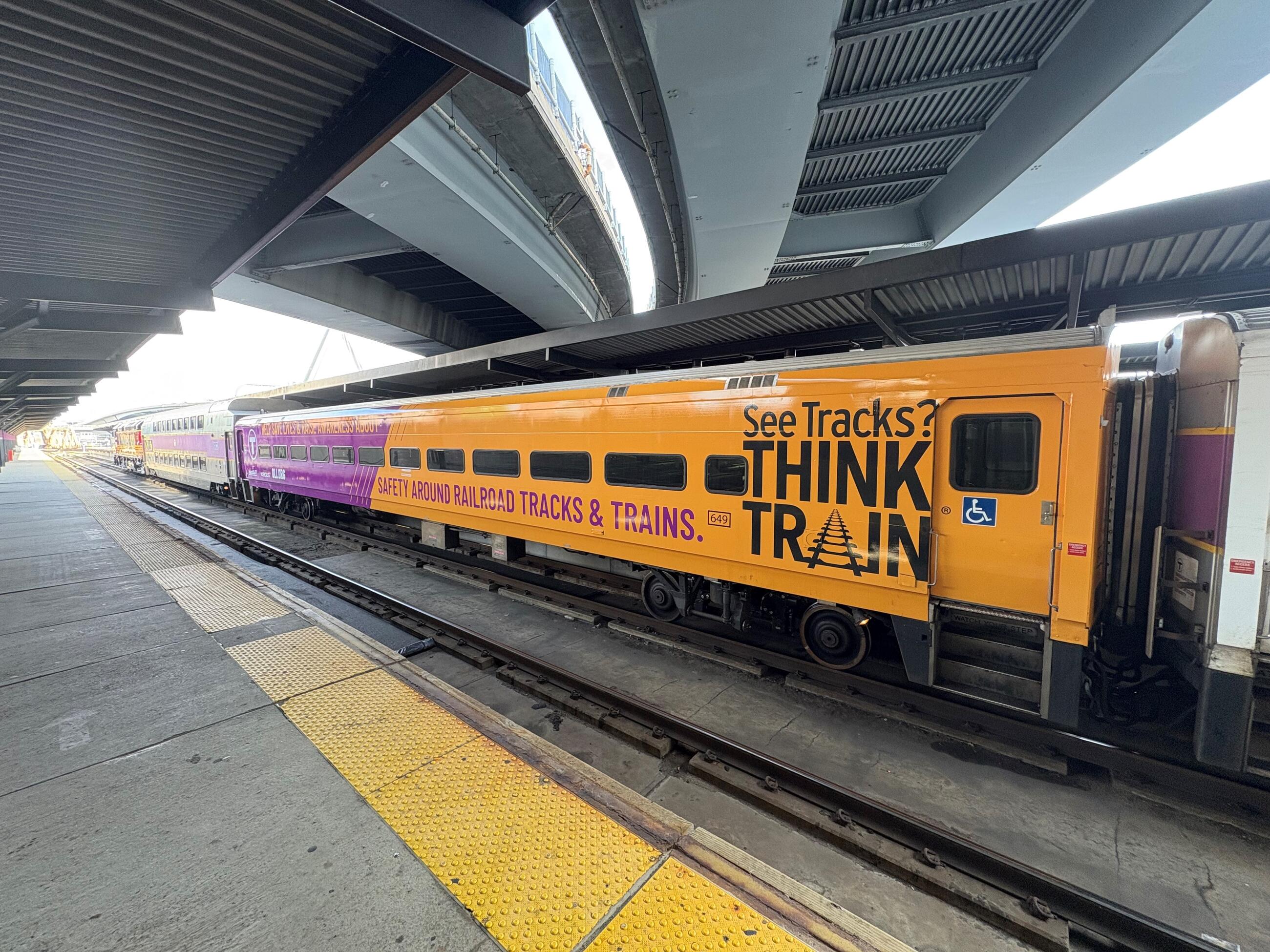
Bicycles and passengers aboard last year’s Fall Rail Ride.
The MBTA today announced that its second annual Fall Rail Ride will take place on Saturday, November 7, 2026. Departing from North Station and operating express to Newburyport, this “Rails & Trails” train will connect riders with a guided autumnal bicycle tour along scenic municipal bike trails or offer passengers a car-free afternoon to enjoy all that Newburyport has to offer. More information is available at mbta.com/FallRide.
“We are excited to again offer this special Fall Rail Ride to the public, and we encourage passengers to buy their tickets as soon as they can – last year’s Fall Rail Ride sold out quickly! With so much to enjoy in Massachusetts all year long, the Commuter Rail offers the public a truly unique way to experience the spirit and beauty of the autumn season,” said Interim Secretary of Transportation and MBTA General Manager Phillip Eng. “Much like our CapeFLYER, Haunted Happenings, football trains, and other special event services, the Fall Rail Ride is another great example of the many ways the public can utilize mass transportation. More than just commuting for work, it connects communities and allows friends and families to enjoy all the fall festivities that New England has to offer. We thank our partners at MassDOT, the city of Newburyport, and Keolis for collaborating with us on this year’s special offering, and we look forward to continuing this annual tradition at the T.”
Train Information
The Fall Rail Ride will operate direct between North Station and Newburyport, departing North Station at 11 AM and arriving at noon. The ticket cost includes the return trip, departing Newburyport at 4 PM and arriving back at North Station at 5 PM.
Passengers getting ready to board last year’s Fall Rail Ride at North Station.
Round-trip tickets for the Fall Rail Ride are $20 each and will be sold exclusively on the mTicket app beginning at 11 AM on Monday, October 19, 2026. Passengers are encouraged to purchase tickets in advance – last year’s Fall Rail Ride sold out quickly.
Passengers can choose between a Passenger Only ticket to enjoy an afternoon in Newburyport, or a Passenger + Bike ticket to bring a bike aboard the train. The train includes special bicycle coaches able to accommodate 75 bikes, a café car stocked with local beers from breweries along the Newburyport line and a fall-themed menu of items available for purchase, and children will receive a free activity bag onboard to enjoy on the trip. A t-shirt to commemorate the experience will also be available for purchase on board the train within the café car.
The Fall Rail Ride ticket also functions as a Weekend Commuter Rail Pass, allowing passengers to access the entire Commuter Rail network for the entire weekend, November 7 – 8.
Bicycle Tour and Car-Free Afternoon Information
Passengers with bicycles will be offered an autumnal and picturesque guided tour by MassDOT staff along the area’s most scenic trails. A map of the bike trail ride is available here. An extremely limited number of bicycles will also be available for rent through Port Bikeshare.
Passengers without bicycles can also enjoy the Clipper City Rail Trail on foot from Newburyport Station to Newburyport’s downtown area, which is about a 25-minute walk (approximately one mile). Merrimack Valley Transit (MEVA) Regional Transit Authority vehicles will also be onsite to assist passengers with travel options between the station and downtown for the afternoon. For a convenient list of places to visit in Newburyport, visit massbytrain.com/stations/newburyport/.
MBTA opened its second biannual Private Fixed Routes Survey, seeking feedback from Routes 712, 713, 714, and 716 riders through MBTA.com/PrivateFixedRouteSurvey.
The MBTA today announced that its second biannual Private Fixed Routes Survey is available for feedback beginning today. Aimed at engaging with riders to improve the service and routing of Bus Routes 712, 713, 714, and 716, the MBTA is encouraging riders of these routes to send their comments to the MBTA at MBTA.com/PrivateFixedRouteSurvey.
Bus Routes 712, 713, 714, and 716 are fixed bus routes that are operated by private contractor services. The objectives of the Private Fixed Routes Survey are to:
Understand the desired origins/destinations of riders who use these bus routes
Identify any destinations riders would like improved connections with
Obtain service-related feedback from riders so the MBTA can further improve their journeys
Assess how satisfaction rates have changed from 2024 to 2026 following service changes that have been implemented, including the service improvement pilot on the 714 and 716
The survey will be available until the MBTA has received its target response rate. Participants will be entered into a raffle to receive a $20 Visa gift card.
The MBTA advanced Green Line modernization during a nine-day outage, installing 20 miles of signal cable and completing major track, station, power, and Type 10 fleet upgrades.
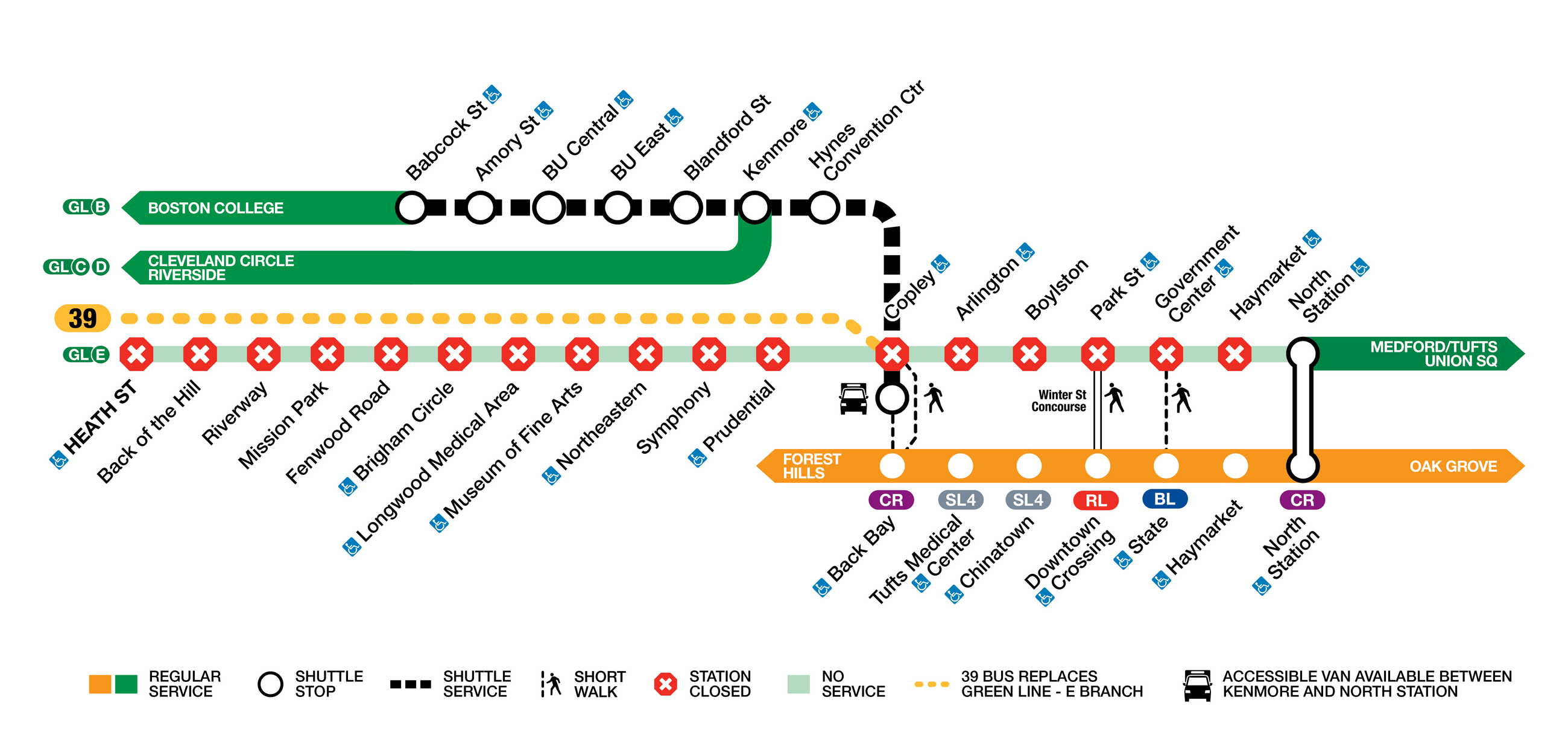
The MBTA today announced the successful advancement of work on the Green Line, including critical work to replace and upgrade the 120-year-old signal system within the central tunnel and much more.
“The latest phase of work to replace our 120+-year-old signal system within the central Green Line tunnel is critical to building the modernized transit system that our riders deserve and can count on. Know that we maximized productivity by continuing to upgrade tracks, stations, and other essential components during the same track outage. It is vital that we build upon the momentum of previous phases of work, bringing us another step closer to ensuring we continue to deliver improved service today and in the future,” said Interim Secretary of Transportation and MBTA General Manager and CEO Phillip Eng. “The new signals will provide the operational flexibility that is necessary to run a world-class system that Boston deserves, driving economic vitality and quality of life for all that we serve. This work enables us to deliver for our riders the new fleet of state-of-the-art Green Line Type 10 cars next year. Thank you to the public for their patience and allowing us to perform this vital work that has been so long-deferred. Under the Healey-Driscoll Administration and with the support of the Legislature, we are investing in the system which is an investment in the future of Massachusetts and the businesses and communities that we serve.”
Green Line Work Accomplished
This important work within the Green Line central tunnel was accomplished during nine consecutive days of 24/7 access to portions of the Green Line that ended yesterday, which allowed the MBTA to expedite the long-awaited upgrades in the most cost-efficient manner possible.
At over 100 years old, the MBTA’s Green Line legacy signal system is as old as the tunnel itself – the old signals currently in use are the same signals that were used when the first electric trolleys in North America were put into service in the late 1800s. This signal system is ready to be replaced with the upgraded, modern technology of today.
The age of the MBTA’s signals and the scale of replacing the entire system within the central tunnel makes the project significant, and previous administrations had deferred this work due to its challenging complexities. With a commitment to accomplishing long-awaited upgrades that riders deserve, the MBTA is no longer deferring these critical investments. It was determined that the best way to accomplish the Green Line’s signal modernization on an accelerated timeline is the phased approach: several diversions in service in which the MBTA could maximize each outage by performing as much other piggybacking work as possible.
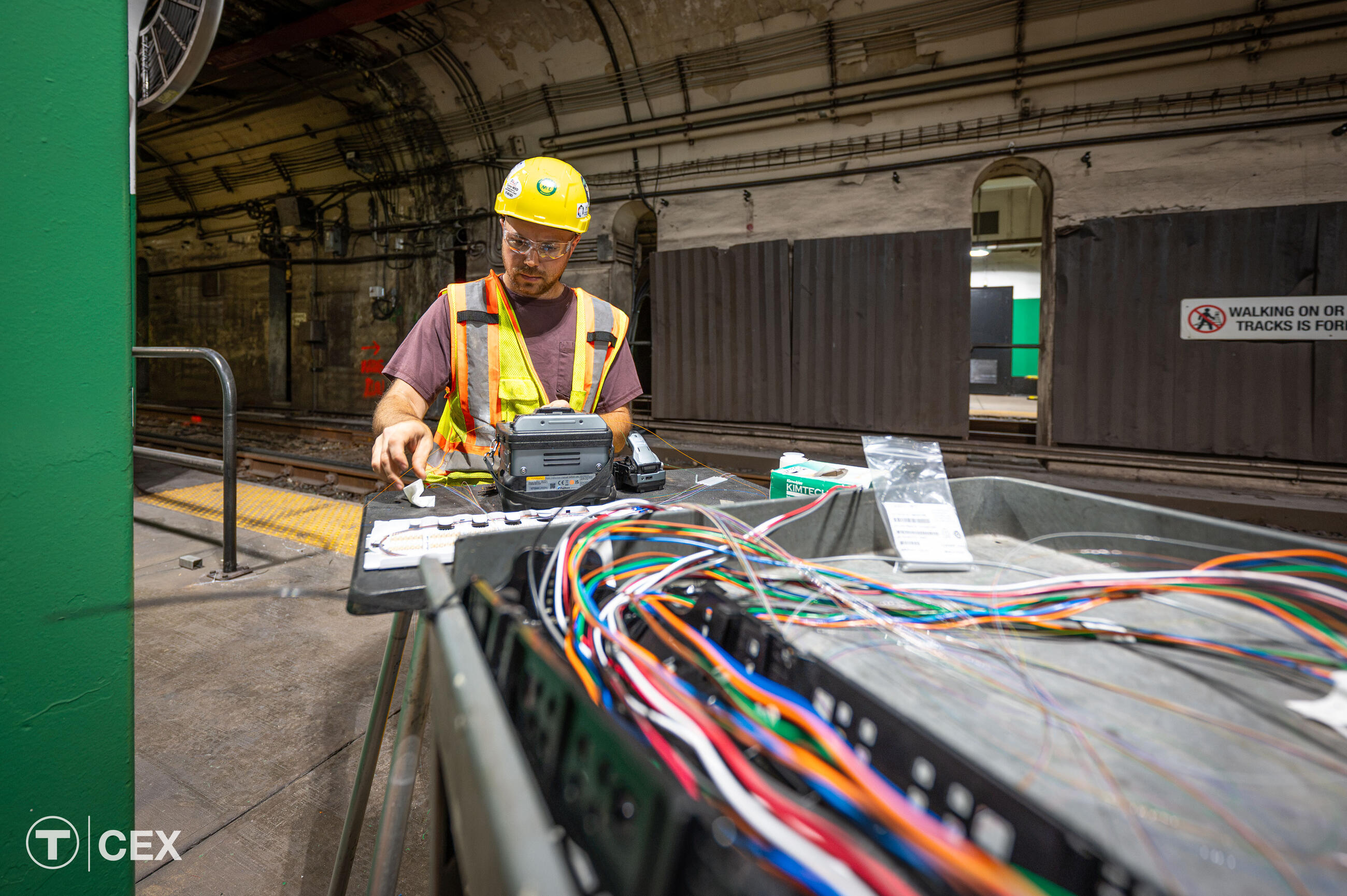
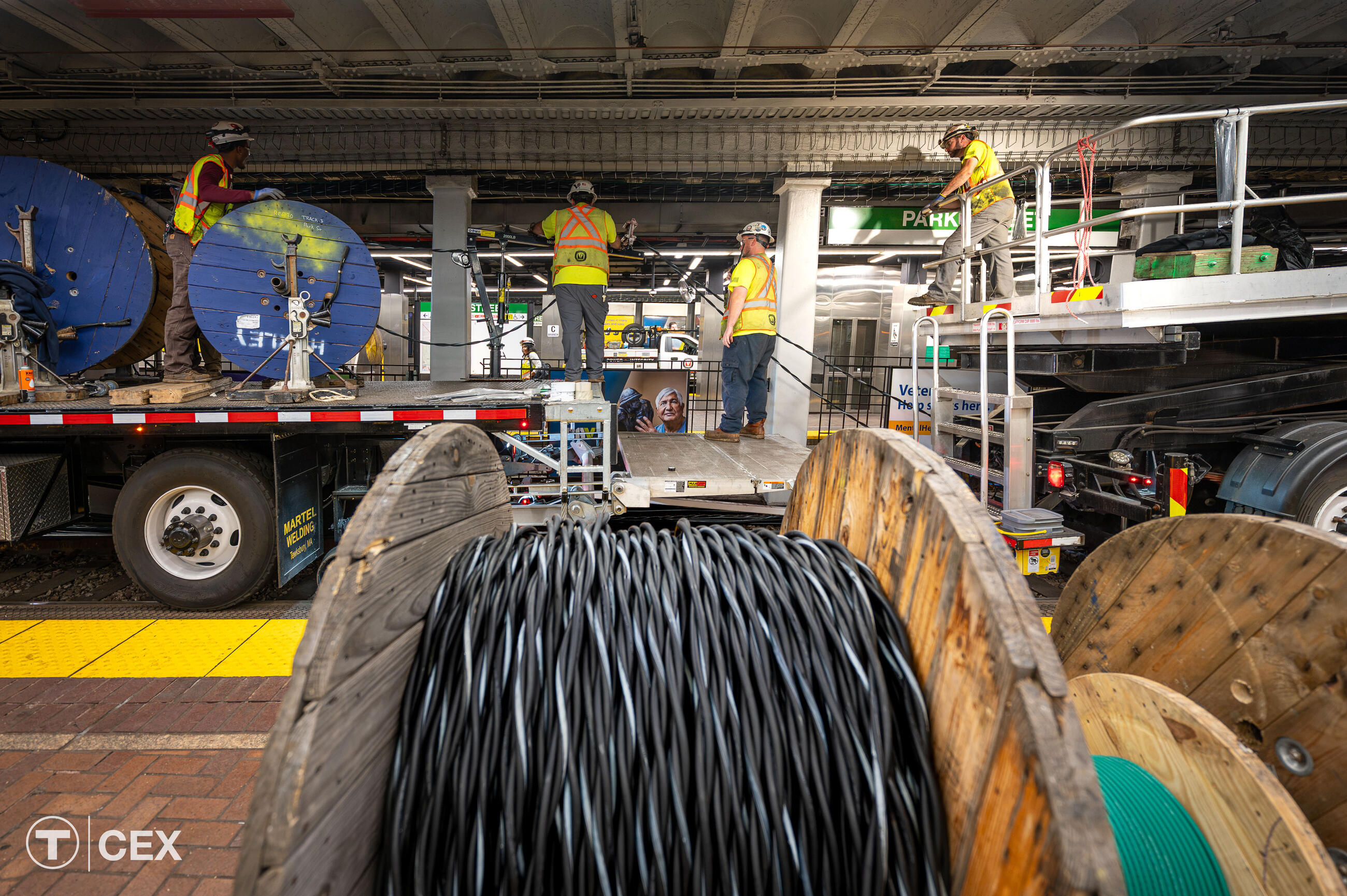
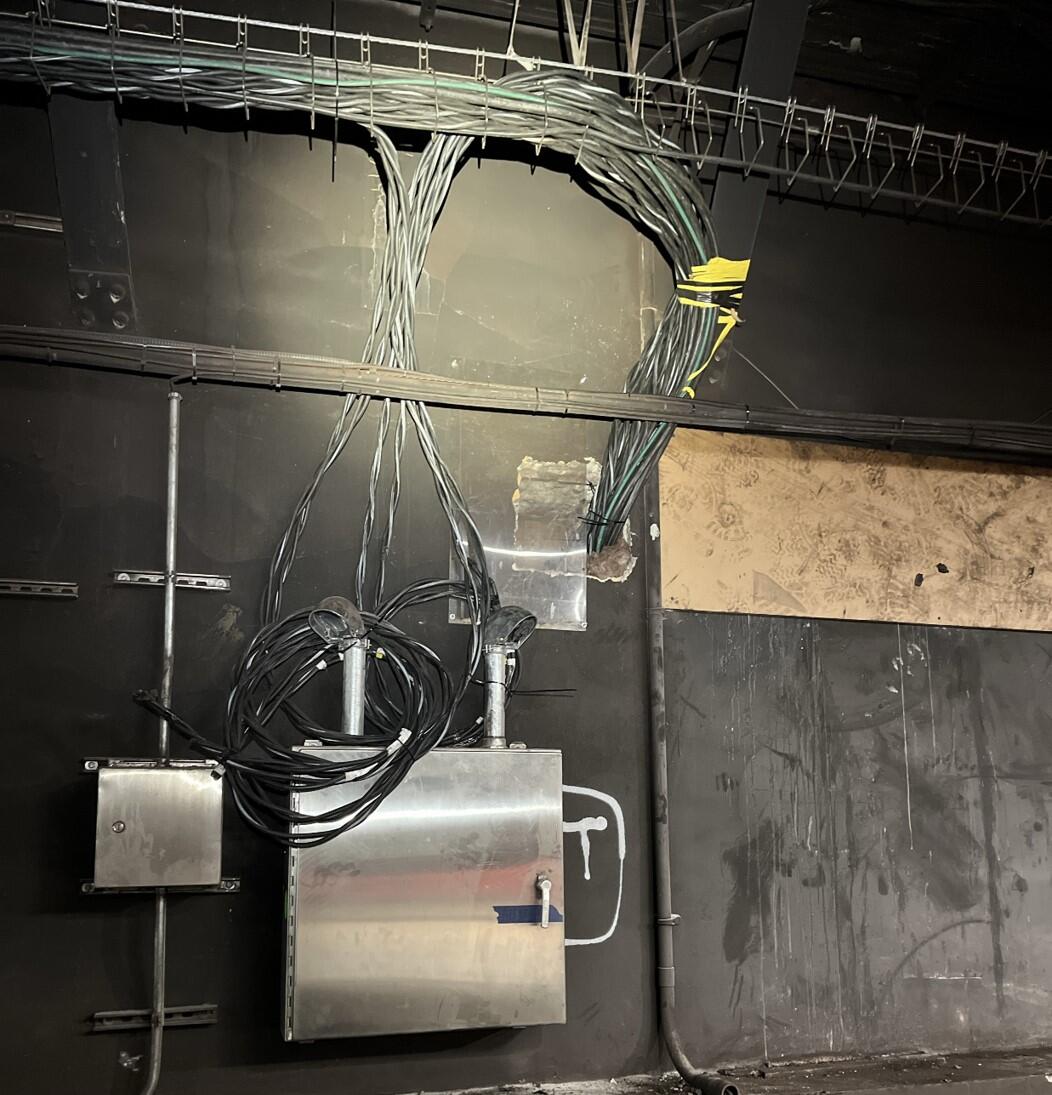
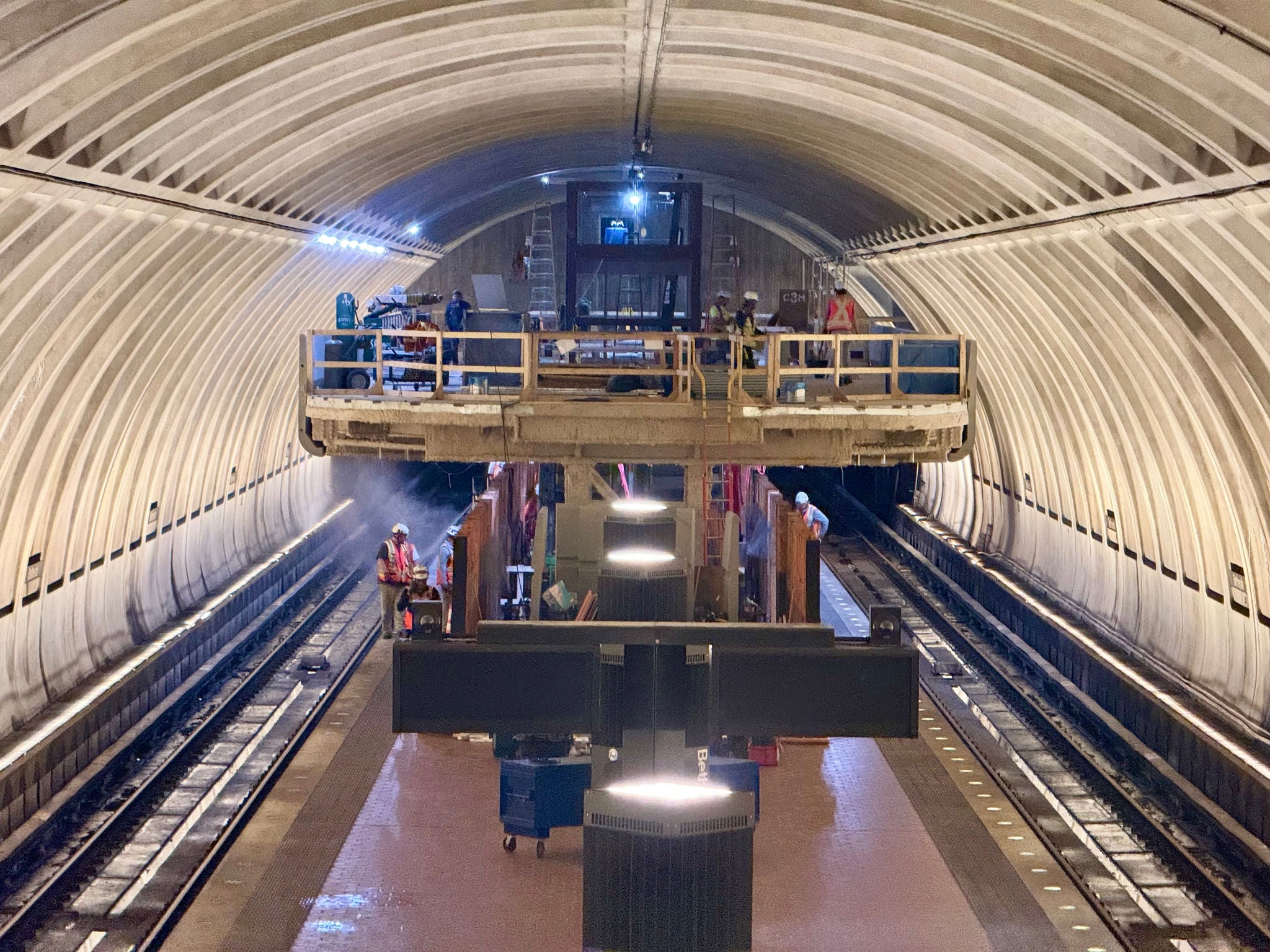
During these nine days of unencumbered access to the Green Line, work crews have continued to make progress on a variety of complicated activities in the tunnel, including extensive signal cable and infrastructure installations, messenger cable work, and complex work at electrical conduit crossings. Over 20 miles of new signaling cable were routed through newly installed signal equipment during this most recent service outage, totaling 40 miles of cable installed so far – the MBTA plans to route 72 miles of new cable in total. Approximately 75% of junction boxes, signal heads, and termination cases have been installed within the Green Line track area, including signal heads that will be activated during the commissioning and verification process at the end of the project. More than 85% of the project’s 129 new signal junction boxes have been installed throughout the tunnel and near station platforms, replacing boxes dating back to the 1940s.
This construction work is part of the MBTA’s phased approach to accomplishing signal upgrades in three major areas at Copley, Park Street, and Government Center, and builds upon previous work that has taken place this year. Within the Copley area, infrastructure installation and routing of the signal cable are 100% complete, and the installation of signal equipment within the track area is 95% complete. At Park Street, infrastructure installation is 98% complete, the installation of signal equipment within the track area and routing of signal cable are each 60% complete, and a new signal communications room serving the Park Street signal system is 25% complete with wiring and equipment installation underway. At Government Center, infrastructure installation is 95% complete, and the installation of signal equipment within the track area is 70% complete.
Following this work to install all of the signaling infrastructure, the testing and commissioning phase will begin, which is the thorough and exacting process of cutting over to the new system and verifying that the new system is functioning properly.
When the testing and commissioning phase is complete and the Green Line has fully transitioned to the new signals, the new system will provide the MBTA Operations team with improved train detection, better train congestion management, and more consistent train spacing, which provide the foundation for improved service frequency. These operational upgrades also mean more reliable service for riders with fewer unplanned disruptions and emergency repairs caused by the older, aging signal system.
Compatible with the upcoming fleet of new Type 10 Green Line cars, these signal upgrades also help prepare the MBTA for future generations of riders.
The unencumbered access to the Green Line track area allows the MBTA to accomplish many other piggybacking projects. This work includes the following:
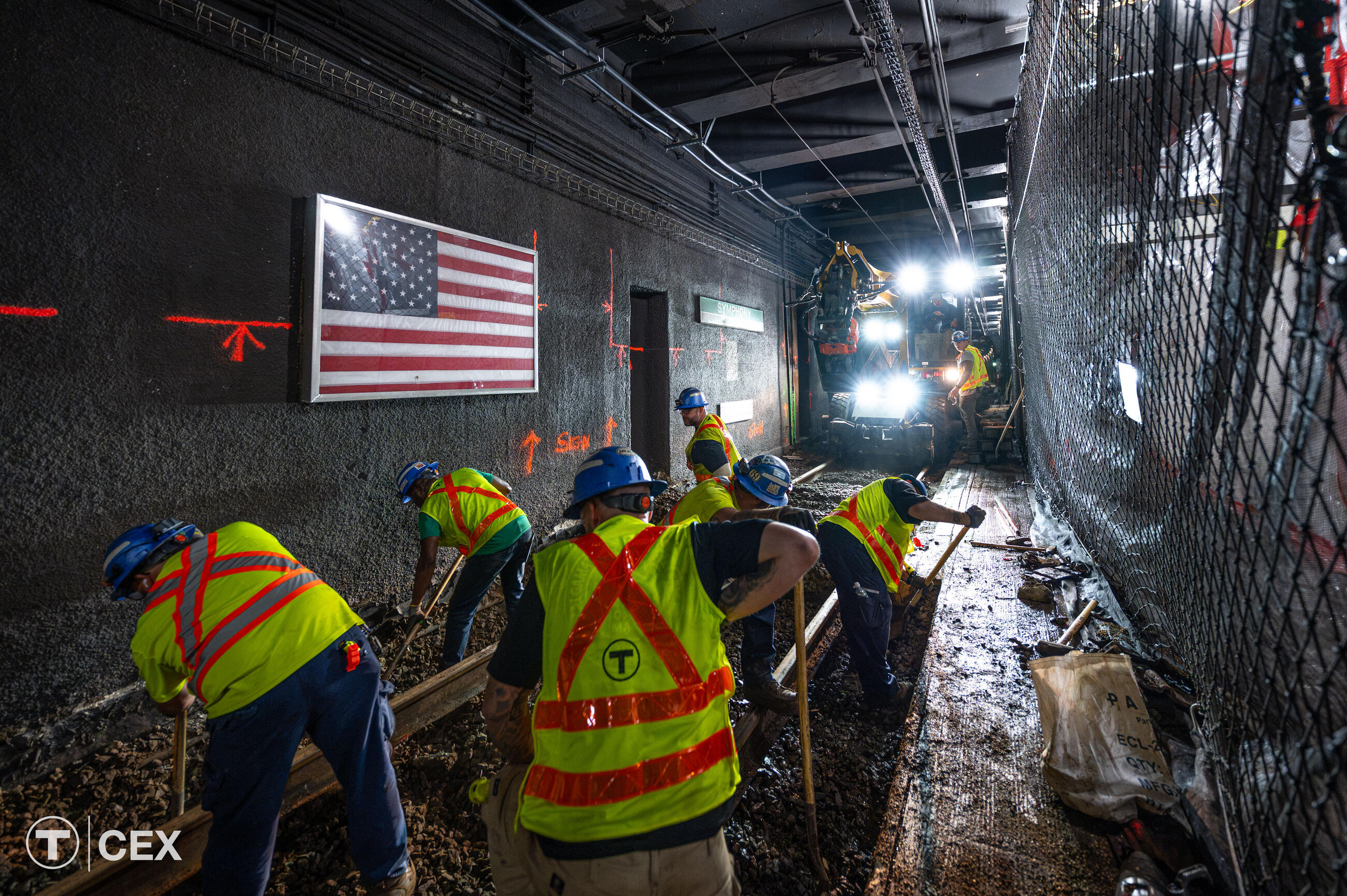
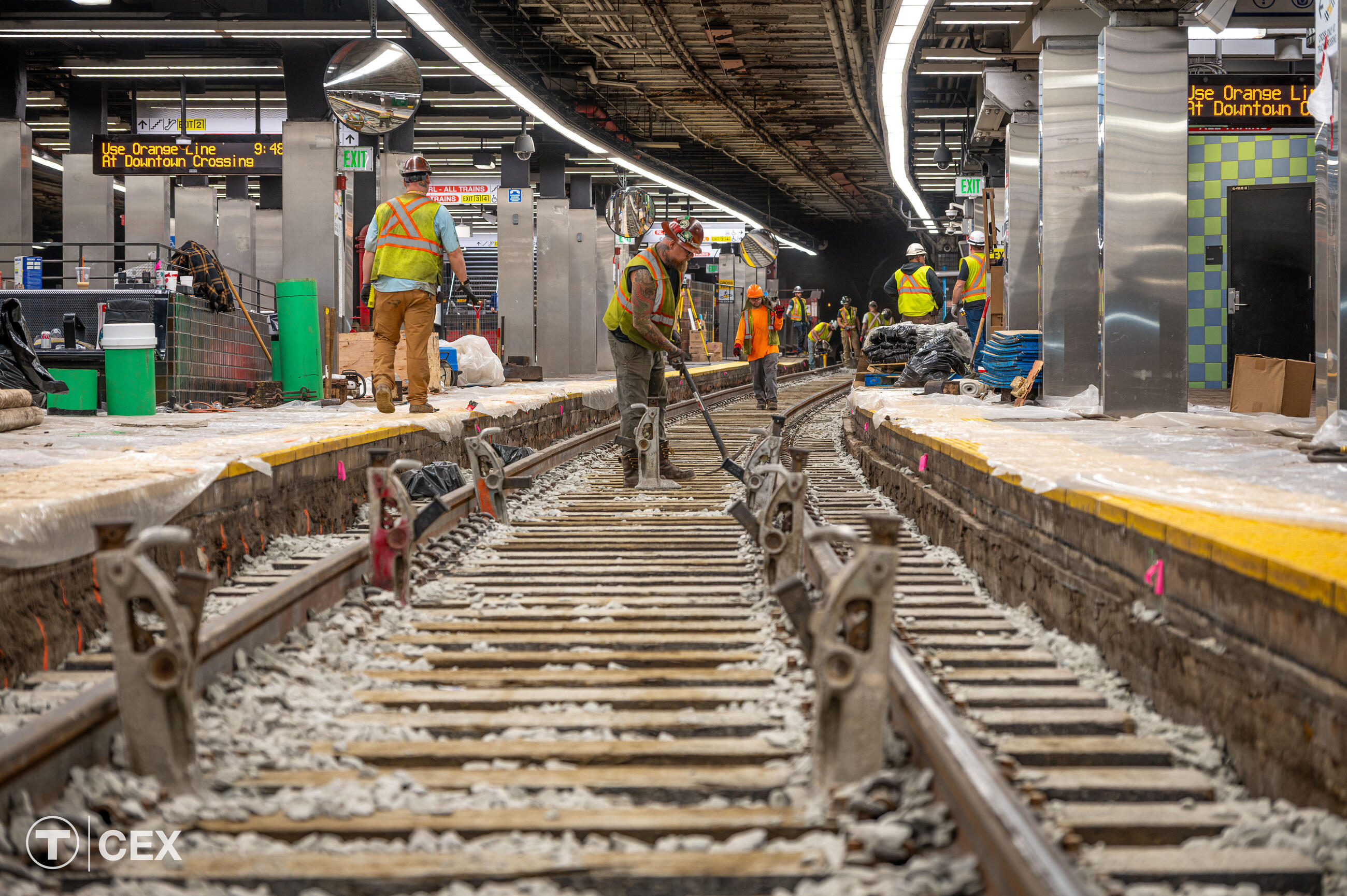
Maintenance of Way crews are continuing the critical station upgrade work at Symphony as well as replacing ties and ballast in the track area of the station.
Power maintenance crews inspected and repaired power cables and underground access boxes, and clean or replace switchboxes.
The Vehicle Engineering team continued work on the critical Green Line Train Protection System.
With the new fleet of Type 10 cars soon arriving, crews performed modifications to curbs and platform edges between Boylston and Haymarket as well as the “Brattle Loop” track area near Government Center to provide clearance for the new larger vehicles.
Crews upgraded radio infrastructure throughout the diversion area and began the installation of new radio system cable within the E Branch tunnel area.
Crews relocated the electric overheard catenary wires, which power Green Line cars, at complicated sharp curve area in order to accommodate both existing vehicles and the new Type 10 fleet.
At Park Street, workers performed over 400 feet of full-depth reconstruction of the eastbound track and rebuild the pedestrian crossing.
Station brightening, critical maintenance, and repair work took place at all stations between Kenmore Station and North Station, including painting, assorted repairs, HVAC maintenance, and inspections.
Through close coordination with utility partners, Verizon also installed a manhole casting near Amory Street.
Significance of Multi-Day Outages
The MBTA is reminding riders that service outages such as these are a critical and necessary part of maintaining the infrastructure improvements that took place as part of the 2024 Track Improvement Program while also making further system upgrades and modernizing the MBTA’s infrastructure. This work cannot be performed during the overnight hours when the MBTA does not operate, and would be extremely inefficient and costly if planned during single weekend outages.
Closing a section of the transit system for multiple days is the most efficient way to perform the MBTA’s routine maintenance, revitalization efforts, inspections, and upgrade work, and combines the efforts of multiple contractors and the MBTA workforce around the clock 24/7 to maximize productivity. This work is necessary and continuous to maintain the reliable service riders count on.
MTA crews completed rehabilitation at the 138 St–Grand Concourse station, refreshing more than 35,000 square feet and replacing damaged flooring and tiles while nearby pump-room work proceeded.
The Metropolitan Transportation Authority (MTA) today announced that New York City Transit crews completed subway rehabilitation work at the 138 St-Grand Concourse station. Station upgrades such as repainting and retiling are usually done while transit crews are already completing other projects to ensure stations are closed for the shortest amount of time possible. Crews were able to complete the station enhancements at 138 St-Grand Concourse while planned work revamping a pump room nearby was already underway.
“New York City Transit is dedicated to providing customers with fast, reliable and safe service, and that begins with our station environment,” said NYC Transit President Demetrius Crichlow. “With a new coat of paint, brighter lights, and new flooring, customers can immediately experience a cleaner, brighter, and safer trip.”
“Modern, well-maintained, and inviting stations play a key role in creating the quality experience New Yorkers expect and deserve,” said NYC Transit EVP, Subways Bill Amarosa Jr. “Delivering refreshed stations shows we’re taking a comprehensive approach to enhancing the rider experience at every stage of their trip.”
More than 35,000 square feet of ceilings, walls, mezzanines, fencing, gates, floors, and entrance structures were given a facelift and were cleaned and repainted. On top of ensuring all station specific maintenance, crews also painted five trash receptacles, two refuse boxes, and one sand box. In addition, 12 doors were painted and fortified. Around 1,000 square feet of rubbing board were inspected and fortified, which allowstrains to safely enter and exit the station without causing damage to the train or the platform. 50 square feet of vinyl composition tile flooring, 65 square feet of damaged concrete flooring, and 75 square feet of missing wall tiles were all replaced, preventing tripping hazards and improving the physical appearance of the station. Crews also cleaned 13 drains, fixed and installed 1,000 feet of LED rope lights, and replaced corroded expansion plates which allow the tracks to safely expand and contract due to temperature changes.
More About Station Improvement Projects
New York City Transit has completed projects at more than 180 stations across the city, including:
6.3 million square feet of repainted surfaces
120K square feet of wall tile replaced
35K square feet of floor tile replaced
Over 4,000 drains cleaned
Over 900 benches refinished
Over 250K linear feet of rubbing board inspected/repaired
"The newly renovated 138 St–Grand Concourse station gives South Bronx commuters the well-maintained stop they deserve. New York City Transit crews refreshed more than 35,000 square feet of the station and limited disruption by timing the work with nearby pump room repairs,” said Representative Ritchie Torres. “Families across the borough depend on the subway to get to work and school, and they deserve a commute that is both safe and dignified. Replacing damaged tile and flooring eliminates tripping hazards and gives riders a cleaner, better-kept place to start and end their day. I'm grateful to the MTA and the transit workers who made this happen, and I will keep pushing for every subway station in the Bronx to receive the same level of care.”
“South Bronx riders deserve stations that are safe, clean, reliable and reflective of the communities they serve," said Assembly Member Amanda N. Septimo. “A well-maintained station is not a luxury. It is a basic part of a transit system that millions of New Yorkers depend on every day. The work completed at 138th Street represents the kind of continued investment that makes a meaningful difference for riders, from the improvements they see and experience to the critical infrastructure working behind the scenes. I thank the MTA and the transit crews who delivered these upgrades, and I look forward to continuing our partnership to build a safer, more accessible and more reliable transit system for the South Bronx.”
“The rehabilitation of the 138th Street Station is a significant upgrade for our Bronx transit riders, making the station brighter, cleaner, and more welcoming for commuters,” said Bronx Borough President Vanessa L. Gibson. “Thank you to the MTA for ensuring the infrastructure upgrades keep pace with the needs of our communities and for their continued commitment to modernizing our transit system.”
CTA opened the RLE Community Office at 401 W. 111th St. in Roseland to provide project information and opportunities as the 5.5-mile Red Line extension to 130th Street advances toward 2030 completion.
CTA welcomes neighbors to the office, providing in-person opportunities to learn about the RLE project
The CTA’s Red Line Extension (RLE) project today held a grand opening celebration for the new RLE Community Office in Roseland, where residents, businesses, stakeholders and the public can talk with CTA staff about the historic RLE project – from construction to career and small business opportunities.
The new office at 401 W. 111th St. is in the center of the Red Line Extension project area, serving residents and CTA riders in Roseland, Washington Heights, West Pullman and Riverdale. The grand opening event was attended by local residents and community leaders, featuring food, CTA mini-bus rides, music and games.
The CTA in April broke ground on the Red Line Extension, which is the largest transit investment in agency history. It will extend the Red Line from the existing terminal at 95th/Dan Ryan to 130th Street. The 5.5-mile extension will include four new fully accessible stations near 103rd Street, 111th Street, Michigan Avenue, and 130th Street.
“The Red Line Extension is delivering on a promise to the Far South Side and expanding access to jobs, education and opportunity,” said CTA Acting President Nora Leerhsen. “As we build the largest transit investment in CTA history, we are committed to keeping residents informed and connecting them with the opportunities this project creates. This community office puts our team directly in the project area we are serving, making it easier for residents and local businesses to get answers, share ideas and help shape the project’s success.”
“The RLE Community Office will be a tremendous resource to our residents,” said Ald. Ronnie L. Mosley, 21st Ward. “I applaud the CTA for its commitment to the communities the Red Line Extension will serve.”
“The opening of this community office is another important step toward completing the Red Line Extension—a once-in-a-generation investment that will help transform the Far South Side and strengthen the future of our entire city,” said Ald. Anthony A. Beale, 9th Ward. “This office will put information, resources and a voice within reach of residents—helping them understand the project, stay informed and make sure their communities are ready to benefit from the jobs, investment and opportunity it will bring.”
“The opening of the RLE Community Office means that this much-needed mass transit project is well on its way,” said Ald. Peter Chico, 10th Ward. “This new rapid rail service will significantly increase connectivity for people on the Far South Side, include Altgeld Gardens and surrounding neighborhoods, to the rest of the city.”
RLE Community Office events
The Community Office will serve multiple purposes for residents and CTA riders on the Far South Side, including as a central meeting place to share ideas and talk through questions. The office’s uses include:
Monthly “Workforce Connections” events the first Tuesday of every month to provide personalized guidance for individuals interested in careers in transit and construction (upcoming dates include October 6, November 3, and December 1)
CTA-hosted events for groups interested in learning more about the project
Community groups seeking meeting space in the project’s footprint
The office is open Tuesday through Thursday from 10 a.m. to 3 p.m. or by appointment. It will remain open until the RLE project is completed in 2030.
The RLE Community Office complements the project’s regular outreach efforts, which include:
Community meetings
Construction Activity Notices online and posted in the communities where work is occurring
Regular project updates via email and on transitchicago.com/RLE
RLE social media accounts: @CTARLE on Facebook and Instagram
Build a 5.5-mile extension of the Red Line starting at 95th Street Terminal to 130th Street.
Include four new accessible stations near 103rd Street, 111th Street, Michigan Avenue (near 116th), and 130th Street, each of which will include bus, bike, pedestrian and parking facilities.
Build a new rail yard and rail maintenance facility to improve operational efficiency for the entire Red Line and CTA system.
The new extension and stations are expected to be completed and in service in 2030.
For more information about the RLE project, visit transitchicago.com/RLE. The public can sign up for project alerts here.
Metro-North adds 28 weekend Hudson Line trains from Oct. 3 through Nov. 8, including service to Beacon, Poughkeepsie, and Croton-Harmon for Hudson Valley fall foliage travel.
28 Extra Weekend Trains Will Serve Hudson Valley Fall Foliage Travel Through Nov. 8
The Metropolitan Transportation Authority (MTA) today announced that Metro-North Railroad’s popular Leaf Peeper trains return tomorrow, Saturday, Oct. 3, giving customers more ways to visit the Hudson Valley during peak fall foliage season.
Each weekend through Nov. 8, five additional morning trains will travel north toward Beacon and Poughkeepsie, and 11 extra express trains will travel between Grand Central Terminal and Croton-Harmon, stopping at Harlem-125th Street, Tarrytown, and Ossining, serving riders who want to visit the legendary Village of Sleepy Hollow this fall.
On the return trip via the Hudson Line, there will be three additional afternoon trains from Poughkeepsie and Beacon making trips returning to Grand Central Terminal, as well as nine additional express trains from Croton-Harmon to Grand Central Terminal, stopping at Ossining, Tarrytown, and Harlem-125th Street.
MTA will rehabilitate 125 St station’s platforms and structural steel, beginning October 26, with southbound trains bypassing the station and weekend express service through mid-December.
The Metropolitan Transportation Authority (MTA) today announced upcoming state of good repair work at 125 St station on the line in Upper Manhattan starting Monday, Oct. 26. The work will feature rehabilitation of platform and structural steel components on both the southbound and northbound platforms at the station to support safe and reliable service.
The repairs are part of ongoing work to bring the station into a state of good repair, focusing on sections of the platform that are outside of the canopy structure and most exposed to the elements. Design is also underway to bring full accessibility to the 125 St Station, after the MTA announced a partnership with Columbia University in May to fund $33 million in ADA upgrades. The timeline for the planned accessibility improvements will not be affected by the platform rehabilitation project, with construction expected to begin following the anticipated contract award in 2028.
"Thanks to our public-private partnership with Columbia, we'll be making 125 St station fully accessible," said MTA Construction & Development President Jamie Torres-Springer. "In the meantime, we're making critical repairs to the platform as part of our commitment to keep our riders safe."
“This critical work ensures safe and reliable service at this station for many years to come,” said New York City Transit President Demetrius Crichlow. “And throughout this time we are committed to providing convenient service alternatives that this Harlem community can count on to get them where they need to go.”
The work on the southbound platform will start in late October 2026 and will be completed in the first quarter of 2027. After completion of that work, rehabilitation of the northbound platform will begin. To enable this work, southbound trains will bypass 125 St at all times while the work is underway. On weekends, southbound trains will operate express between 137 St and 96 St.
Customers traveling downtown who need to reach 125 St should remain on a downtown train and transfer to an uptown train at 116 St-Columbia University on weekdays or 96 St on weekends. Customers can also use the nearby , , and subway service or local buses, including the M4, M104 and M125.
The following service changes will be in effect to enable this work:
Oct. 24 to Dec. 18
Weekdays:
Southbound trains will operate normally but bypass 125 St.
Weekends:
Southbound trains will operate express between 137 St and 96 St.
Prior to the start of the main repair work, additional weekend service changes will allow crews to conduct station surveys and install protective shielding at 125 St. On the following weekends, southbound trains will operate express between 137 St and 96 St:
Sept. 19–20
Sept. 26–27
Oct. 3–4
Oct. 10–11
Customers traveling downtown toward South Ferry who need to reach 125 St should remain on a downtown 1 train and transfer to an uptown train at:
116 St-Columbia University on weekdays
96 St on weekends
Customers can also use nearby , , and subway service as an alternative.
Local bus service also provides alternatives for customers traveling to 125 St:
M4: Stops near 110 St, 116 St and 137 St stations on the line
M104: Runs parallel to the line between Times Sq-42 St and 125 St
M125: Serves 125 St and provides connections to the 125 St A/C/B/D station, 125 St 2/3 station and 125 St 4/5/6 station
“Accessibility is a vital part of an inclusive and vibrant community,” said Representative Adriano Espaillat. “I commend the MTA for investing in critical repairs at 125th street and thank Columbia University for its $33 million commitment to ADA upgrades. These investments will ensure service equity for all New Yorkers that rely on this line for daily commutes from home, school, and work. I will continue to work with the MTA and our community partners to make sure this work is completed on schedule and that riders are kept informed throughout.”
“The accessibility improvements planned for 125th Street, including elevator installation and new escalators, will dramatically improve accessibility in a neighborhood that truly needs it,” said NYC Council Majority Leader Shaun Abreu. “However, it’s important that in the meantime the station remains safe for riders. Neighbors raised the issue of the uneven platform, and the MTA responded swiftly. I’m thankful for the MTA’s responsiveness and look forward to repairs getting underway so that West Harlem has the safe station it deserves.”
“Riders have been clear for years: the 125th Street- line station is overdue for a serious upgrade,” said Manhattan Borough President Brad Hoylman-Sigal. “I'm thrilled the MTA is beginning critical state-of-good-repair work, replacing worn platform and structural steel, with ADA accessibility improvements to follow. Thank you to MTA Chair Janno Lieber, Comptroller Mark Levine, City Council Majority Leader Shaun Abreu, and Assemblymember Micah Lasher for their persistent advocacy and partnership. Together, we're delivering the modern, accessible station that West Harlem deserves.”
Ways to Stay Informed
The MTA offers customers a variety of ways to receive real-time and planned service change information, including:
mta.info – The definitive source for real-time arrival information and service change information for each line or route in the MTA system. Customers can find current statuses on mta.info and upcoming planned service changes using the lookup tool at mta.info/alerts.
MTA app – Customers who use the comprehensive MTA smartphone app will see real-time train, bus and rail arrival times, and can chat with the customer care team all in one place. The app is available in the Apple Store and in Google Play.
Email & Text Alerts – Customers can sign up for email and SMS alerts tailored to their specific commutes and travel times. They can also sign up for MTA newsletters like The Weekender, a weekly newsletter that covers major weekend planned service changes. Customers can sign up here.
511 – Customers who prefer to contact the MTA by telephone, information is available by dialing 511. Those who are deaf or hard of hearing can use their preferred service provider for the free 711 relay to reach the MTA at 511.
Metro expanded Art in Transit with a local artist pool, community feedback, and projects including a Deanwood station installation; submissions close Oct. 12, with four visual projects and performances planned next year.
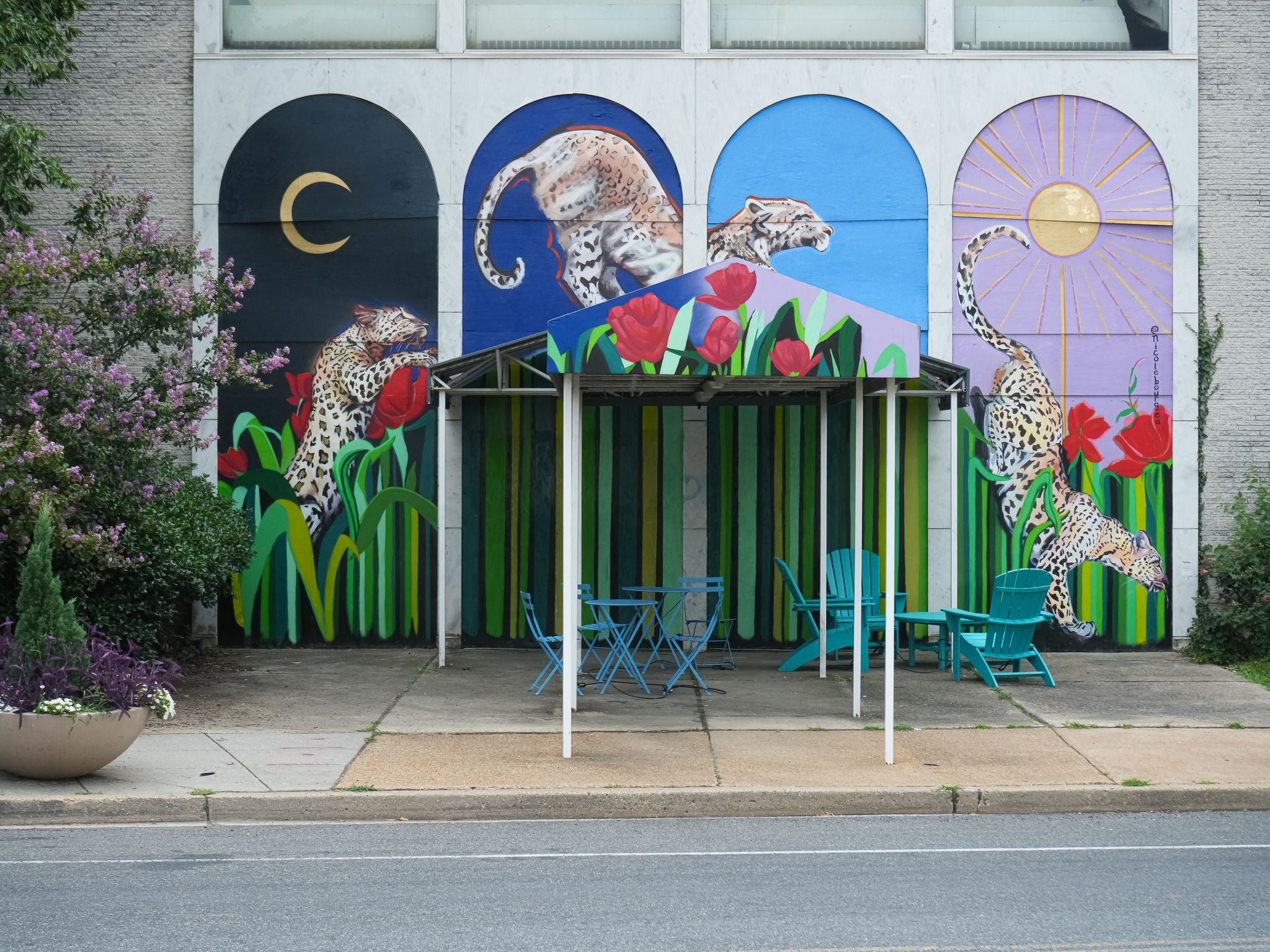
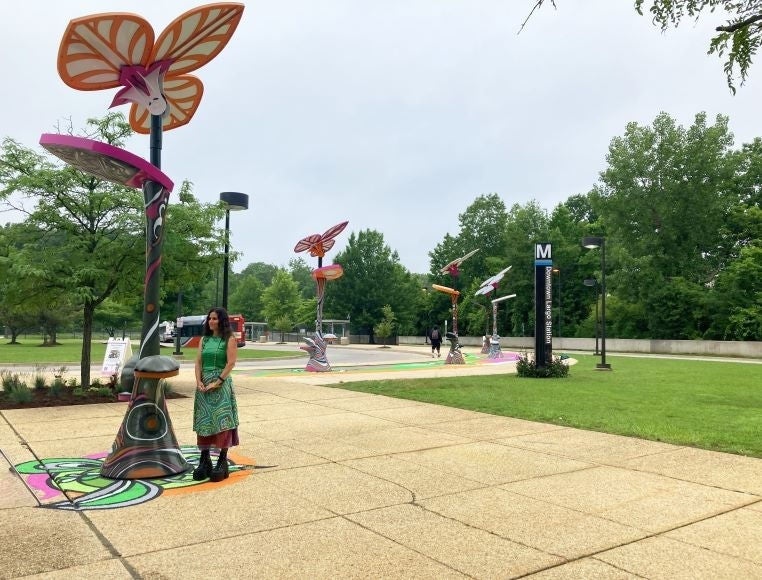
More art is coming to Metro facilities across the region thanks to changes to the Art in Transit program. In a first for the Art in Transit program, Metro is building a pool of local artists and artworks that may be selected for future temporary installations and digital displays at Metro stations, facilities, and customer-facing spaces. Through the “Created Together: Your Art. Your Community. Your Metro.” initiative, the Art in Transit program will focus on more localized and community-based art collaborations.
“The DMV is home to an extraordinary community of artists, and Metro is uniquely positioned to bring their work to millions of customers each year,” said Sarah Meyer, Metro Chief Customer Officer. “Art in Transit allows us to showcase the creativity and culture of our region while creating spaces throughout the system that are welcoming, engaging, and representative of the communities we connect every day.”
To publicly kick off the “Created Together” initiative, Metro is partnering with Theatre Washington to celebrate community and art during Theatre Week. Live performances, community activities and other treats will take place at Eastern Market station on Oct. 6. Click here to learn more and register for the event.
The first project under the new “Created Together” initiative will be installed at Deanwood Metro Rail Station. The project will transform two station passageways with a large-scale temporary art installation that celebrates the history, culture, creativity, and people of Deanwood. Community members are also encouraged to submit feedback to help shape the project. Local artists may also submit their work for consideration. More information is available here. Submissions will be accepted until 5:00 p.m. on Oct. 12.
Metro aims to host four visual art projects and four live performances at its facilities throughout the system in the next year, and we want to hear from community members to determine what they would like to see at their bus stops and rail stations.
In the past, Metro contracted with artists on a project-by-project basis. This database of artists, designers, photographers, poets, illustrators, and interdisciplinary creatives will allow Metro to select projects that meet the needs of the community in which they will be displayed in a more timely manner. Emerging local artists and established professionals from across the region are encouraged to submit their work. The Art in Transit program is open to individual artists as well as artist teams. For more information about this open call, please visit: Art in Transit Open Call for Artwork.
CTA, Metra and Pace will provide free rides, extra service and connections for Northwestern’s Oct. 2 football game against Penn State at the new Ryan Field.
Free rides and extra service planned on CTA and Metra for NU vs. Penn State
Northwestern football fans will finally be able to enjoy the new Ryan Field when the Wildcats take on Penn State at 7 p.m. on Friday, Oct. 2, and the secret to a stress-free game experience is taking public transportation.
Longtime fans know that traffic and limited parking are among the least enjoyable parts of the experience. Why endure that aggravation when the CTA Purple Line and the Metra UP North Line, with connecting Pace buses, can deliver you to stations on Central Street, steps away from the new field?
Thanks to a partnership with The Ryan Field Foundation, riders who show their game tickets can ride for free on the Metra UP Metra North Line to and from the game. And
Metra will have an additional inbound train making all stops to Ogilvie and an extra outbound train making all stops to Waukegan waiting after the game at its Central Street Station, just west of the field. The trains will depart from Central Street about 30 minutes after the game ends. Metra plans to offer extra service following the team’s remaining home games at Ryan Field this season.
CTA will provide Purple Line Express service to Ryan Field to get fans to the game PLUS CTA will also provide Purple Line Express trips at the end of the game. After the game, fans boarding the Purple Line Express at Central Station will get a free ride funded by The Ryan Field Foundation for approximately one-hour post-game or roughly 10 p.m. to 11 p.m.
Fans can use Pace local service to connect with Metra and CTA and reach Ryan Field from throughout the region. Routes 208, 213 and 250, along with the Pulse Dempster Line, connect riders with downtown Evanston at the Davis Street CTA Purple Line and Metra UP North stations. From Davis Street, riders can transfer to the CTA Purple Line and exit at Central Street, a short walk from the stadium, or take CTA Route 201, which directly serves both downtown Evanston and Ryan Field. Fans can also take the UP North Line from Davis St. to Central Street. Pace Route 213 provides another option, with service along Green Bay Road and a stop at Central Street near Ryan Field.
“Metra’s UP North Line can get you to and from the new Ryan Field without all the stress and cost of driving,” said Metra Executive Director/CEO Jim Derwinski. “They’re comfortable, affordable, and with our extra service, convenient. Using public transportation to get there is the right choice.”
“A world-class stadium deserves world-class access to public transportation, and the CTA is proud to join Metra and Pace in playing a central role in connecting fans to this historic new chapter in Northwestern’s history,” said CTA Acting President Nora Leerhsen. “Every train and bus arriving at or near the new stadium represents an important connection between the whole Chicago region and this great university.”
“Major events like these are a great opportunity to leave the driving to someone else and take advantage of the region’s connected transit network,” said Pace Executive Director Melinda Metzger. “Pace is proud to join CTA and Metra in helping fans travel to Ryan Field safely, conveniently and affordably.”
“This level of coordination to get fans to Ryan Field and home again safely and seamlessly is a big win for the region,” said NITA Interim Executive Director Jamie Rhee. “This is the kind of collaboration and convenience riders can expect in this new era for Chicago public transportation.”
Don’t forget to save money with Metra’s Day Pass, good for unlimited rides all day, which can be purchased from vending machines or on the Ventra app (download it from the App Store or Google Play). Ventra app users can save even more money by purchasing the Regional Day Pass option that allows Metra Day Pass buyers to add unlimited travel on CTA and Pace for an additional $2.50.
By working together on service, the region’s three transit providers are embodying the mission of the Northern Illinois Transit Authority (NITA) Act to provide a coordinated transit system that improves service for public transit riders and all residents of Northeast Illinois.
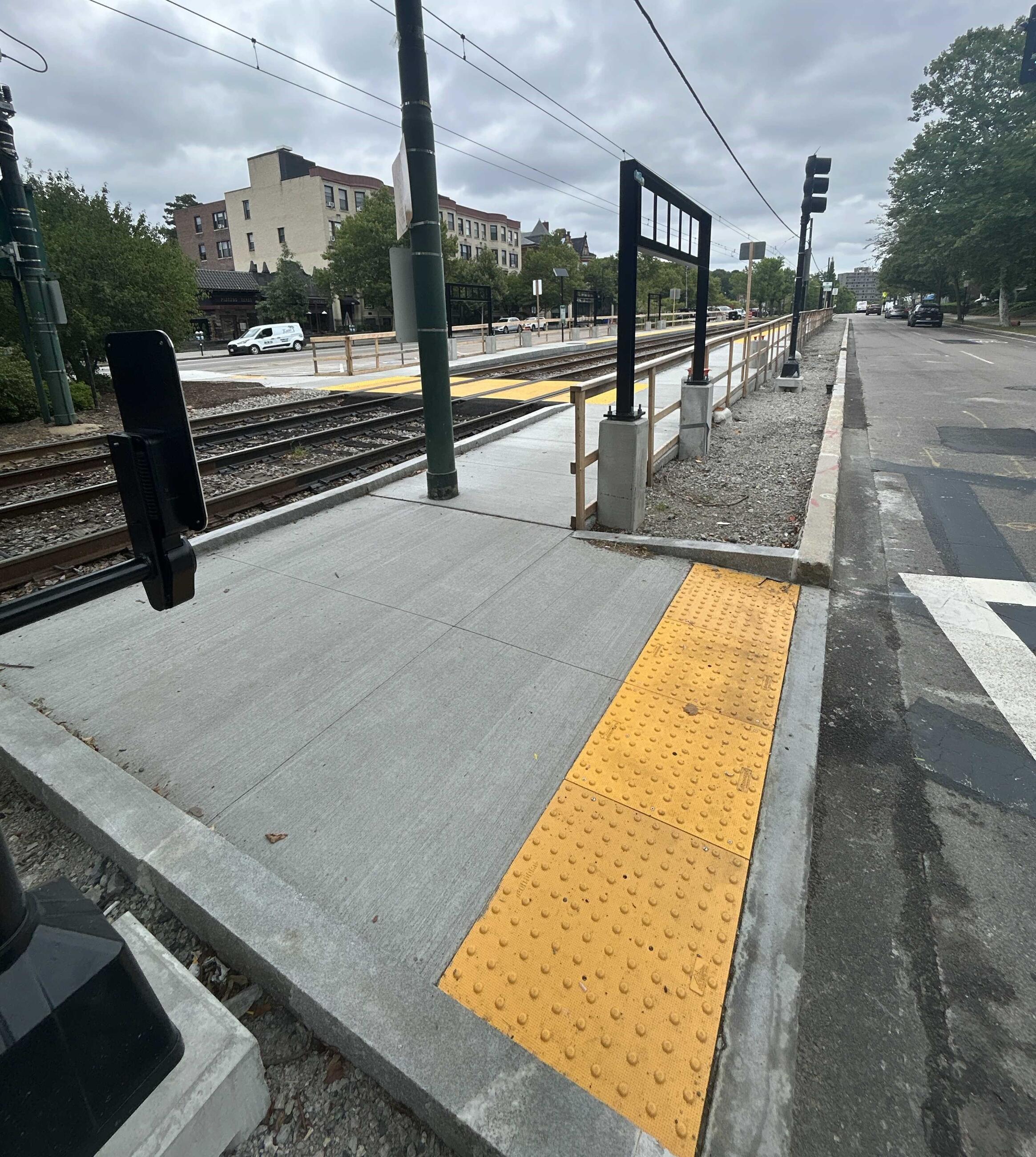
MBTA opened an ADA-compliant walkway connecting Adams Street and Milton Station on September 30, 2026, adding lighting, cameras, handrails, signage, seating, and landscaping.
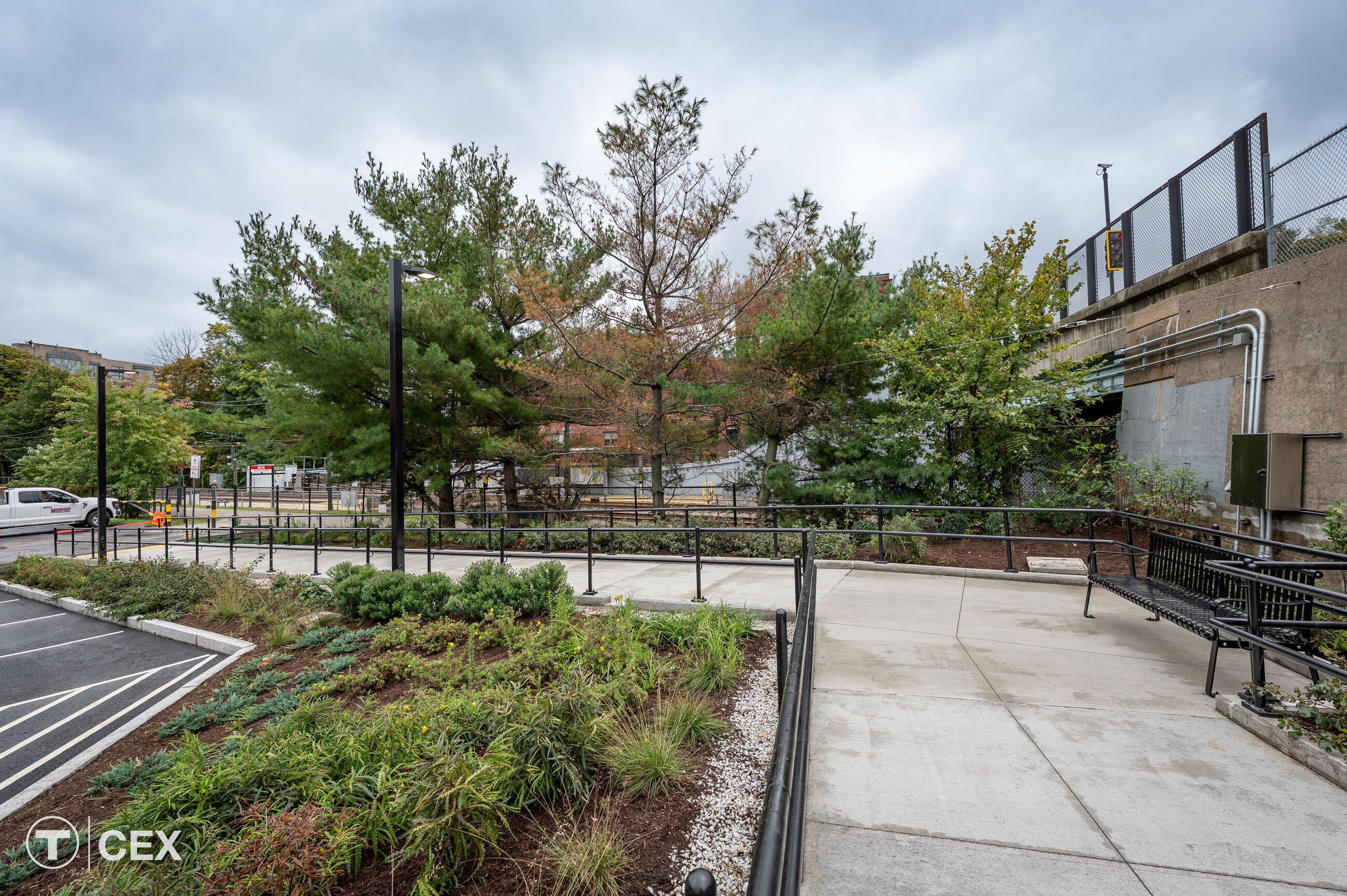
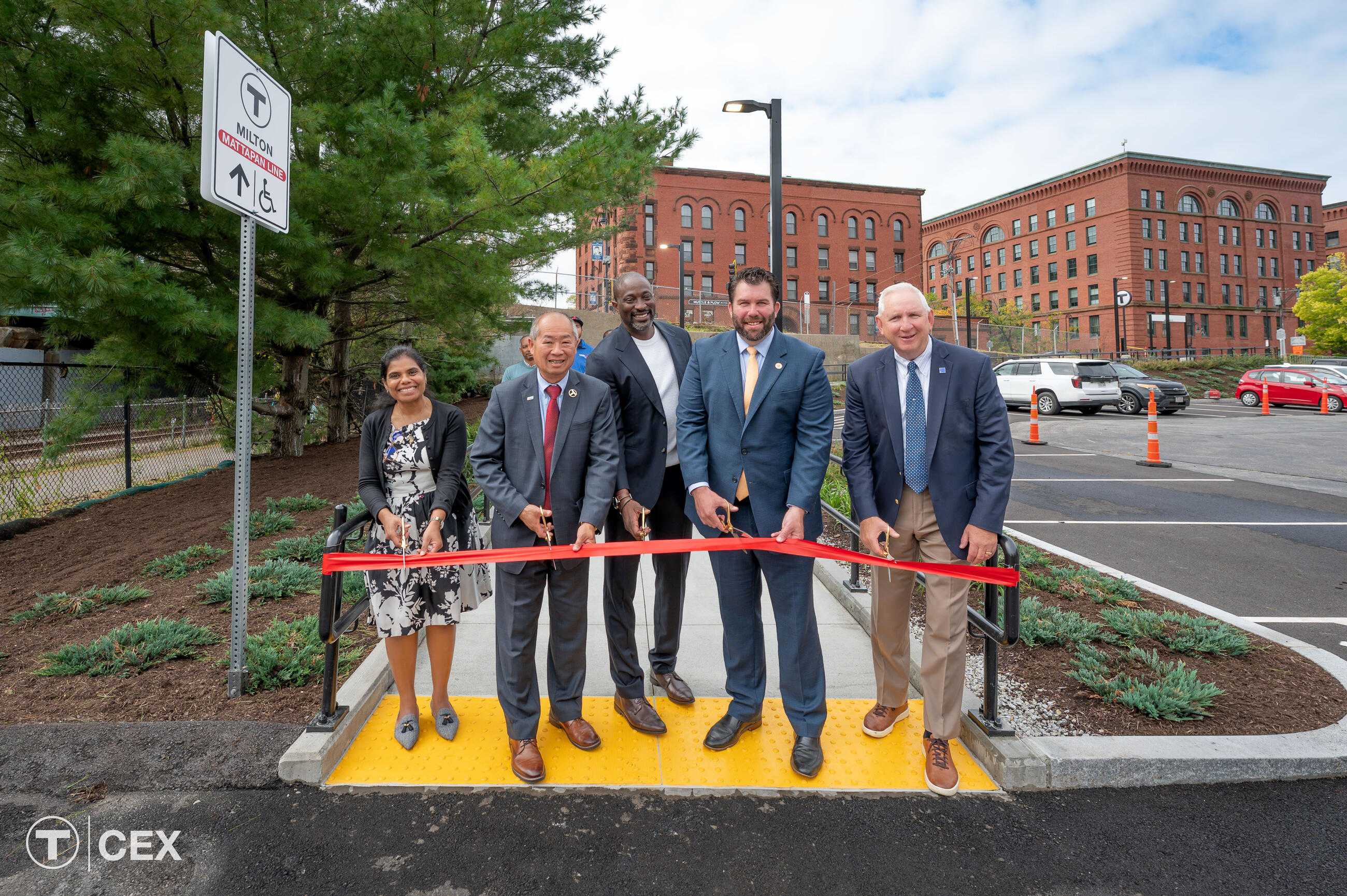
The Massachusetts Bay Transportation Authority (MBTA) held an official ribbon cutting September 30, 2026 to celebrate the opening of the Milton walkway, which is ADA compliant and connects the public between Adams Street and Milton Station.
The project, part of the larger Mattapan Line Program, ensures anyone can now safely and accessibly travel to the station from Adams Street. The project also includes new lighting, security cameras, handrails, signage, seating, and landscaping.
"Under the leadership of the Healey-Driscoll Administration, we continue to think outside the box to solve problems and deliver meaningful results for the communities that we serve. Making transportation more convenient, and accessible for all is what the public deserves and expects. This new accessible ramp demonstrates our ability to accelerate work and make it easier to choose transit,” said Interim MassDOT Secretary and MBTA General Manager Phillip Eng. “I am proud of the MBTA team for continuing to deliver projects that improve quality of life for the public we serve and rely on mass transportation.”
"The installation of the new entrance and ADA-compliant walkway to the Milton trolley stop marks both an important investment and positive milestone. This represents the first visible and major improvement made to the Mattapan Line since the refurbished trolleys began entering daily service several years ago," said Senator William Driscoll Jr. "I look forward to welcoming the MBTA back for additional celebratory ribbon cuttings in the future as the stops and stations are renovated as part of the projects that will bring 100's of millions of dollars in improvements to the overall service, accessibility and experience for riders all along the Mattapan Line."
“This long-awaited improvement at Milton Station will make the station more accessible for commuters who use the Mattapan Line,” said Representative Richard G. Wells, Jr. “I’m glad to see this project finally completed, and I thank my colleagues in government, Senator Bill Driscoll and Representative Brandy Fluker-Reid, for their continued advocacy and partnership in this effort.”
“I'm glad to see the MBTA investing in a safer, more accessible route between Adams Street and Milton Station, which so many of our neighbors rely on to get to work, school, and appointments,” said Representative Brandy Fluker-Reid. “A sloped walkway with new lighting, handrails, and security cameras will make this stop easier and safer for seniors, people with disabilities, families with strollers, and everyone else who uses the Mattapan Line and the Neponset Greenway.”
MTA crews completed Fort Hamilton Parkway D station upgrades in September, repainting 36,000-plus square feet, repairing concrete and lighting, replacing flooring, and reinforcing safety features.
The Metropolitan Transportation Authority (MTA) today announced that New York City Transit crews completed subway rehabilitation work at the Fort Hamilton Parkway station. As Fort Hamilton Station is an outdoor station, crews took advantage of the warm weather during the first week of September and were able to complete functional and aesthetic updates.
“At New York City Transit we understand that providing reliable, efficient and safe service starts the moment customers enter a station,” said NYC Transit President Demetrius Crichlow. “With brighter lights, repainted ceilings and repaired concrete, Fort Hamilton riders can see the improvements to their trips before they even board a train.”
“Brighter, cleaner, and more visually appealing stations are important to delivering the customer experience New Yorkers deserve,” said NYC Transit EVP, Subways Bill Amarosa Jr. “Through this station enhancement program, we’re committed to addressing all aspects of a rider’s journey, from start to finish.”
More than 36,000 square feet of ceilings, walls, beams, floors, entrance structures, columns, gates and railings were scraped, primed and painted. Crews also refinished five benches, painted five trash cans and the station booth, 20 doors were also painted and fortified. To ensure trains are safely entering and exiting stations with no damage to platform or train, around 1,200 square feet of rubbing board were inspected and fortified. 225 square feet of vinyl composition tile flooring and 300 square feet of damaged concrete flooring were replaced to prevent tripping and slipping hazards. Crews also replaced corroded expansion plates, which allow tracks to safely expand in hot weather and contract in cold weather, cleaned 12 drains, and fixed and replaced LED fixtures to offer better and safer lighting conditions.
More About Station Improvement Projects
New York City Transit has completed projects at more than 180 stations across the city, including:
6.3 million square feet of repainted surfaces
120K square feet of wall tile replaced
35K square feet of floor tile replaced
Over 4,000 drains cleaned
Over 900 benches refinished
Over 250K linear feet of rubbing board inspected/repaired
“Investing in and maintaining our public infrastructure is essential to improving the quality of life for working-class New Yorkers,” said Assembly Member Marcela Mitaynes. “The improvements at the Fort Hamilton Parkway station are a welcome reminder of the important role government plays in ensuring our communities have access to safe, reliable, and well-maintained public transit. Our public infrastructure is a public good, and we must continue investing in it to meet the needs of the people who depend on it every day.”
“We thank the Metropolitan Transportation Authority for completing these much-needed rehabilitation efforts at Fort Hamilton Parkway,” said NYC Council Member Alexa Avilés. “From fresh paint and upgraded lighting to the replacement of aging fixtures, these improvements will help create a safer, cleaner, and more welcoming commuting experience for the working-class New Yorkers who rely on this station every day. I look forward to continuing our partnership with the MTA to deliver additional station improvements and infrastructure investments throughout the district.”
"Thousands of my constituents use the Fort Hamilton Parkway station every day, and they deserve a station that is clean, safe and well maintained," said NYC Council Member Simcha Felder. "The peeling paint and worn surfaces are gone, and riders can see the difference the moment they walk in. Thank you to New York City Transit and the crews who got this done."
Metro-North’s Leaf Peeper trains return Oct. 3 through Nov. 8, while new Oct. 4 schedules add five weekday trains across the Hudson, Harlem and New Haven lines.
Six Extra Weekend Trains Will Serve Hudson Valley Fall-Foliage Travel Through Nov. 8
New Schedules on the Hudson, Harlem and New Haven Lines Take Effect Sunday, Oct. 4, Include Five Trains Added to Weekday Schedule
The Metropolitan Transportation Authority (MTA) today announced that Metro-North Railroad’s popular Leaf Peeper trains return Saturday, Oct. 3, giving customers more ways to visit the Hudson Valley during peak fall foliage season. Each weekend through Nov. 8, three additional morning trains will travel north toward Beacon and Poughkeepsie, with three additional afternoon trains returning to Grand Central Terminal.
New Metro-North schedules take effect Sunday, Oct. 4, adding five regularly scheduled weekday trains across the Hudson, Harlem and New Haven lines. Adjustments to some existing departure times and stops will accommodate Metro-North’s growing ridership more comfortably and effectively. Customers should check their trips in the TrainTime app or at mta.info before traveling.
Hudson Line
A new 4:52 p.m. peak express train from Grand Central Terminal to Croton-Harmon will make stops at Tarrytown, Philipse Manor, Scarborough and Ossining.
Harlem Line
A new 7:32 a.m. peak express train from North White Plains to Grand Central Terminal, stopping at White Plains before nonstop service to Harlem-125th St and Grand Central.
New Haven Line
The existing 6:59 a.m. peak local train from Harrison to Grand Central will be split into two trains to provide more capacity: A 7 a.m. peak express train from New Rochelle to Grand Central, stopping at Pelham and Mount Vernon East before operating nonstop to Harlem-125th Street and Grand Central, and a 7 a.m. peak express train from Harrison to Grand Central, stopping at Mamaroneck and Larchmont before operating nonstop to Harlem-125th Street and Grand Central.
A new 4:36 p.m. peak express train from Grand Central to South Norwalk, stopping at Stamford, Noroton Heights, Darien and Rowayton.
A new 5:01 p.m. peak express train from Grand Central to South Norwalk, stopping at Stamford, Noroton Heights, Darien and Rowayton.
MTA opened two modernized elevators at Manhattan’s 72 St 1/2/3 station, completing its 24th elevator replacement of 2026 and improving accessibility for 25,000 weekday riders.
The Metropolitan Transportation Authority (MTA) today announced the opening of two modernized elevators serving the 72 St station in Manhattan as part of larger accessibility and safety upgrades. The elevators opened on budget. Regular replacements are crucial to keep the system running effectively and efficiently resulting in less repairs and fewer disruptions needed later. This is the 24th elevator replacement completed in 2026, the second highest number of replacements completed in a single year in MTA history.
The elevators at 72 St include one from the street to the downtown platform and one connecting the street to the uptown platform. The station serves more than 25,000 riders every weekday. The elevator design-builder is Forte-Gramercy, JV. The elevator installer is Mid- America.
"72 St is a major transit hub for thousands of daily riders who can now count on more reliable elevator service for years to come,” said MTA Construction and Development President Jamie Torres-Springer. "With 24 elevator replacements completed so far in 2026, the MTA is delivering these projects faster than ever before.”
“The 72 St station is more than 100 years old, and modernizing its elevators is essential to ensuring New Yorkers have reliable, accessible transit for generations to come,” said MTA Chief Accessibility Officer Quemuel Arroyo. “By proactively replacing aging equipment across the system, the MTA can improve reliability, minimize disruptions and help prevent unplanned elevator outages.”
Work involved in the elevator replacement included:
Full replacement of elevator cab and associated equipment within the cab, shaft, and pit, along with new replaced elevator head house glass and canopy at street level.
Modifications to the shaft and pit needed to accommodate new equipment. Equipment updates ensure the elevator ride is smoother and the elevator is more reliable in the future.
Replacement and modernization of all elevator machine room, electrical and mechanical equipment for better and more reliable service.
Upgrades to the remote monitoring equipment, fire alarm system, intercom system and cameras to enhance security and allow crews to respond more quickly and precisely if an elevator goes out of service.
There is a total of 163 fully accessible stations across the MTA, 48 of which have been completed since 2020. As part of a long-term commitment to systemwide accessibility, the MTA is investing nearly $7.1 billion in station accessibility in the 2025-2029 Capital Plan, to make 60 stations newly ADA-accessible and modernize an additional 48 subway elevators.
The MTA currently has elevator replacement projects in progress in the Bronx, Brooklyn, Queens, and Manhattan. Details can be found here.
SFMTA mechanics Niño Ramos and Wen Huang inspect, repair, organize, and maintain Muni buses at the Presidio yard, supporting safe service on routes including the 1 California and N Judah.
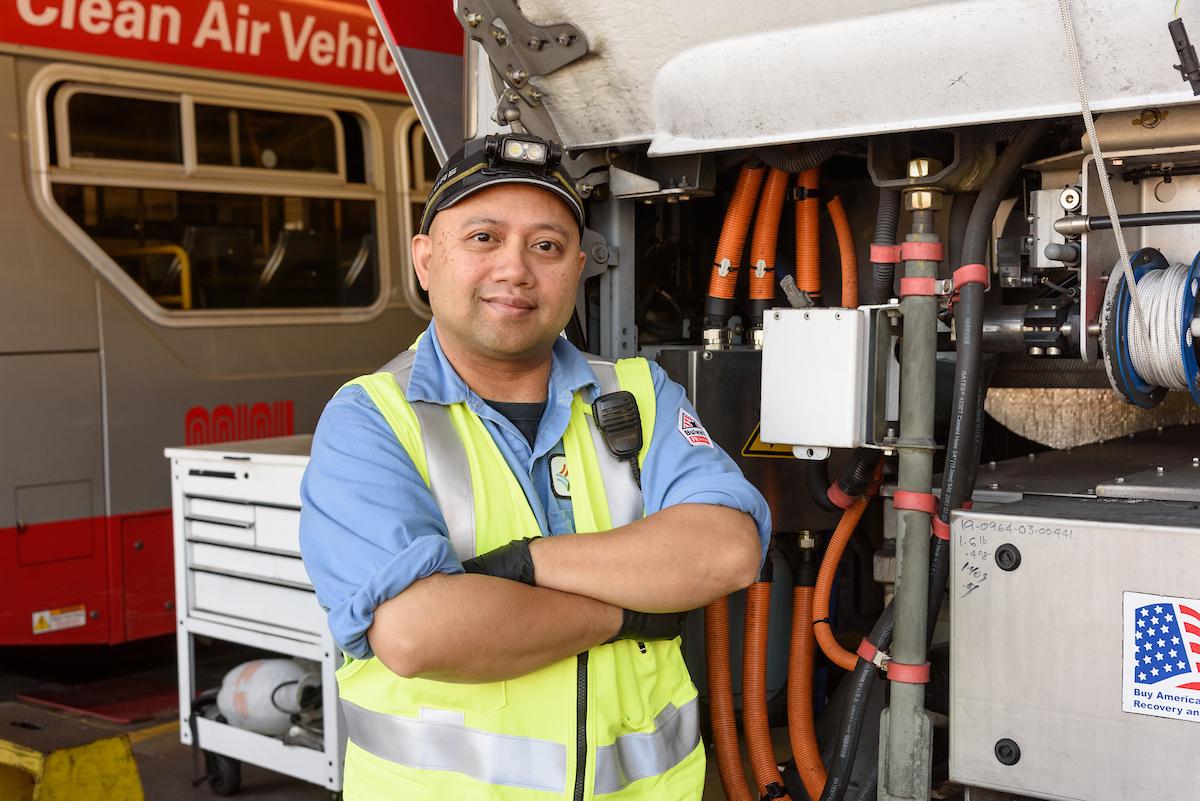
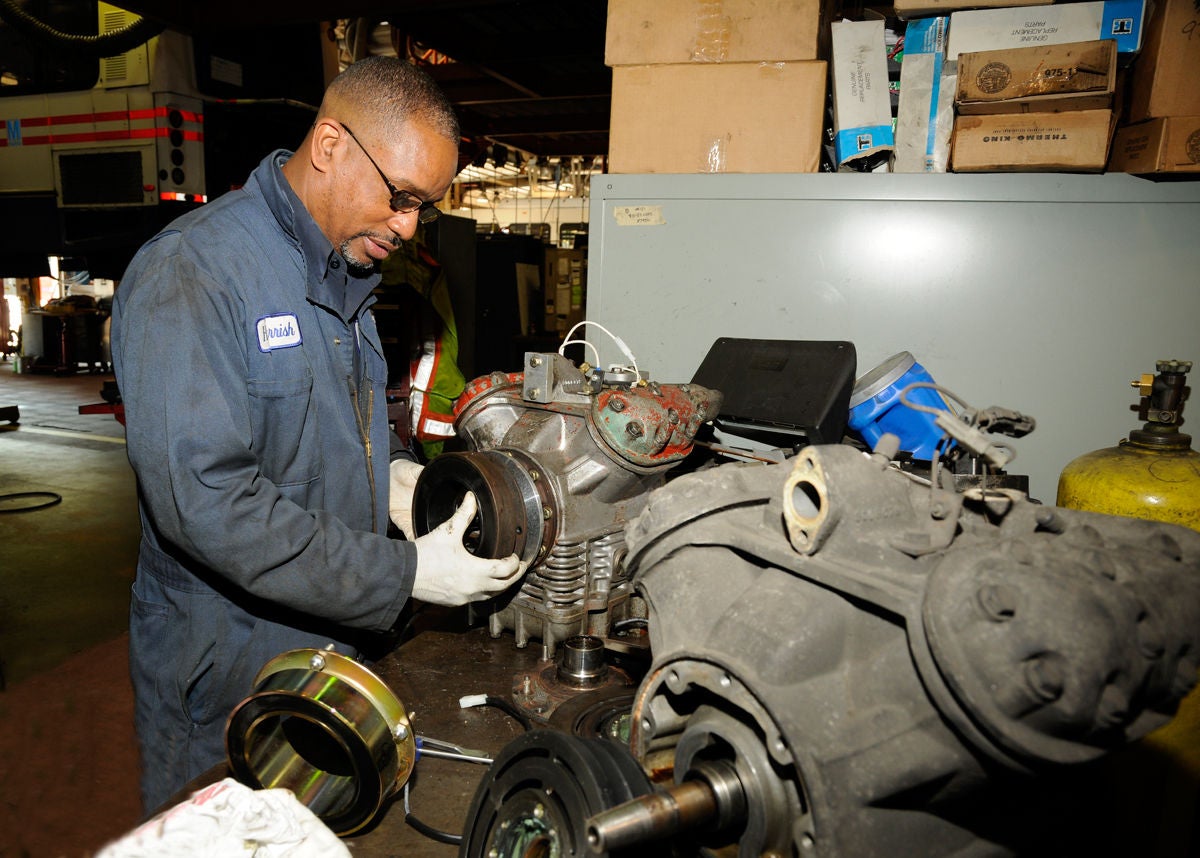
Transit Mechanic Niño Ramos calls his position at the SFMTA a dream job.
You may never see them, but they are a critical part of your Muni ride.
Our mechanics, welders, inspectors and other maintenance staff keep our transit system in good shape. Their work helps ensure that Muni is there when you need it.
We recently had a chance to catch up with a couple SFMTA mechanics at our Presidio bus yard. We wanted to hear directly from them about what they do.
Vehicles that are in working order
“My job here [at] Muni is pretty much inspecting the bus,” Mechanic Niño Ramos told us. “I make sure there are no defects on the bus, especially if there's anything loose on the ceiling or somewhere on the side. [I make] sure everything is perfect, [and that] all the seats are okay to sit on.”
To Ramos, his position is a dream job. “I love being a mechanic because ever since I was little, I've always liked taking things apart, putting things together, especially cars,” he explained. “Little cars, toy cars, whatever it is, as long as it's near cars, then I'm happy to be there.”
Ramos also recognizes that he plays an important role in keeping the city moving. “Muni helps a lot of people get places, especially elder people,” he said. “People with no cars that don't drive, and especially kids that go to school. They take the bus wherever they need to go.”
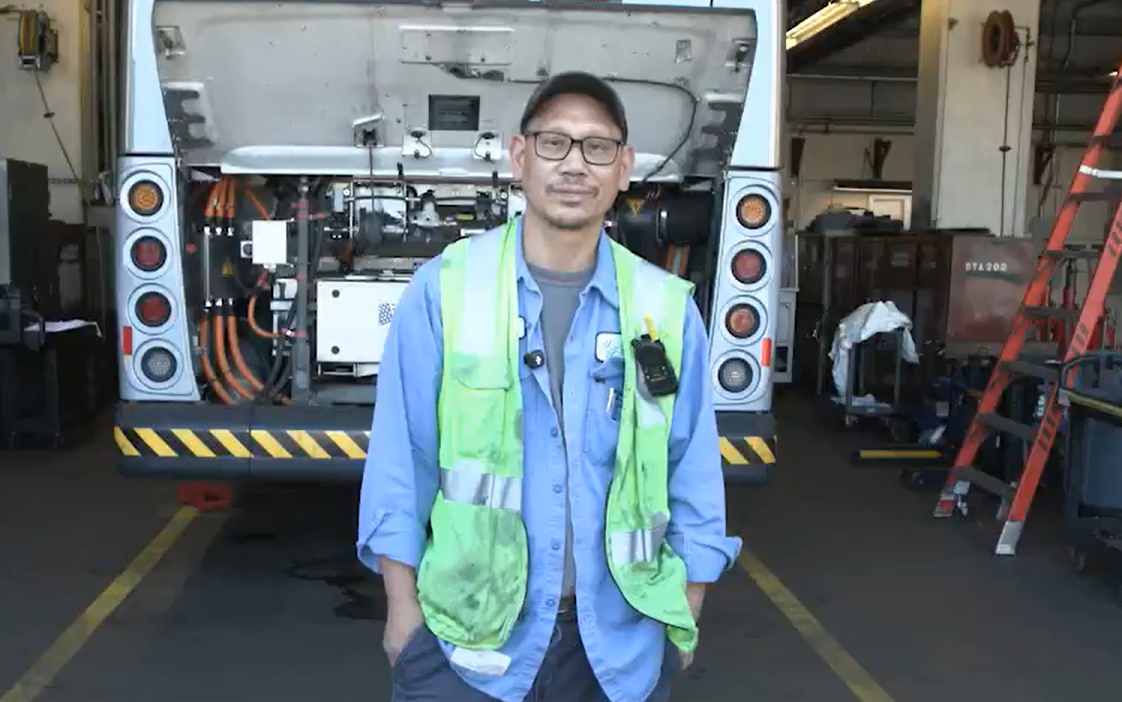
Transit Mechanic Wen Huang takes his responsibility to ensure the safety of our vehicles seriously.
Protecting your safety
Safety and efficiency are on Mechanic Wen Huang’s mind while he’s on the job. “We make sure [every bus is] safe so it can go out there,” Huang said.
“My job is moving buses around,” Huang explained. “The [defective buses] go to a certain area. The good [buses] go to certain area.”
Keeping the yard organized helps maintenance work get done. “I make sure all those [buses] get fixed,” he told us. “So, all those riders will be on a safe bus all the time.”
Huang is also a Muni rider, himself. So, he can experience the benefits of his labor. “I take the 1 [California] line,” he said. “I take the N Judah.”
And Huang knows that the role he plays in Muni’s safety is part of a bigger picture. “I want to make sure the whole city is safe,” he said. “I see a lot of people everywhere. There's so much traffic around. I want those people to [be] safe and sound.”
Ensuring a smooth ride
Muni was the first public transit system to operate in a major U.S. city. We have been around for more than a hundred years, and we intend to be around for years to come.
We can do it, as long as we keep up our maintenance.
Chicago will install a nearly 1.5-mile northbound bus lane on Michigan Avenue from Roosevelt Road to Wacker Drive, benefiting 22,000 weekday CTA riders across 21 routes.
New northbound bus lane between Roosevelt Road and Wacker Drive will improve efficiency for CTA riders
Mayor Brandon Johnson today joined the Chicago Department of Transportation (CDOT), Illinois Department of Transportation (IDOT), Chicago Transit Authority (CTA), and Northern Illinois Transit Authority (NITA) in announcing a new dedicated bus lane on northbound Michigan Avenue between Roosevelt Road and Wacker Drive. CDOT will install the nearly 1.5-mile lane, which will help reduce delays and keep buses moving along this key downtown route.
“Reliable and accessible public transportation is essential to a city that works for everyone,” said Mayor Brandon Johnson. “Chicagoans depend on our buses every day to get to work, attend school, access essential services and connect with their communities. By creating a dedicated bus lane on Michigan Avenue, we are making a critical investment in reducing delays, improving service and ensuring that the thousands of residents who rely on public transit can get where they need to go. We are committed to building a safer, more accessible and more connected transportation system that puts the needs of working people first.”
Michigan Avenue in the Loop is one of the busiest spots in the CTA bus system, with 1,490 buses on 21 different routes using at least part of the new bus lane. Four of the routes — #4 Cottage Grove, #J14 Jeffrey Jump, #20 Madison, and #60 Blue Island/26th — are part of CTA’s burgeoning Frequent Network, with service every 10 minutes or better between 6 a.m. and 9 p.m. on weekdays and 9 a.m. to 9 p.m. on weekends. An estimated 22,000 bus riders travel through the segment every weekday and will experience the benefits of the new bus lane — more than 7 million riders annually. During the morning rush, CTA buses carry an estimated 35 percent of all trips on Michigan Avenue but make up only 3 percent of the vehicles.
“CTA's buses will be faster and more reliable as a direct result of this new Michigan Avenue bus lane. The benefits of the bus lane will have ripple effects across CTA's entire network and make traveling easier for the thousands of riders every day, including doctors, students, tourists, and many others who rely on the bus to get where they need to go,” said CTA Acting President Nora Leerhsen. “This bright red bus lane in the heart of the city sends an important message to residents and visitors alike that public transit is a priority for our region.”
This week, CDOT will begin installing new pavement markings and signage to clearly identify the bus lane. Work will take place overnight and is expected to be completed over the next seven to ten days, weather permitting.
"Michigan Avenue is one of the busiest corridors in the region, and every minute we save here adds up for the thousands of riders who use it every day,” said NITA interim Executive Director Jamie Rhee. “This new dedicated bus lane is the kind of change that NITA was created to deliver — working hand-in-hand with CDOT, IDOT and CTA to make travel faster, safer and more reliable for everyone who rides."
“Creating a stronger transportation network means making sure our streets work better for people riding buses,” said CDOT Commissioner William Cheaks, Jr. “This new lane will help keep hundreds of buses and the thousands of people who ride them moving along this busy downtown corridor. We’re proud to deliver this improvement through close coordination among agencies.”
Michigan Avenue is under IDOT’s jurisdiction, and CDOT worked closely with the agency to develop and secure approval for the project.
“Under Gov. Pritzker, IDOT is committed to partnering with our cities to help them meet their goals for mobility and safety,” said Illinois Transportation Secretary Gia Biagi. “This addition to Michigan Avenue promises to be the first of many under NITA to strengthen and support more efficient transit along major corridors in Chicago and throughout the region.”
Following installation, CDOT and CTA will conduct field observations and collect data over the first six months to evaluate bus travel times, schedule reliability, traffic operations, safety and other conditions along the corridor. The agencies will use the findings to identify any adjustments that may be needed.
To help keep the lane clear for buses, the new Michigan Avenue bus lane is within the enforcement area of the Smart Streets Pilot Program. The program uses camera technology to enforce parking and standing restrictions in bus lanes, bike lanes and at bus stops, helping ensure Chicago’s growing network of bus and bike lanes works as intended.
Dedicated bus lanes are one of several tools Chicago is using to advance a citywide vision for safer, more efficient, and better organized streets for all road users. Through the Better Streets for Buses program and other collaboration between CDOT and CTA, Chicago is using a range of infrastructure treatments, including dedicated bus lanes, traffic signal improvements, bus boarding islands and other transit-priority measures, to reduce delays and make bus service faster and more reliable for riders.
Approved, the MTA’s 99-year ground lease enables Gotham’s Monitor Point in Greenpoint to build 1,324 homes, including 662 permanently affordable units, public space, and Nassau Av G station accessibility upgrades.
Monitor Point Development to Allocate 662 Units as Permanently Affordable and Over 100,000 sq. ft. of Mixed Retail and Commercial Space
Gotham to Create New Publicly Accessible Open Space, Including a Waterfront Walkway and Expansion of Green Space for Long-Awaited Box Street Park
Developer Will Relocate Three Existing MTA Facilities to New, Modern Turnkey Facility in North Brooklyn Industrial Business Zone
Ground Lease Revenue to Support MTA Capital Program, Including Accessibility Upgrades at Nearby Nassau Av Station
The Metropolitan Transportation Authority (MTA) Board today authorized a transaction to redevelop the MTA-owned property at 40 Quay St in Greenpoint, Brooklyn, clearing the way for the Monitor Point development project. Monitor Point is a planned mixed-use development that will generate lease revenue to fund transit projects across the system and deliver approximately 1,324 new rental homes, 50 percent of which will be permanently affordable, more than 52,500 square feet of publicly accessible waterfront space, new retail and community space, climate resiliency improvements, and a permanent home for the Greenpoint Monitor Museum.
This transaction highlights the MTA’s commitment to transit-oriented development, ensuring MTA assets support critical housing development goals across the region while also supporting the transit system New York relies on.
“When New York City Transit bought this site in the 1990s, the North Brooklyn waterfront was an industrial enclave,” said MTA Chair and CEO Janno Lieber. “Today our facility no longer fits in, so better to redevelop the land and create much-needed new housing while generating new revenue to fund transit improvements.”
"Monitor Point is yet another example of the benefits public-private partnerships can deliver,” said MTA Construction & Development President Jamie Torres-Springer. "This project will support new homes and open space while generating revenue for the MTA capital program, allowing us to accelerate game-changing accessibility upgrades for the local community and support continued investment in the transit system overall."
The 99-year ground lease is expected to deliver $61 million on a net present value basis to the MTA capital program, along with real estate taxes. This revenue enables the MTA to make the nearby Nassau Av G train station fully accessible. The deal includes the relocation of three outdated MTA facilities to a new turnkey facility in the North Brooklyn Industrial Business Zone, creating brand new, modern facilities to support essential MTA operations-- valued at approximately $54 million.
The MTA first purchased 40 Quay St in 1998 as its headquarters for the NYC Transit Mobile Wash Division, the group responsible for cleaning the subway system. At the time, the North Brooklyn waterfront was predominantly industrial, and over the years, Greenpoint’s waterfront has greatly transformed, where the existing MTA facilities no longer fit in. Gotham Organization (Gotham), the selected developer, will construct a new facility for the Mobile Wash Division on a separate property at 213 Meadow Street in East Williamsburg, Brooklyn, and will house essential NYCT functions, including an emergency response unit. Following completion of this facility, Gotham will demolish the existing NYC Transit building at 40 Quay Street and construct the new 840,000 square-foot mixed-use project – Monitor Point. Construction on 213 Meadow Street is expected to commence in the summer of 2027.
Additionally, this new facility will free up the Emergency Response Unit’s current site at 65 Commercial Street, unlocking 25,000 square feet of additional parkland at Box Street Park, along with new public bathrooms and $300,000 in annual funding to support Bushwick Inlet Park. The project will also include shoreline restoration, environmental remediation, and expanded waterfront access.
Monitor Point is a partnership between the Gotham Organization, the MTA, the New York City Department of Housing Preservation and Development (HPD), and the Greenpoint Monitor Museum. In 2021, the MTA Board previously approved Gotham’s conditional designation as the successful proposer in the Request for Proposal (RFP) process. In July 2026, the New York City Council approved the development, following completion of the city’s Uniform Land Use Review Procedure (ULURP) process.
“The majority-affordable Monitor Point housing development will add desperately needed deeply affordable homes in Greenpoint, providing some of our most vulnerable neighbors with stable, dignified housing, while improving critical public infrastructure and expanding public green space,” said NYC Council Member Lincoln Restler. “I’m grateful to the MTA team for their partnership and contributions to the agreement, including by making the Nassau Av G station fully accessible and relocating the MTA’s Emergency Response Unit to make way for additional green space at Box Street Park. I’m also grateful to Council Speaker Menin, Mayor Mamdani, and the Gotham Organization for realizing this dynamic public-private partnership.”
“Today’s announcement to redevelop 40 Quay Street is a critical step toward realizing the Monitor Point project,” said Brooklyn Borough President Antonio Reynoso. “From increased affordable housing and public space to MTA station improvements and investments in shoreline resiliency, my office worked closely with local elected officials and the development team to maximize the public benefit at this site. Monitor Point offers an innovative model for leveraging MTA-owned land to unlock new housing and tangible community benefits, and I appreciate the MTA’s essential partnership on this development.”
Governor Hochul urged federal tariff exemptions after an MTA analysis found tariffs could add $1 billion to its $23 billion 2025–29 rolling-stock program.
View MTA Rolling Stock Program Chief Jessie Lazarus Deliver Presentation Here
Governor Kathy Hochul today announced that a new report presented at September's Metropolitan Transportation Authority (MTA) board meeting demonstrates the $1 billion price hike caused by the Trump Administration’s tariff policy to the MTA’s plans to upgrade its rolling stock by purchasing new subway cars, commuter rail cars and buses. Following this report, the Governor wrote directly to U.S. Secretary of Commerce Howard Lutnick and U.S. Trade Representative Ambassador Jamieson Greer to request exemptions to transit rolling stock purchases from the current tariff regime. The MTA is in the midst of a generational upgrade to its fleet, with $23 billion committed to purchase thousands of new vehicles, an investment that will support thousands of New York jobs at companies that manufacture these vehicles as well as companies that make the components required to build them.
“Donald Trump’s reckless trade war does more than just raise prices for New York families, it severely threatens government’s ability to deliver on big, ambitious projects,” Governor Hochul said. “New York’s historic investments in mass transit include plans for the largest improvement to our rail and bus fleet in history, but Trump’s tariffs have created a $1 billion tax on transit and put these improvements at risk. Our entire region depends on the MTA to get around, and this planned investment promises to support thousands of good New York jobs; these reckless tariffs must end now.”
The MTA's most recent generation of subway cars, the R211s which run on the lettered subway lines and the Staten Island Railway, are assembled in Nebraska and Yonkers. More than 75 percent of their components were made in the U.S.A. — well above the “Buy America” threshold for transit agency procurements required by the federal government. But modern railcars require some imported parts for which American manufacturers have no domestic alternative.
Current tariffs on specialized components required to build rolling stock dramatically dilute the value of the MTA's 2025-29 capital plan. The $1 billion in potential increased costs could instead be used to purchase most Metro-North coaches; 150 new M9-A rail cars to reduce crowding on the Long Island Rail Road; nearly 1,000 new buses; or more than 250 subway cars on the 1, 2, 3, 4, 5 and 6 lines.
MTA Chair and CEO Janno Lieber said, “As the MTA keeps breaking ridership records, our investments in the next generation of rolling stock become more important than ever. New subways, buses and railcars are needed to give our riders the service they deserve. It’s time for our partners in Washington to let us support American workers and responsibly spend taxpayer dollars.”
MTA Rolling Stock Program Chief Jessie Lazarus said, “An investment in rolling stock is more than just an investment in a more modern, comfortable ride. It's an investment in American workers. The MTA is committed to securing maximum value from our capital program, and that means speaking honestly and candidly about the impact of policies that dilute New York's spending power."
State Senator Jeremy Cooney said, “Thousands of New Yorkers rely on the services provided by the Metropolitan Transportation Authority each day. These upgrades can’t wait. This $1 billion federal tariff risk means job opportunities are placed on hold and New York’s infrastructure doesn’t receive the full potential that the MTA’s 2025-29 capital plan offers. I’m proud to stand behind Governor Hochul in ensuring that New York’s transportation system moves forward.”
Governor Hochul’s Nation-Leading Actions on President Trump’s Tariff Policies
Since President Trump first implemented his chaotic and harmful tariff policies, Governor Hochul has been on the frontlines demanding money be returned to hardworking New Yorkers and small businesses. Earlier this year, the Governor sent a letter calling on the U.S. Department of Treasury to immediately refund $13.5 billion in tariff payments to New Yorkers, and has held roundtables across the state with local business leaders highlighting the impacts that tariffs have had on their businesses. In August, Governor Hochul, New York Attorney General James and a coalition of other states sued to halt illegal tariffs imposed under the Trade Act. In February, the Governor was part of a major United State Supreme Court ruling outlawing tariffs imposed by the Trump administration under the Economic Powers Act (IEEPA).
As part of the FY27 Enacted Budget, Governor Hochul launched a $30 million tariff relief program for agricultural producers in the state to help those who rely heavily on the forces of international markets. The Governor’s tariff relief program will provide direct payments of a minimum of $1,000 and a maximum of $25,000 to eligible producers.
MTA acquired 46 acres at 100 Sheep Pasture Road in Port Jefferson Station for $10, preserving potential future Port Jefferson Branch railyard and modernization improvements while protecting the greenway.
Land Purchase Preserves Opportunity to Build Rail Yard for Port Jefferson Branch
Acquisition Made Possible Following Legislation Signed by Governor Hochul in July 2026
Governor Kathy Hochul today announced the Metropolitan Transportation Authority (MTA) acquired more than 46 acres of land in Port Jefferson Station in a move that secures the property for potential future Long Island Rail Road (LIRR) infrastructure needs. The parcel, at 100 Sheep Pasture Road, is part of a larger 126-acre property often referred to as the Lawrence Aviation Site after the aeronautic sheet metal manufacturer that vacated in 2003 and was its last occupant. The MTA bought the land for $10 from the Suffolk County Land Bank.
"When we signed legislation in July, we protected the Setauket-Port Jefferson Station Greenway while preserving the ability to improve rail service on Long Island into the future," Governor Hochul said. "Today, we deliver on that commitment by securing this property and ensuring that the Port Jefferson community has this beloved greenway permanently preserved while also allowing the MTA to plan for long-term upgrades to LIRR service for tens of thousands of riders. This is a win-win for transportation and green space on Long Island."
MTA Chair and CEO Janno Lieber said, “We’ve invested almost $20 billion in the LIRR over the last 10 years – Grand Central Madison, Double Track, Third Track, the new Penn Station concourse, and so much more. Now, thanks to Governor Hochul, we have a new opportunity to explore service and reliability upgrades for the Port Jefferson branch through this land deal.”
Long Island Rail Road President Rob Free said, “As we develop our capital plans, we always look for opportunities to address possible infrastructure needs in the future – especially as the busiest commuter railroad in the country. Securing this land gives us the flexibility to plan for the railroad’s expansion and modernization opportunities.”
State Senator Monica R. Martinez said, “Long Island cannot build the transportation network of tomorrow if we do not preserve the space necessary to build it today. The MTA’s acquisition of this property keeps open the possibility of a future modernization of the Port Jefferson Branch, including the infrastructure that would be needed to support eventual electrification and expanded rail service. I thank the MTA for taking this important first step and preserving an opportunity that could become a significant economic driver for our region.”
Assemblymember Rebecca Kassay said, "Today, New York State and the MTA took a meaningful step towards modernizing and electrifying the Port Jefferson LIRR line. This acquisition of more than 46 acres near the terminus of the Port Jeff line is a once-in-a-lifetime opportunity to advance much-needed and long-awaited rail transit improvements. I am very proud to have sponsored the legislation that permanently preserved the Setauket-Port Jefferson Station Greenway. In addition to the enormous relief of knowing this trail will forever be open space in our community, this legislation resolved a long-standing land use conflict that previously prevented this acquisition and planning from moving forward. I thank Governor Hochul for signing this legislation in July and for her partnership in helping move this critical infrastructure project forward. Today’s acquisition is the first in a series of investments necessary to electrify the line, deliver a one-seat-ride from our region to the city, improve local air quality, and advance more reliable rail service for our neighbors. I am excited to see this project moving forward and will continue working with our civic partners and colleagues at every level of government to realize the full potential of this acquisition."
Suffolk County Executive Ed Romaine said, "The Lawrence Aviation property sale represents a major investment in Suffolk County’s north shore. Thanks to our collaboration with New York State and the Metropolitan Transportation Authority this community blight is transforming into a clean energy and transportation asset.”
Town of Brookhaven Supervisor Daniel Panico said, “This represents another important step toward creating a positive future for a property once scarred by industrial use. Years ago, the Town of Brookhaven preserved more than 46 acres of surrounding woodlands for our community and our environment. Now, on the previously cleared portion of the property, we are taking another step forward with this latest solar installation—creating clean energy on land that was once polluted. I thank everyone involved in transforming this property and helping create a cleaner, brighter future for generations to come.”
The purchase was made possible by enabling legislation signed by Governor Kathy Hochul in July that protected the Setauket-Port Jefferson Station Greenway while retaining the MTA’s right to, if future needs arise, build a railyard for the Port Jefferson Branch of the LIRR. In the event of railyard construction, the New York State Department of Transportation would preserve this greenway by relocating it.
With responsibility for preserving the greenway clearly identified, the legislation essentially granted the MTA the flexibility to consider building a yard on the site as a necessary part of future improvements to the Port Jefferson Branch.
While there are no current plans or funding for the type of Port Jefferson Branch improvements that would require a railyard at the site, the acquisition preserves the railroad’s ability to keep those opportunities open and evaluate them as part of its long-term planning.
SFMTA’s “Community” podcast episode features Jac Matter Resnik’s Muni-focused magazine, produced with Jack Sloop and contributors including Lia Smith, and is available on SFMTA platforms and major podcast services.
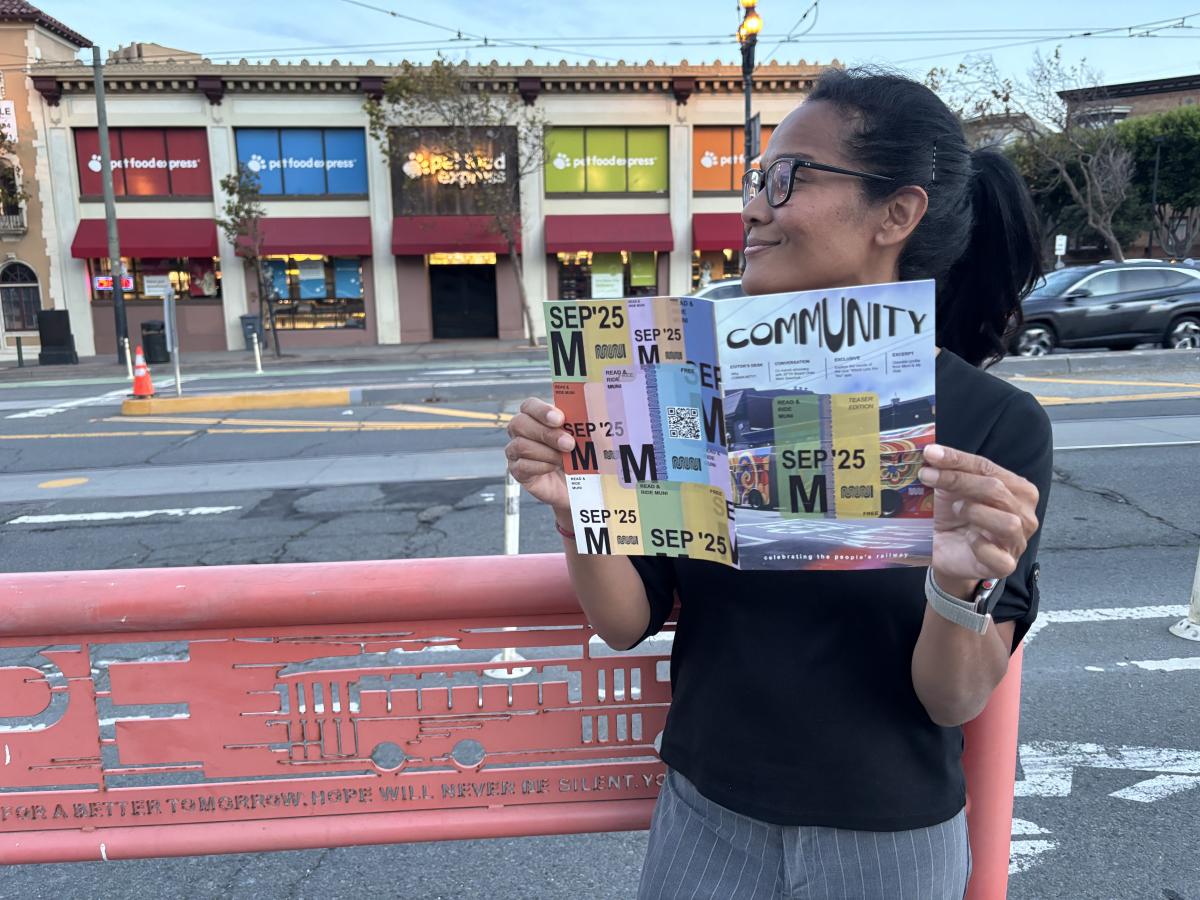
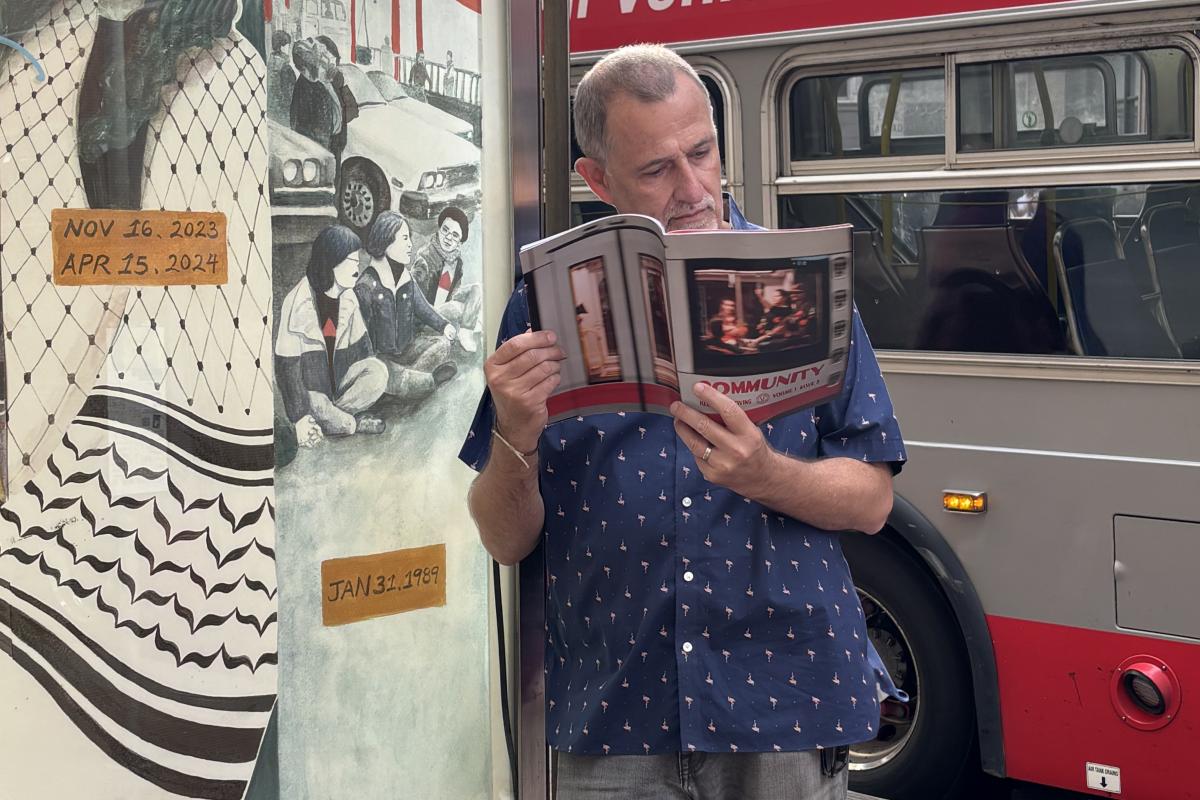
Community Magazine debuted last year. It focuses on Muni and what the system brings to the experience of living in San Francisco.
Where do you find community? One place Jac Matter Resnik finds it is on Muni. That’s why she created Community, a magazine that celebrates our transit system.
Resnik joins us on the new episode of the Taken with Transportation podcast to talk about her publication. “I think Community really encompasses not only the Muni system, but San Francisco as a city, as an ecosystem,” she says.
“It started as a passion project,” Resnik adds. “But it's turned into, pun intended, a really great community of people that I would have never met otherwise.”
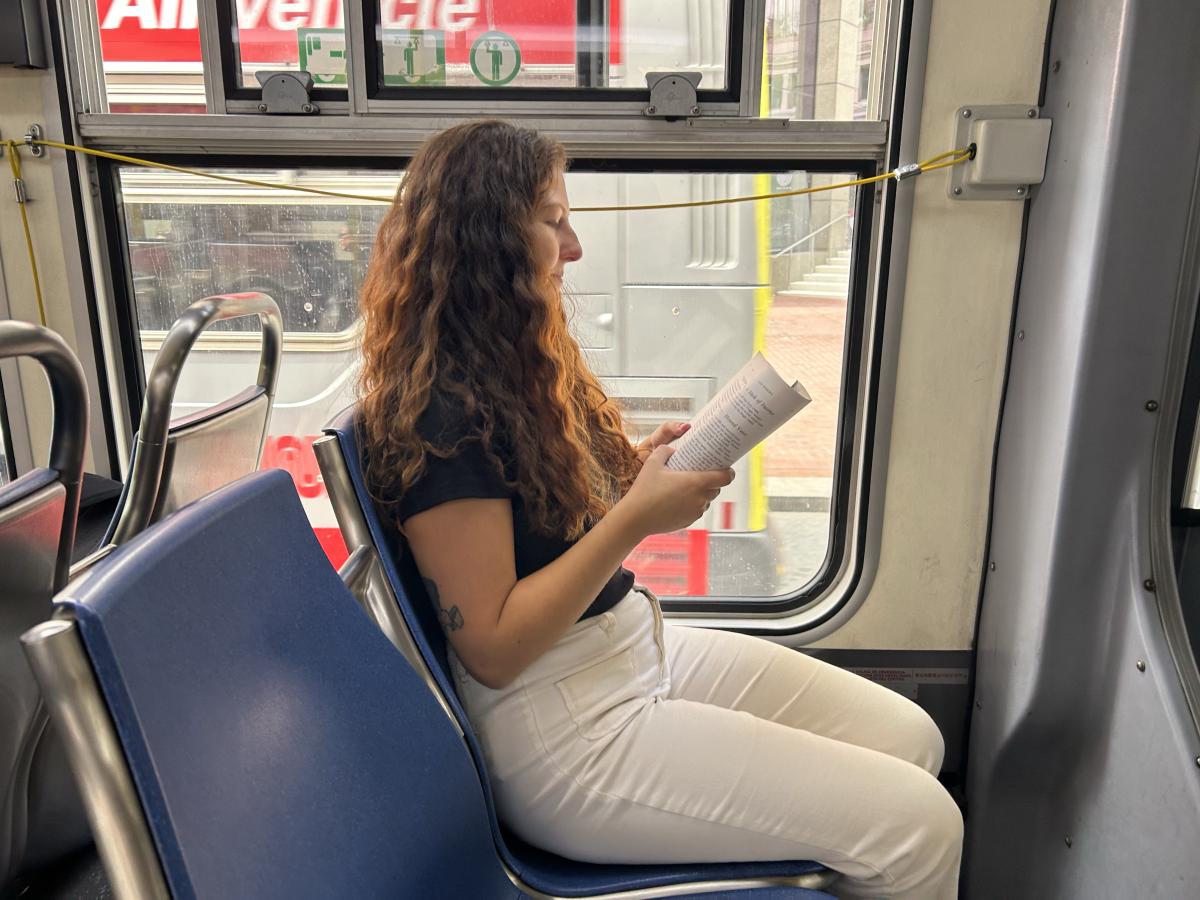
Need something to read while you wait for Muni? The producers of Community hope you’ll choose their magazine.
The village that creates Community
Resnik produces Community with Jack Sloop, who describes himself as the magazine’s designer in chief.
“I’ve done a ton of magazines for a ton of different community organizations in the past,” Sloop explains in the episode. “And this was exactly what I was looking for: transit, San Francisco and a writer who … is talented beyond belief.”
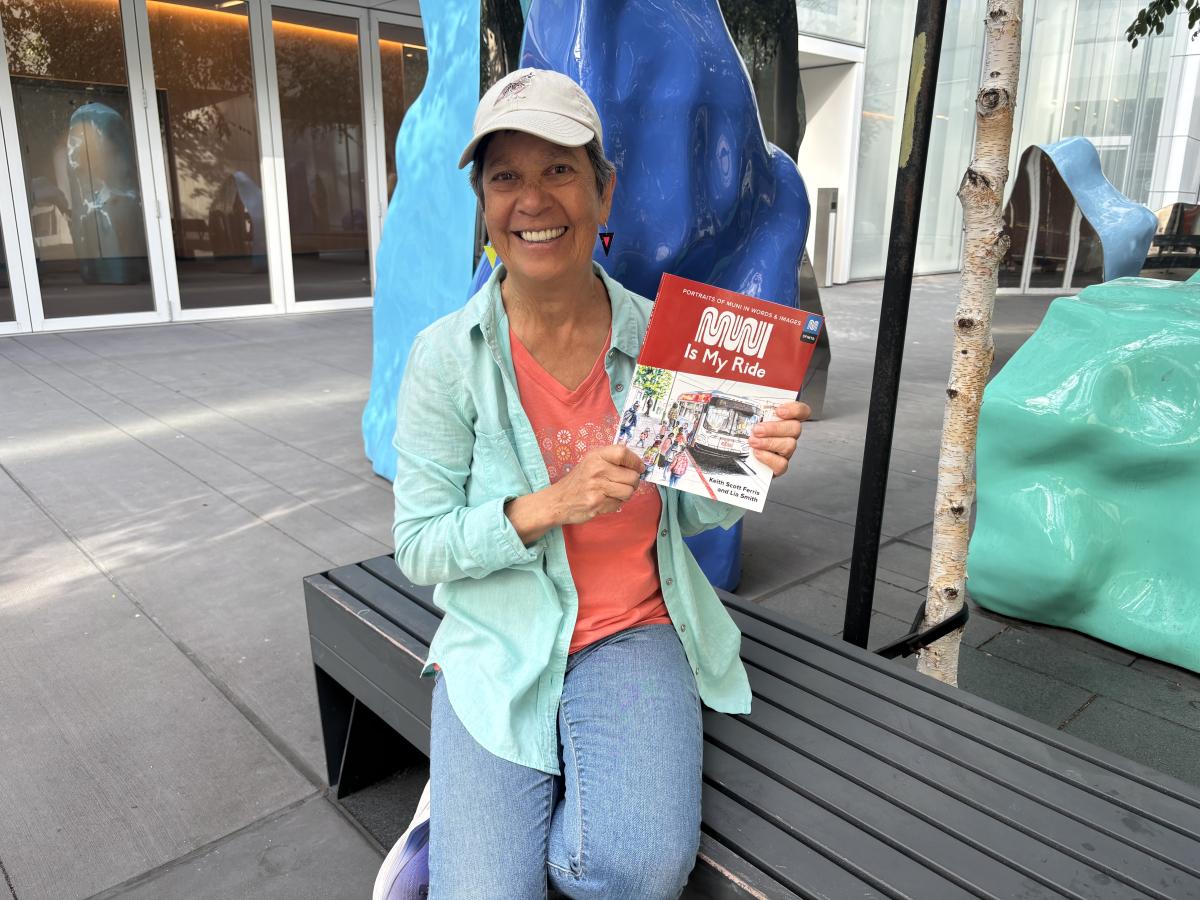
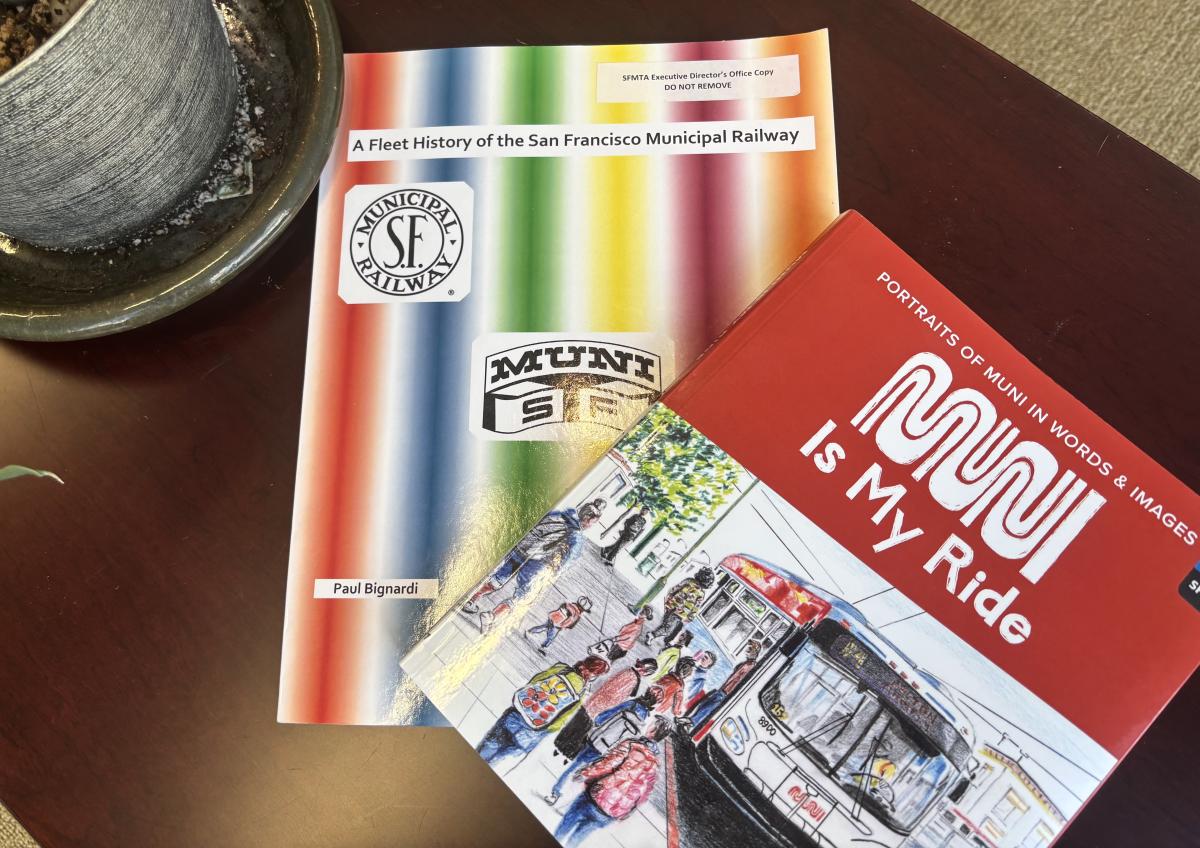
In addition to Sloop, more than two dozen writers and contributors make Community what it is. One of them is Lia Smith. She’s the author of the book Muni is My Ride.
“It's really amazing how many people … are Muni fans [and] Muni advocates,” Smith says. “Something's happening. And Jac is contributing to that.”
We also talk with SFMTA Digital and Brand Communications Manager Dovid Coplon in the episode. He discusses the popularity of Muni merchandise and how it can help create community.
Muni Is My Ride author Lia Smith. You can find excerpts from her book in Community.
How to listen
Like the magazine, this latest Taken with Transportation episode also is called “Community.” You can find it on our podcast webpage (SFMTA.com/Podcast) and the SFMTA YouTube Channel. We’re also on Apple Podcasts, Spotify, iHeart and other podcast platforms.
CTA and partners will host the Fall 2026 Citywide Career Fair September 30 at Kennedy-King College, featuring over 60 employers and thousands of opportunities.
Job seekers can connect directly with employers offering opportunities across transportation, healthcare, construction, government and other industries
The Chicago Transit Authority (CTA), in partnership with local government agencies, nonprofit organizations and private-sector employers, will host the Fall 2026 Citywide Career Fair on Wednesday, September 30, at Kennedy-King College on Chicago’s South Side.
The career fair will connect hundreds of job seekers with employers and workforce resources representing a broad range of industries, including transportation, construction, manufacturing, healthcare, security, retail, education, banking and government. Attendees are encouraged to review the list of participating employers at www.chicityclerk.com/citywidecareerfair.
Event Details:
Wednesday, September 30, 2026
10:00 a.m. – 2:00 p.m.
Kennedy King College
U-Building
740 W. 63rd St, Chicago, IL 60621
“CTA’s role in Chicago extends beyond providing public transit services—we help connect people to opportunity,” said CTA Acting President Nora Leerhsen. “A strong transit system and a strong workforce go hand-in-hand with a strong city. This career fair brings employers and talented job seekers together, creating pathways to good careers, greater economic opportunity and a stronger future for Chicago and the communities we serve.”
More than 60 employers and resource agencies are expected to participate, representing thousands of available employment opportunities. Several participating employers will conduct on-site interviews and may extend conditional job offers during the event.
“Chicago residents are looking for a break, and at a time when families are facing challenges nationally and here at home, we’re willing to be the leaders who open doors to opportunity and connect our neighborhoods with meaningful careers,” said City Clerk Anna Valencia. “This citywide career fair is about helping people find not just a job, but their passion—unlocking the talent that already exists in our communities and creating pathways for Chicagoans and their families to not only succeed but thrive.”
“Cara Collective is honored to support the Citywide Career Fair,” said Cara Collective President and CEO Karin M. Norington-Reaves. “We believe meaningful partnerships like this are essential to creating greater access to opportunity. By working alongside City Clerk Anna Valencia, the Clerk’s Office, and other community organizations, we can help ensure that all job seekers, including those overcoming significant challenges, have access to employers, resources, and connections that help change the trajectory of their lives.”
"This job fair represents what we can achieve when we work collaboratively with public agencies, the private sector, and community organizations, coming together with a shared purpose,” said Civilian Office of Police Accountability, Chief Lakenya White. “The purpose is simple but powerful, to ensure opportunity is accessible, inclusive, and impactful."
Participating organizations include CTA, the Office of Chicago City Clerk Anna Valencia, City Colleges of Chicago, Chicago Cook Workforce Partnership, Civilian Office of Police Accountability, Skills for Chicagoland’s Future, Illinois Tollway, Pace Suburban Bus, Chicago Police Department and others.
Attendees will be able to connect directly with hiring employers, learn about available positions and explore career pathways across multiple industries. Workforce and resource organizations will also be available to provide information about employment preparation, training and other supportive services.
Job seekers are strongly encouraged to review available positions and apply in advance to increase their chances of securing an interview or conditional offer during the event.
MBTA begins camera-based bus-stop and bus-lane enforcement October 1, 2026, issuing warnings before fines of $25–$125 start January 1, 2027, initially on SL4 and SL5.
A bus is driven in a dedicated, red, bus lane with cars driving alongside of it
The Massachusetts Bay Transportation Authority (MBTA) announced that a new Automated Camera Enforcement program will begin on October 1, 2026. As part of an educational period, the MBTA will begin issuing educational advisory notices to motor vehicles parked in bus stops and parked or standing in bus lanes. Violators are subject to fines beginning January 1, 2027.
“Riders deserve safe, accessible, and efficient bus rides, which is why we are implementing Automated Camera Enforcement education this fall, with enforcement in January 2027,” said Interim Transportation Secretary and MBTA General Manager Phillip Eng. “When bus stops are blocked, people with disabilities, people with strollers, and anyone who has mobility challenges loses the option for level boarding. When bus lanes and stops are blocked, thousands of riders are impacted and lose time out of their schedules every day. This program is about keeping buses moving, but also about keeping people safe and giving everyone valuable time back in their day.”
An MBTA bus pulls up to a sidewalk curb so it can deploy its ramp, which allows riders to safely board.
Safety, accessibility, and improved bus service for all riders
This program, as authorized by a January 2025 change in state law, directly improves safety, accessibility, and reliability. Blocked bus stops are a hazard to riders and make bus service inaccessible. Automated Camera Enforcement ensures that buses can safely pull up to the curb and deploy ramps so all riders can get on and off the bus safely. Additionally, Automated Camera Enforcement ensures that buses can properly fit in bus stops and travel in dedicated bus lanes, so buses do not have to weave through traffic making difficult maneuvers. Keeping lanes and stops clear also helps to keep bus trip times consistent and reduces overall delays for riders. The MBTA anticipates that enforcing bus lanes will result in an additional time savings for riders.
Tickets
Violations will be automatically captured by cameras installed on MBTA buses, and a team of human evidence reviewers will review all incidents to confirm if a violation has occurred. Fines will be sent to vehicle owners (both private and commercial) and will range from $25 to $125.
Using the RMV database, warnings or tickets will be mailed to the address where the vehicle is registered. Vehicles registered in Massachusetts will be mailed a warning or ticket within 14 business days of the violation. Vehicles registered in another state or country will be mailed a warning or ticket within 21 business days. This follows the same process used for HOV violations and tolling.
A first-time bus lane violation will receive a warning (with a lifetime lookback) unless the violation created a public safety risk. Drivers who violate bus stop laws will automatically receive tickets, not a warning, due to safety and accessibility concerns.
To dispute a ticket, the registered vehicle owner may submit an appeal within 60 days of the violation being issued.
In regard to privacy; the automated enforcement cameras on MBTA buses will not be used to track vehicles, nor can the data collected by the automated camera system be used or shared for any purpose other than to enforce a bus lane or bus stop violation as stated by the MBTA’s Privacy Policy.
The program will begin with enforcement along SL4 and SL5 routes and will expand to other routes.
Interacting with bus lanes
Under Automated Camera Enforcement, fines may be issued to drivers parking in bus stops and parking or standing in bus lanes. However, exceptions apply, with the most common ones listed below.
Turning in a bus lane: As a driver approaches a turn near a bus lane, hashed markings or a sign will show where a driver can legally enter the lane to make a turn. Drivers must give approaching buses the right of way.
Parking next to a bus lane: As a driver is pulling in or out of a parking space next to a bus lane, drivers are permitted to temporarily stop in bus lanes. Drivers must give approaching buses the right of way.
Making way for emergency vehicles: Drivers can temporarily stop in bus stops and bus lanes to safely make way for emergency vehicles. Active emergency vehicles are permitted to drive in bus lanes.
The MBTA will modernize the Green Line’s 120-year-old central-tunnel signals during a September 26–October 4 outage, alongside station, track, accessibility, radio, power, and catenary upgrades.
Major construction taking place September 26 – October 4
As the MBTA continues to make significant improvements in its service and infrastructure, the MBTA is today reminding riders about construction work that is critical to ensuring the long-term reliability of the line. The necessary work to replace and upgrade the 120-year-old signal system within the central tunnel will take place during nine consecutive days of 24/7 access to portions of the Green Line from September 26 through October 4, which allows the MBTA to expedite these long-awaited upgrades in the most cost-efficient manner possible.
More About The Work
At over 100 years old, the MBTA’s Green Line legacy signal system is as old as the tunnel itself – the old signals currently in use are the same signals that were used when the first electric trolleys in North America were put into service in the late 1800s. This signal system is ready to be replaced with the upgraded, modern technology of today.
The upcoming construction work beginning on September 26 is part of the MBTA’s phased approach to accomplishing these signal upgrades and builds upon previous work that has taken place this year. The age of the MBTA’s signals and the scale of replacing the entire system within the central tunnel makes the project significant, and previous administrations had deferred this work due to its challenging complexities. With a commitment to accomplishing long-awaited upgrades that riders deserve, the MBTA is no longer deferring these critical investments. It was determined that the best way to accomplish the Green Line’s signal modernization on an accelerated timeline is the phased approach: several diversions in service in which the MBTA could maximize each outage by performing as much other piggybacking work as possible.
When the project is complete, the new signal system will provide the MBTA Operations team with improved train detection, better train congestion management, and more consistent train spacing, which provide the foundation for improved service frequency. These operational upgrades also mean more reliable service for riders with fewer unplanned disruptions and emergency repairs caused by the older, aging signal system.
Photo of brand new, fully upgraded signaling equipment within the central Green Line tunnel.
Compatible with the upcoming fleet of new Type 10 Green Line cars, these signal upgrades also help prepare the MBTA for future generations of riders.
New Type 10 Green Line vehicle being tested on tracks at the manufacturing facility in Elmira, New York. The first of the Type 10s will be received by the MBTA next year.
The unencumbered access to the Green Line track area allows the MBTA to accomplish many other piggybacking projects. This work includes the following:
Crews are continuing the critical station upgrade work at Symphony as well as replacing ties and ballast in the track area of the station.
With the new fleet of Type 10 cars soon arriving, crews will perform modifications to curbs and platform edges at stations to provide clearance for the new larger vehicles.
Crews will upgrade radio infrastructure throughout the diversion area and begin the installation of new radio system cable within the E Branch tunnel area.
Crews will relocate the electric overheard catenary wires, which power Green Line cars, at complicated sharp curve area in order to accommodate both existing vehicles and the new Type 10 fleet.
Power maintenance crews will inspect and repair power cables and underground access boxes, and clean or replace switchboxes.
At Park Street, workers will perform full-depth reconstruction of the eastbound track and rebuild the pedestrian crossing.
Station brightening, critical maintenance, and repair work will take place at all stations between Kenmore Station and North Station, including painting, assorted repairs, HVAC maintenance, and inspections.
Other Recent Major Accessibility Accomplishments on Green Line
The MBTA has made major progress in upgrading the accessibility of the Green Line this year. The Green Line C Branch Station Accessibility Improvements project is in the process of making accessibility improvements at seven inaccessible above-ground stations on the C Branch along Beacon Street in the Town of Brookline: Englewood Avenue, Dean Road, Tappan Street, the consolidated Fairbanks Street/Brandon Hall station, Summit Avenue, Saint Paul Street, and Hawes Street.
As part of the first phase of the project, the seven stations are being upgraded with 8” platforms in order to be ADA-compliant and accessible with the current fleet of MBTA Green Line vehicles. When complete, all stations along the C branch will be accessible.
Previous platform conditions at Englewood AvenuePrevious platform conditions at Englewood AvenueCurrent upgraded platforms at Englewood AvenueCurrent upgraded platforms at Englewood Avenue
Since the beginning of the Healey-Driscoll Administration, the MBTA has made great strides in coordinating construction and maintenance activities so that, when planned service outages to conduct major construction are necessary, the MBTA accomplishes as much work as possible. This approach minimizes service disruptions for riders and reduces the cost of replacement shuttle bus service. The work to upgrade each of the seven C branch stations was planned in conjunction with other critical Green Line work like the central tunnel signal upgrades, which allowed the MBTA to make improvements on a faster, accelerated timeline that has saved the T millions of dollars in redundant service outage costs associated with coordinating shuttle buses, personnel, equipment, and construction support.
For the remaining C branch accessibility work during this first phase, the MBTA is limiting the number of stations bypassed at any one time, generally to no more than two platforms. The C branch has the advantage of relatively closely-spaced stations, so riders typically have a nearby alternative about a quarter of a mile or so away when a platform is temporarily bypassed.
Previous platform conditions at Dean RoadPrevious platform conditions at Dean RoadCurrent upgraded platforms at Dean RoadCurrent upgraded platforms at Dean Road
With safety and the accessibility of the system of critical importance to the MBTA, the project has been thoughtfully and intentionally planned in two phases in order to bring accessibility upgrades to riders immediately, including a variety of new station amenities like upgraded lighting, wider waiting areas, and upgraded street crossing for pedestrians. A future second phase of the project will take place as the MBTA standardizes its Green Line fleet with a exclusively Type 10 vehicles. At that time, the MBTA will make plans to raise the platform an additional six inches to achieve a 14” platform height for level-boarding of the Type 10s.
The MBTA is unable to raise the platform to these heights now due to the bi-fold doors of the current Green Line vehicle fleet, which would make contact with a 14” platform and not be able to open. Importantly, the MBTA has prioritized delivering safety and accessibility improvements now before the complete retirement of the current fleet of vehicles to give riders the safe, modern, accessible station experience they deserve.
Previous platform conditions at Tappan StreetCurrent upgraded platforms at Tappan Street
When the second phase is implemented, the existing platforms will have approximately six inches of height added to the existing platform structure with 6” slabs. The future work will be substantially simpler and less disruptive than constructing the platforms from scratch, and this approach allows the MBTA to improve safety and accessibility now while preserving a practical path to the ultimate platform configuration as the Green Line fleet evolves.
Alternate Travel Options, September 26 – October 4
B Branch: Free and accessible shuttle buses will operate between Babcock Street and Back Bay.
Riders can connect to the Orange Line at Back Bay for continued service through downtown toward North Station.
There will be free fares at Kenmore with the fare gates open. Fares will also be free at all surface-level stops west of Kenmore.
Route 57 bus service will be fare-free during this service change.
C Branch: Free and accessible shuttle buses will operate between Kenmore and Back Bay.
Riders can connect to the Orange Line at Back Bay for continued service through downtown toward North Station.
There will be free fares at Kenmore with the fare gates open. Fares will also be free at all surface-level stops west of Kenmore.
D Branch: Free and accessible shuttle buses will operate between Kenmore and Back Bay.
Riders can connect to the Orange Line at Back Bay for continued service through downtown toward North Station.
There will be free fares at Kenmore and Riverside with the fare gates open. Fares will also be free at all surface-level stops west of Kenmore.
E Branch: Route 39 will replace Green Line E Branch service between Heath Street and Back Bay. Extra buses will be added to the 39 to accommodate additional capacity. The route will be fare-free during this service change.
Riders using shuttle bus service should budget ample extra travel time. For example, a rider travelling to Park Street from Boston College should budget at least an additional 25 minutes of travel in additional to their regular commute.
All shuttle buses are accessible to riders with disabilities. Some of the buses used will be lift-equipped, coach-style buses. Accessible van service will be available for Green Line stops between Kenmore and North Station for those who prefer it. Riders should see station personnel or use a station call box to request this service.
More information is also available through in-station signage and public announcements. Transit Ambassadors and MBTA staff will be available on-site to offer information and assistance during these service changes. Riders are encouraged to subscribe to T-Alerts or to follow the MBTA on X @MBTA for up-to-date service information.
Significance of Multi-Day Outages
The MBTA is reminding riders that service outages such as these are a critical and necessary part of maintaining the infrastructure improvements that took place as part of the 2024 Track Improvement Program while also making further system upgrades and modernizing the MBTA’s infrastructure. This work cannot be performed during the overnight hours when the MBTA does not operate, and would be extremely inefficient and costly if planned during single weekend outages.
Closing a section of the transit system for multiple days is the most efficient way to perform the MBTA’s routine maintenance, revitalization efforts, inspections, and upgrade work, and combines the efforts of multiple contractors and the MBTA workforce around the clock 24/7 to maximize productivity. This work is necessary and continuous to maintain the reliable service riders count on.
The MBTA will cancel all ferry service September 26–27, cancel Lynn and Quincy trips September 24–25, and adjust other routes amid anticipated Boston-area nor’easter conditions.
With a possible autumn nor’easter anticipated in the greater Boston area this weekend, the MBTA has been preparing for the upcoming extreme storm since early this week. The MBTA is also announcing ferry service changes ahead of tomorrow and this weekend.
Riders are encouraged to allow extra time for their travel plans and check daily weather forecasts, including for any return trips they anticipate taking. Riders can also visit the MBTA’s Extreme Weather Guide at MBTA.com/Weather for helpful tips on staying safe and connected, and sign up for and check T-Alerts for the most current service information.
Ferry Service Information
The MBTA and its ferry services operator have daily discussions with the US Coast Guard and National Weather Service to talk about the forecast and expected conditions. These discussions help inform decisions regarding commuter boat operations.
All MBTA ferry services will be cancelled this Saturday and Sunday, September 26 – 27.
All Lynn and Quincy ferry service have been cancelled today, September 24, due to rough seas. Winthrop and Harbor Loop ferry passengers may experience uncomfortable conditions and possible cancellations today due to rough seas.
Assessing conditions day-to-day, the upcoming weather will affect ferry services tomorrow, September 25:
Several Charlestown Ferry trips are cancelled Friday morning. Additional trips are scheduled to operate as conditions allow, but may be cancelled as well.
All Lynn, Winthrop, and Quincy Ferry trips are cancelled tomorrow.
Hingham, Hingham/Hull, East Boston, Charlestown, and Harbor Loop trips are currently scheduled to operate as conditions allow, but may be cancelled tomorrow.
Passengers are strongly encouraged to stay connected and check T-Alerts for the most current ferry service information.
Other MBTA Services
Flooding and downed tree limbs or wires can impact train service during storms. With safety as a top priority, the MBTA may operate buses, subway trains, and the Commuter Rail at slower speeds. If flooding occurs, subway and Commuter Rail service may be suspended or replaced with shuttle buses, and bus routes may be detoured to avoid the area.
Extreme storms may impact road conditions for RIDE vehicles, and drivers may not be able to access some locations due to flooding or debris. Before and during the storm, RIDE customers can call The RIDE Access Center (TRAC) at 844-427-7433 for information about delays or cancelations for any scheduled trips.
MBTA Preparations Information
Flooding, heavy winds, and lightning may cause delays and disruptions to MBTA service during major storms. The MBTA is closely tracking the approaching weather and continues to coordinate with the US Coast Guard, meteorological experts, and emergency services.
Emergency generators are being tested and deployed to key locations throughout the system to mitigate the risk of potential power outages.
The MBTA is deploying crews now to look for and remove any trees, branches, or vegetation that may pose a threat to track areas and/or overhead catenary wires.
Crews are also securing any loose materials at stations and facilities, checking pumps, and fueling vehicles to be used for any emergency response needs.
The flood barriers at Aquarium will be proactively deployed this weekend to alleviate possible water infiltration issues.
MBTA emergency crews will be on standby throughout the storm to respond to rail issues, issues affecting power systems, potential switch problems, and any flooding issues that may occur.
Massachusetts secured $153 million in federal transportation funding for 16 MassDOT and MBTA projects, supporting roads, bridges, walking, biking, and public transit statewide.
Funding will support roads, bridges, walking and biking infrastructure and MBTA projects across Massachusetts.
Governor Maura Healey today announced that Massachusetts has successfully secured $153 million in additional federal transportation funding for 16 MassDOT and MBTA projects across the state.
The funding comes through the Federal Highway Administration’s annual redistribution process, which makes federal transportation dollars available when other states and programs are unable to use them. Because Massachusetts had eligible projects ready to move forward, MassDOT and the MBTA were able to compete for these additional dollars and bring them to Massachusetts.
“We go after every federal dollar available because every dollar we bring back to Massachusetts means we can do more for our residents and communities,” said Governor Maura Healey. “This $153 million will help us improve roads and bridges, make it safer to walk and bike, and invest in public transportation across the state. We’re going to keep competing for these opportunities and putting every available resource to work to make transportation better in Massachusetts.”
“Bringing more federal dollars to Massachusetts allows us to move important projects forward faster while getting more out of our state investments,” said Lieutenant Governor Kim Driscoll. “These projects will improve the infrastructure people rely on every day in communities across the state, from local roads and bridges to walking and biking connections and public transit.”
Each year, the Federal Highway Administration redistributes funding that other states and federal programs are unable to use before the end of the federal fiscal year. States that have eligible projects ready to advance can request that funding. MassDOT and the MBTA worked together to identify projects that could meet federal requirements and put the additional funding to use quickly.
“The Healey-Driscoll Administration has challenged us to pursue every federal dollar available, making state funds go further. Ensuring we have eligible projects at MassDOT and the MBTA is helping us to secure the federal dollars available through redistribution so we can deliver critical projects that make meaningful improvements to our transportation system,” said Interim Transportation Secretary and General Manager Phillip Eng. “Our teams across agencies worked together to make sure we were well positioned and successful for redistribution. This is exactly the kind of collaboration and strategic approach that allows us to deliver a multimodal transportation network across the entire Commonwealth that works for our residents, visitors and businesses.
SFMTA made Muni Routle, created in 2024 by River Honer, its official website game, challenging players to identify nearly 60 Muni routes in five guesses.
You can play Muni Routle any time, including while you wait for your bus or train.
Call it a match made in transit heaven.
Muni Routle’s official home is now the SFMTA website. It's a Transit Month surprise and the perfect game to play during your next adventure on Muni. It’s also a fun way to master Muni’s expansive system.
Our website is just the right place for that.
Our new favorite game is born
Muni Routle was created in 2024 by River Honer, a software engineer who studied Urban Planning at San Francisco State University. She was living in London at the time and was inspired by Metrodle, a transit-themed spinoff of Wordle that focuses on London Underground stations.
"Muni is very much about the routes, which have iconic names and which locals can trace out from memory," said Honer. "So, I thought this would be a great idea to try.".
Routle gives players five guesses to identify one of nearly 60 Muni routes drawn over a blank map of the city. It pays homage to a system that's long defined life in San Francisco.
"I hope the game inspires people to talk about Muni more,” Honer explained. “Muni is important to the culture of the city. And I wanted to make something to celebrate it."
Since creating Muni Routle, Honer has launched versions in Portland and Seattle. The new games have been well received, but San Francisco continues to have the most users.
How many guesses will it take you to identify the Muni Routle line or route of the day?
Muni in art, culture and fashion
Muni Routle is one of many Muni inspired works created by our riders and peer organizations. Other Muni partner collaborations and fan creations include:
We are always looking for creative ways to engage Muni riders. Just under two years ago, we launched the Muni Store, a one-stop shop for Muni merchandise. And we’ve organized events that have been popular with Muni fans. You can check out our Transit Month blog to see what we've been up to recently.
Muni is a space to connect and make memories. It resonates with people even after they've moved to a new city, just like it did with River Honer. Now living in Berlin, Honer believes it’s more important than ever to use technology to promote local causes.
"Something that I realized this game has done since making it, is contribute to civic discourse around public transit," she said. "Public transit agencies, like sports teams or iconic parks, contribute to city pride."
You can show some of your San Francisco pride and test your Muni knowledge with Routle. Find it on our Routle webpage (SFMTA.com/Routle).
Metro seeks developers for a 3.4-acre Braddock Rd station site in Alexandria supporting 420,000 square feet, 380 residences, 21,000 square feet of retail, and transit-facility improvements.
Metro has released a Request for Proposals (RFP) seeking a qualified development team to transform Metro-owned property next to Braddock Rd station in the City of Alexandria into a new mixed-use, transit-oriented development.
The approximately 3.4-acre property presents an opportunity to bring new housing, neighborhood-serving retail, and other amenities close to public transportation while improving connections between the station and surrounding neighborhood.
The vision for the future development is a connected, walkable destination with active ground-floor amenities, inviting public spaces, and strong pedestrian and bicycle connections to the station and surrounding neighborhood. Metro's planning analysis indicates the property could support approximately 420,000 square feet of development and up to approximately 380 residences and 21,000 square feet of retail. Metro welcomes creative development and financing approaches.
“Braddock Rd is an opportunity to transform underused transit property into a walkable, mixed-use destination that brings more homes and neighborhood-serving amenities close to reliable transit,” said Metro General Manager and Chief Executive Officer Randy Clarke. “We are looking for a development partner with the creativity, experience, and financial capacity to deliver a project that strengthens the station, supports Alexandria’s growth, and creates long-term value for Metro and the region.”
Located at 720 North West Street, Braddock Rd station is served by the Blue and Yellow lines and multiple Metro Bus routes. More than 1.3 million jobs are accessible within a 30-minute commute, with downtown Washington less than 20 minutes away by Metro Rail.
As part of the joint development, the selected developer would also deliver improvements to transit facilities including the station's bus loop and Kiss & Ride area.
Metro's joint development program leverages private investment to bring housing, jobs, retail, and services closer to transit while generating revenue and ridership for Metro and new tax revenue for local and regional partners.
“This opportunity reflects Alexandria’s commitment to creating vibrant, transit-oriented neighborhoods that connect people to housing, jobs, and local businesses. Braddock Rd station site has tremendous potential to welcome new residents, strengthen our local economy, and build on the walkable character that makes this community unique. We look forward to seeing innovative proposals that deliver benefits for both Alexandria and the region,” said Canek Aguirre, Alexandria City Council Member and WMATA Board Alternate Director.
The Braddock Rd solicitation advances Metro's 10-Year Strategic Plan for Joint Development, which established a goal of advancing 20 joint development projects by 2032.
Joint development is an important part of Metro's strategy to make the region more connected and transit-oriented. By working with private developers and regional partners, Metro is making better use of transit-owned property, creating opportunities for more people to live and work near transit, increasing ridership, and generating long-term value for the region.
D Line Ridership Increases a Whopping 71.6% on Sundays, Continuing Trend of Rising Weekend Leisure Travel
LOS ANGELES (Sept. 23, 2026) – LA County sizzled in the August heat, but temperatures weren’t the only hot thing in August – Metro ridership was 26,565,486, an increase of more than 5% from August 2025. Increases were similar on weekdays and Saturdays at 5.05% and 5.85%, respectively, with a slightly larger increase on Sundays at 6.15%, demonstrating that passengers are relying more on Metro for leisure activities.
Overall, August ridership averaged 608,366 boardings on Sundays and 702,526 boardings on Saturdays. The average weekday boardings were 952,906.
August was filled with many events including KCON in downtown LA, Rams and Chargers pre-season games at SoFi Stadium, the Nisei Week Parade in Little Tokyo, DayTrip in the Park at the LA State Historic Park, the Pomona Swap Meet and Classic Car Show at the LA Fairplex, and the Just Like Heaven Music Festival at the Rose Bowl. August also marked the beginning of classes for the county’s school districts, including LA Unified School District. There were 1,538,572 boardings using GoPass, which gives free transit to students in grades K through community college at participating schools.
Rail Ridership is on the Rise
Rail ridership continued its growth in August, rising 12.1% over August 2025 to 6,458,238. Sundays saw the highest growth at 17.1%, with average boardings of 168,243. This marks the first time Metro heavy rail has seen Sundays beat Saturdays in boardings. Continuing that trend, the D lines saw a whopping 71.62% growth on Sundays and averaged 16,417 boardings.
Other year-over-year rail ridership highlights include:
A line ridership increased 14.3% to 2,106,929, and Saturdays grew nearly 17% to 59,315 average ridership
B line ridership increased by 6% in August to 1,420,635. The biggest growth came on Sundays, up 32.4% to an average ridership of 46,815.
D line growth skyrocketed by nearly 63% to 650,857. The increases were significant every day of the week, with Sundays rising 71.62%, weekdays 63.17%, and Saturdays 54.37%.
E line ridership was 1,579,553, a 10% increase, with weekdays showing the strongest growth at 11.27% to 55,043 average ridership.
Bus Ridership Continues to Grow
Bus ridership rose 3.3% year over year, with 3.37% increases on both weekdays and Saturdays: weekday ridership averaged 729,858, and Saturday ridership averaged 515,923. The J line, a Bus Rapid Transit (BRT), was up 4.4%. Total bus ridership in August was 20,107,248.
Public Safety on MetroMetro has continued its focus on making the system safer for riders and employees by maintaining a visible, engaged presence of uniformed personnel, strengthening access control, and partnering with the County, the Cities, and Regional Agencies to address societal issues.
Maintaining a visible presence is crucial to enhancing both system safety and perceptions of safety. In July, enforcement activity included 662 arrests, 587 citations, and 4,480 Code of Conduct removals.
Metro’s Homeless Outreach and Mobile Engagement (HOME) team engaged 295 individuals experiencing homelessness in July, resulting in 191 interim and 31 permanent housing placements through coordination with regional service providers. In FY26, the HOME teams placed 2,705 individuals in interim or permanent housing, exceeding their goal of 2,100 housing placements through June. For FY27, 222 people have been connected to interim or permanent housing, with the goal of 2,400 housing placements for the new fiscal year.
As a result of these continued efforts, overall crime on the system decreased 24% in July 2026 compared to the previous July. In addition, July 2026 had the lowest total rate of violent crimes for a July since 2023. The system had 99.997% incident-free trips.
Enrollment opens October 13, 2026, for Governor Maura Healey’s Car-Free Seniors Pilot, offering Massachusetts residents 75 and older with Mass IDs free MBTA bus, subway, ferry, and Commuter Rail travel.
Governor Maura Healey today announced that enrollment for the Car-Free Seniors Pilot Program, a new initiative providing free MBTA service to Massachusetts residents age 75 and older who no longer drive, will open on October 13, 2026.
In partnership with the Massachusetts Bay Transportation Authority (MBTA) and the Registry of Motor Vehicles (RMV), the program will allow eligible seniors who hold a Massachusetts identification card, rather than a driver's license, to obtain a free-fare credential valid across the MBTA's bus, subway, ferry, and Commuter Rail services.
“My administration is focused on making Massachusetts more affordable, accessible, and connected for people at every stage of life,” said Governor Maura Healey. “For seniors who have made the decision to stop driving, transportation shouldn’t become another cost or barrier. The Car-Free Seniors Pilot Program will allow older adults with a way to stay independent, connected, and able to get where they need to go for free.”
“Being able to get where you need to go is a big part of staying independent,” said Lieutenant Governor Kim Driscoll. “Seniors who give up their driver’s license shouldn’t have to worry about how they’ll get to an appointment, visit family or go about their daily lives. This program gives them a free and reliable option on the T while continuing our work to lower transportation costs across Massachusetts.”
“Freedom to move about is essential to quality of life – for work, medical, fun, and so many other reasons,” said Interim Secretary of Transportation and MBTA General Manager Phillip Eng. “Under the Healey-Driscoll Administration, we have prioritized providing the public with options for safe, reliable travel opportunities and for seniors who no longer drive. We are proud to offer a new Car-Free Seniors program making the MBTA available for them. We want the older generation to have the ability to travel as they please, even without a license. Our seniors deserve to feel empowered to use the public transit system to access resources, recreational activities, and to connect with their loved ones.”
How to Enroll in the Car-Free Seniors Pilot:
Obtain a Massachusetts ID: Residents must have a Massachusetts ID card to participate in the pilot. A Massachusetts ID is an official form of identification that does not provide driving privileges. Residents who do not already have one can apply through the Registry of Motor Vehicles. Learn more on the RMV website.
Once you have a Mass ID or if an individual has one already, apply for the Car-Free Seniors free-fare credential
Online (beginning October 13): Qualified residents who have a Mass ID and who want to be part of the pilot may obtain their free-fare credential by completing the application online. The application will only be available beginning October 13. Applicants who use the online form will receive the credential via mail or can elect to pick up their credential in-person. Check here for updates.
In person (beginning October 13): Seniors may also visit the Charlie Service Center to apply for the credential beginning October 13, 2026. The Charlie Service Center is located at 296 Washington St, between Milk Street and Water Street. The center is near the State Street and Downtown Crossing MBTA stations and is fully accessible. Riders who visit the Charlie Service Center for their free-fare credential will be able to obtain a temporary credential the day of their visit. A permanent credential will be mailed following the visit.
“We are proud to partner with the MBTA on Car-Free Seniors, supporting their mission to help seniors maintain independent mobility and stay connected to their communities. The partnership reflects our shared commitment to safety, education, and providing residents with the information and resources they need to navigate transportation options with confidence. We look forward to working with the MBTA on this venture and supporting our car free seniors in the process,” said Registrar of Motor Vehicles Colleen Ogilvie.
This summer, Governor Healey announced a series of new and extended MBTA affordability programs to lower costs and make public transportation more flexible and easier to use. The package included 50 percent off monthly Commuter Rail passes from September through November, an extension of the $1 Weekend Companion Fare, new two-hour unlimited transfer windows, the elimination of higher express bus fares and the new Car-Free Seniors Pilot.
The Car-Free Seniors Pilot was announced as part of that package, with the launch date to be finalized this fall. Today’s announcement sets October 13 as the date eligible seniors can begin enrolling for free travel across MBTA bus, subway, ferry and Commuter Rail services.
These affordability programs build on the Governor Healey’s broader work to make the MBTA safer, more reliable and more affordable. Since taking office, her administration has eliminated slow zones, increased service, strengthened the MBTA workforce and advanced major investments in tracks, signals, stations and other infrastructure across the system.
Metro will release five commemorative SmartTrip card designs every two weeks from September 24 through November 19 at select stations, offering about 20,000 cards per design for its 50th anniversary.
Metro continues to celebrate our 50th year of service with the release of five commemorative Smart Trip card designs that honor the five decades of Metro. The gold-tinted cards offer customers a new way to take part in Metro's golden anniversary.
Starting Thursday, Sept. 24, a new card design will be released every two weeks. About 20,000 of each card design will be available at select stations. You can track their availability at wmata.com/metro50. At this year’s holiday pop-up shop, customers will be able to purchase a special Metro-branded Smart Trip and trading card collecting book to store their collection.
Multiple cards will be available at some stations, so look for a sign on top of the fare vending machines to see which card design is available in a particular machine.
“Metro's 50th anniversary is an opportunity to reflect on how far transit has come, and the role Metro has played in transforming mobility across the National Capital Region," said Metro General Manager and CEO Randy Clarke. "These commemorative Smart Trip cards highlight key moments from each decade of our history, and we invite customers to join the celebration by collecting them and sharing in the story of Metro's first 50 years.”
Sept. 24 release: The 1970s
The 1970s card features an image of the installation of an iconic Metro pylon, and the background features architect Harry Weese’s renowned waffle-vaulted ceilings in a rail station.
Available at these stations:
Downtown Largo
Friendship Heights
Gallery Place–Chinatown
King St-Old Town
Metro Center
Pentagon City
Ronald Reagan Washington National Airport
Rosslyn
Union Station
Washington Dulles International Airport
Wheaton
Oct. 8 release: The 1980s
The 1980s card features construction crews that helped build the crossing under the Potomac River.
Available at these stations:
Eastern Market
Foggy Bottom-GWU
Fort Totten
Gallery Place–Chinatown
L'Enfant Plaza
McPherson Sq
Metro Center
Mt Vernon Sq
New Carrollton
Ronald Reagan Washington National Airport
Vienna
Washington Dulles International Airport
Oct. 22 release: The 1990s
The 1990s card highlights a tunnel boring machine that helped carve through rock to build some of the deepest subway stations in the Western Hemisphere.
Available at these stations:
Anacostia
Branch Av
Columbia Heights
Fort Totten
Gallery Place–Chinatown
Greenbelt
L'Enfant Plaza
Mt Vernon Sq
Navy Yard-Ballpark
Ronald Reagan Washington National Airport
Washington Dulles International Airport
Nov. 5 release: The 2000s
The 2000s card features the Metro Rail map in the background, marking the 2001 completion of the originally planned 103-mile, 83-station system, along with a bus highlighting Metro’s connectivity across the region.
Available at these stations:
Ashburn
Downtown Largo
L'Enfant Plaza
Metro Center
New Carrollton
Ronald Reagan Washington National Airport
Rosslyn
Smithsonian
Tysons
Washington Dulles International Airport
Wiehle-Reston East
Nov. 19 release: The 2010s and beyond
The 2010s card displays the 7000-series train, which debuted in 2015 and has become Metro’s safest, most reliable train.
Available at these stations:
Branch Av.
Fort Totten
Franconia-Springfield
Glenmont
Huntington
L'Enfant Plaza
Metro Center
New Carrollton
Ronald Reagan Washington National Airport
Union Station
Vienna
Washington Dulles International Airport
Visit wmata.com/metro50th for more historical timelines, photos, and archival materials.
MBTA and Keolis will observe See Tracks? Think Train® Week September 21–27 with rail-safety outreach at stations, crossings, trains, and communities across the Commuter Rail system.
Rail safety awareness and education efforts taking place across the Commuter Rail system throughout the week.
The MBTA and Keolis Commuter Services (Keolis), the T’s operations and maintenance partner for Commuter Rail, will observe See Tracks? Think Train® Week, September 21–27, with events and safety messaging at stations, railroad crossings, aboard trains, and throughout communities across the Commuter Rail system.
“‘See Tracks, Think Train’ is a simple but powerful message that we want the public to know and embrace. Grade crossings are safe when rules of the road are followed, both for motor vehicles and pedestrians. No one should ever be walking along or crossing the tracks at unauthorized locations. Trains can approach from both directions, and distances can be deceiving as trains move at high speeds. The safety of our employees, riders, and the public is our highest priority, and safety should be on everyone’s mind every day,” said Interim Secretary of Transportation and MBTA General Manager and CEO Phillip Eng. “Every year, we conduct Operation Lifesaver’s message along with our operating partner Keolis to remind and reinforce safety on our rails and at crossings. Under the leadership of the Healey-Driscoll Administration and with the support of the Legislature, investments and improvements are being made to rebuild our infrastructure and deliver safe, more reliable service. As we continue to improve our system, education for the traveling public is equally essential. Safety starts with awareness, so if you see tracks, stay alert, look out for one another, and it’s worth repeating that you should always assume a train is coming from either direction, and never walk along the tracks or cross the tracks when the lights are flashing and the gates are down. See Track, Think Train: it’s a simple message that saves lives.”
“Safety is at the core of everything we do at Keolis,” said Keolis General Manager and CEO John Killeen. “We’re proud to partner with Operation Lifesaver and Samaritans to bring awareness to the importance of safety around tracks, crossings, and railroad stations.”
Organized nationally by Operation Lifesaver, Inc., See Tracks? Think Train® Week focuses attention on the importance of making safe choices when driving or walking near railroad tracks and trains. Throughout the week, the MBTA and Keolis will work with Operation Lifesaver and community partners to reach customers, motorists, pedestrians, and residents with rail safety information and resources.
Awareness and education activities will be held throughout See Tracks? Think Train® Week, including:
On September 21, a Keolis information table will be present at South Station, 3 PM – 6 PM
On September 22, staff will take part in Barnstable Community Safety Day, 9:30 AM – 1 PM
On September 23, crossing safety outreach will take place in Framingham and Concord
On September 24, an information table will be present at North Station, 3 PM – 6 PM
On September 25, staff will conduct rail safety outreach at Brandeis/Roberts and East Taunton stations
On September 26, activities will continue at the Franklin Children’s Museum, 8 AM – 2 PM
On September 27, trespass-prevention outreach will take place along the Grand Junction Running Track near MIT in Cambridge.
Rail safety messages will also appear on digital screens at major stations throughout the week that remind riders and the public to be aware of their surroundings and exercise caution around railroad tracks and crossings.
Passengers and residents throughout the Commuter Rail system may also spot the MBTA’s Operation Lifesaver coach featuring “See Tracks? Think Train!” and other rail safety messages. As the coach travels through stations and communities across the system, it serves as a highly visible reminder to stay alert and make safe choices around railroad tracks and trains.
For information on how to get involved, access campaign resources, or request a rail safety presentation, visit oli.org.
Metro will host an invitation-only Bus Mechanic D hiring event September 26, 2026; qualified applicants for job 128 must apply by September 23 for consideration and potential $7,000 bonuses.
Metro will be hosting an invitation-only hiring event on Saturday, September 26, 2026, for the General Transit Bus Garage Mechanic D (Bus Mechanic) position specifically focused on skilled professionals who meet or exceed the position’s minimum qualifications. Metro is also offering up to a $7,000 signing bonus for these positions.
Metro is expanding its fleet maintenance workforce, ensuring safe and efficient operation of its vehicle fleet. This is a unique opportunity for experienced Automotive Service Technicians to:
Use advanced diagnostic tools to maintain Metro transit buses and innovative transit systems.
Receive comprehensive benefits including free transportation on Metro Rail and Metro Bus, competitive pay, retirement plans, health insurance, and career advancement opportunities.
Be part of a mission-driven organization serving millions of customers across Washington, D.C., Maryland, and Virginia.
To be considered for an invitation to the September hiring event, interested candidates should apply online for the General Transit Bus Garage Mechanic role at wmata.com/careers no later than September 23, 2026, at 11:59 PM EST. While other positions are listed, this hiring event is only for the General Transit Bus Garage Mechanic Drole.
Candidates who are interested in applying should complete the following steps:
Visit wmata.com/careers and scroll down to click on “search jobs and apply” – choose General Transit Bus Garage Mechanic D (job identification #128).
Review the job description to determine whether the position aligns with your professional experience and the stated qualifications (invitations will not be extended to those who DO NOT meet minimum qualifications).
Register and create an account.
Once the application is submitted, a recruiter will evaluate your qualifications.
If qualifications are confirmed, an invitation will be extended detailing the date and time of your interview.
Note: If you are interested in frontline positions, please apply online. These positions will not be included in this event. Frontline (Metro Bus Operator or MTPD recruit) positions will be managed through the normal hiring process.
We appreciate that there are many job seekers interested in careers at Metro. Due to the anticipated high volume of applications, only those who are qualified will be contacted. Metro is continuously recruiting for various positions from Metro Transit Police Officers, Bus Operators, and other essential positions. Please visit wmata.com/careers for more information.
Transit leaders from 15 major U.S. agencies met in Washington, D.C., to share safety strategies and urge Congress for sustained federal transit funding.
Chief Executive Officers and police chiefs from 15 of the nation's largest transit agencies gathered in Washington, D.C. on Tuesday for the National Transit Safety and Security Summit to share proven strategies for reducing crime, protecting transit workers, and improving the customer experience while advocating for continued federal support on Capitol Hill.
These agencies are achieving measurable safety improvements, sharing best practices nationally, and partnering with Congress to keep transit safe and reliable. Recent results include dramatic reductions in crime such as WMATA in Washington, D.C. having its lowest crime rate in history, a 50% crime reduction on San Francisco Muni since 2019, 31% on LA Metro since 2023, 41% on BART in San Francisco since 2025, and 21% on SEPTA in Philadelphia since 2025.
Public transportation remains one of the safest ways to travel in the United States. According to Federal Transit Administration data, major passenger security events occur at a rate of just 0.15 incidents per one million bus passenger trips and 0.29 incidents per one million rail passenger trips.
Transit leaders also highlighted the critical role public transportation plays in supporting regional economies and moving millions of people safely during major national and international events, including the FIFA World Cup, America's 250th on the National Mall, and championship parades across the country.
Transit safety best practices highlighted by agency leadership include:
Modernized fare gates in New York, San Francisco Bay Area, Atlanta, Los Angeles, and Washington, D.C. that reduce fare evasion, improve station security, and enhance the customer experience.
Regional public safety partnerships in Chicago, Los Angeles, and Washington, D.C., that improve coordination among local, state, and federal law enforcement agencies.
Innovative virtual patrol operations, including SEPTA's camera monitoring center staffed by former law enforcement personnel who monitor more than 30,000 cameras across the system and coordinate rapid responses when incidents occur.
Increased security presence on buses, trains, and in stations, including targeted enforcement initiatives and visible patrols focused on customer safety and system reliability. Tactic deployed in New York City, Washington, D.C., Atlanta, San Francisco, and Chicago.
Implemented the use of drones, including the recently established NJ TRANSIT Police Department Drone Unit, to provide real-time aerial awareness during emergencies, large-scale events, and other public safety operations.
Banning policies adopted by agencies in regions including San Francisco Bay Area, Los Angeles, Atlanta, New Jersey, and Washington, D.C. to remove repeat and egregious offenders from transit systems.
Fully enclosed operator barriers and protective shields that reduce assaults on frontline transit workers and enable operators to focus on moving customers safely.
Expanded deployment of public safety technology, including networks of thousands of security cameras, real-time camera monitoring, mobile safety apps, and text-to-police programs that help identify incidents and speed response times.
Crisis intervention and mental health response teams in Washington, D.C. and Los Angeles that connect vulnerable individuals with services while improving safety throughout the transit network.
Student safety initiatives, including school resource officers and truancy-reduction programs that help keep young customers safe and connected to educational opportunities.
Following the summit, transit leaders met with members of Congress to advocate for sustained federal investment and regulatory support. The CEOs emphasized that transit systems are critical national infrastructure, carrying millions of passengers safely each day, connecting workers to jobs, supporting economic growth, and serving as essential transportation networks during major national events.
Continued federal partnership is critical to advancing safety technologies, strengthening security operations, protecting frontline employees, and ensuring transit remains one of the safest and most reliable modes of transportation in the nation.
Quotes from transit CEOs
Randy Clarke, Washington Metropolitan Area Transit Authority General Manager and CEO, co-chair
"Safety and security are our core values at Metro, and every customer and employee deserves to feel safe on our system. We've reduced crime to historic lows, cut fare evasion, and achieved record customer satisfaction while safely transporting millions of customers to major events like America's 250th celebration and a Grand Prix race. We are asking the Administration and Congress to recommit to the federal partners to secure predictable, reauthorized funding for transit."
Stephanie Wiggins, Los Angeles County Metropolitan Transportation Authority CEO, co-chair
"People across Los Angeles County are rediscovering the benefits of public transit, and a big part of that is confidence in feeling safe on our system. We’ve reimagined our public safety strategy around visibility, code-of-conduct enforcement, access control, and care-based approaches. As a result, violent crime on our system has fallen 31% from its pandemic-era highs, and riders tell us the system feels safer and the experience has improved significantly. Since January 2023, overall rail satisfaction has increased 11 percentage points, from 76% to 87%, driven largely by improved perceptions of cleanliness inside trains and stations and safety from trains. We expect this trend to continue as we build our own police force dedicated to keeping our riders and employees safe. When people feel safe, supported, and respected, they’re more likely to choose transit—and that’s good for riders, good for our region, and good for everyone who depends on a safe, reliable transportation system. Strong federal partnership is necessary to continue the safety gains agencies are achieving across the country. Predictable federal funding helps protect riders and employees, strengthen security operations, and support the economic vitality of the communities we serve."
Janno Lieber, Metropolitan Transportation Authority Chair and CEO
“As the nation’s largest transportation system, we know the MTA and New York are always in the spotlight for security, but as evidenced by the City’s falling crime rates and soaring transit ridership and customer satisfaction scores, Governor Hochul’s safety investments and NYPD’s policing strategy are yielding real results.”
Bob Powers, Bay Area Rapid Transit General Manager
“Putting the safety of riders first has meant boosting our visible BART Police Department presence on trains and in stations as well as installing new fare gates at all 50 of our stations. These state-of-the-art gates are not only deterring fare evasion but other types of unwanted activity on BART. Crimes against riders are down 67% and safety-related train delays are down 47% since the end of 2024.”
Scott A. Sauer, Southeastern Pennsylvania Transportation Authority (SEPTA) General Manager
“With unprecedented investment in Transit Police hiring and new technology, serious crime on SEPTA is at its lowest level in more than a decade. After a historic summer in which SEPTA played a critical role supporting Philadelphia’s six World Cup matches, the MLB All-Star Game and our nation’s semiquincentennial celebrations, I am grateful to join fellow transit leaders in highlighting for U.S. Department of Transportation officials and Members of Congress how public transportation is strengthening safety and security, improving the customer experience and delivering the critical service our regions need.”
Michelle Allison, King County Metro General Manager
"At King County Metro, we’re prioritizing investments in rider and employee safety and security—and we’re seeing meaningful results. Overall, security incidents have declined in recent years. At the same time, more people across King County are choosing to ride our growing transit network, and customer satisfaction with safety and security is now at its highest point in several years. Continuing to make transit safer, more frequent, and more reliable is key to supporting further ridership growth."
India Birdsong Terry, Greater Cleveland Regional Transit Authority, Chief Executive Officer and General Manager
“GCRTA is helping lead a nationwide effort to modernize rail systems through coordinated advocacy and strong bipartisan support in Congress. Since its creation, the federal Rail Vehicle Replacement Program has awarded more than $1.5 billion nationwide, including a historic $130 million investment in GCRTA’s Rail Car Replacement Program. Together with our recent $20 million award for station accessibility, this federal funding is helping us replace railcars that are more than 40 years old and provide safer, more reliable and accessible service in Greater Cleveland. Sustained and predictable federal investment is essential to continuing this progress across the nation. GCRTA is glad to participate in this essential safety and security summit, to help keep the health and well-being of our communities and collective transit family at the forefront of our efforts, every day without exception.”
Stacy L. Miller, Miami-Dade County Department of Transportation and Public Works Director and CEO
"Safety and security are a mindset that runs through every decision we make. Bringing together the CEOs and security chiefs from the country's largest transit systems, alongside our federal partners, provides an invaluable opportunity to discuss shared priorities and lessons learned. We're facing an evolving landscape, and the fastest way forward is sharing what's actually working — the data, the technology, the partnerships — across agencies. Miami-Dade County is proud to be part of this conversation, and is committed to keeping our riders, employees, and residents safe every day.”
Julie Kirschbaum, San Francisco Municipal Transportation Agency Director of Transportation
"Muni is a safe, fast and reliable way to get around San Francisco. The safety of our riders and our transit operators is critical to the success of our transit system, and we’ve implemented multiple measures to reinforce safety and security as our top priority. We are deepening our partnership with the San Francisco Police Department, and crime is dropping on Muni as it is throughout the city. With our customer satisfaction rating the highest it’s been in decades, we have made significant progress, but we know there is more work to do, and we remain steadfast in our commitment to ensuring that Muni is safe for everyone."
Jim Derwinski, Metra Executive Director & CEO
“Passengers and the public deserve the safest and most secure operations from those entrusted with this responsibility. At Metra commuter rail, our police force and our employees remain the most valued part of the mission. Through vigilance, training, and technology we keep our system safe and secure 24/7.”
Kris Kolluri, NJ TRANSIT President & CEO
“Nothing is more important than the safety and security of our customers and employees, and that commitment is reflected in the progress we achieved across the board in 2025 — including a 60% decrease in assaults on rail crews, a 19% decrease in assaults on bus operators, a 33% reduction in fare evasion and a four-percent reduction in crime systemwide. That same focus helped NJ TRANSIT safely move more than 370,000 fans during the FIFA World Cup’s eight matches at NYNJ Stadium, including the Final. We are proud of this progress and of our ability to deliver safe, world-class transportation for New Jersey residents and visitors, but our work to make the system even safer never stops.”
Full list of participants:
Transit Agency CEO/GM Police Chief/Security Lead
Bay Area Rapid Transit (BART) Robert Powers Deputy Chief Gina Galetti
Greater Cleveland Regional Transit Authority (RTA) India Birdsong Terry Chief Deirdre Jones
King County Metro
Michelle Allison
Chief Jose Marenco
Los Angeles County Metropolitan Transportation Authority (LA Metro)
Stephanie Wiggins
Chief William Scott
Maryland Transit Administration (MTA)
Tony Bridges
Metra
Jim Derwinski
Chief Dan O’Shea
Metropolitan Atlanta Rapid Transit Authority (MARTA)
Jonathan Hunt
Chief Michael Kreher
Metropolitan Transportation Authority (MTA)
Janno Lieber
Chief Kemper
Miami-Dade County Department of Transportation
Stacy Miller
New Jersey Transit (NJ TRANSIT)
Kris Kolluri
Chief Christopher Trucillo
Northern Illinois Transit Authority
Leanne Redden
San Francisco Municipal Transportation Agency (Muni)
Washington Metropolitan Area Transit Authority (WMATA)
Randy Clarke
Chief Stephen Boehm
SEPTA received an $80 million federal ASAP grant to make Philadelphia’s 22nd, 33rd, and 36th Street Center City Trolley Tunnel stations ADA-accessible with elevators and raised platforms.
PHILADELPHIA (September 14, 2026) – SEPTA has been awarded $80 million in federal All Stations Accessibility Program (ASAP) funding to make three stations in the Center City Trolley Tunnel fully accessible, the Federal Transit Administration (FTA) has announced.
“Ensuring that every customer can access transit service that is safe, clean and reliable is a core part of SEPTA’s mission,” said SEPTA Board Chair Kenneth E. Lawrence Jr. “Station accessibility projects like those this grant will fund are critically important to that effort. I want to thank our Congressional delegation for establishing this vital program and working to support our application.”
ASAP funding will allow SEPTA to construct accessibility improvements at 22nd Street, 33rd Street and 36th Street Stations, which are located in the Center City Trolley Tunnel. Originally built in 1955, these three stations are only accessible via stairs, preventing individuals with disabilities that require the use of a mobility device, families with strollers or anyone who is physically unable to use stairs from traveling to and from these destinations.
The projects will bring the stations into full compliance with the Americans with Disabilities Act (ADA). Each station will be retrofitted with elevators connecting street level to the underground boarding areas. Raised platforms and other enhancements will also be constructed to accommodate the new fleet of low-floor streetcars that SEPTA is procuring as part of Trolley Modernization.
“Accessibility is critical for SEPTA and our riders,” said SEPTA General Manager Scott A. Sauer. “Across the SEPTA system, we are currently advancing more than a dozen Metro and Regional Rail station accessibility projects that will greatly improve the customer experience. This major ASAP grant will expand our capacity to deliver these critical improvements, and we are grateful for the FTA’s confidence in our program in awarding this grant.”
This is SEPTA’s second ASAP grant. The Authority was previously awarded $56 million to support ADA station improvement projects at five Metro stations. At Erie Station on the , SEPTA became the first transit agency in the nation to advance to construction on an ASAP-funded project. Last month, SEPTA broke ground on a $44 million ASAP-funded accessibility project at 11th Street Station on the .
“This money will make all the difference for our seniors, for Pennsylvanians with disabilities and for anyone who relies on SEPTA,” said U.S. Sen. John Fetterman (D-PA). “I’m proud of the steps SEPTA has already taken to make its system more accessible for all riders, and I’m grateful for the FTA’s support of this important work.”
Created in the Infrastructure Investment and Jobs Act, the All Stations Accessibility Program (ASAP) provides discretionary funding for projects that retrofit or upgrade rail stations to ensure that all public areas are accessible to people with disabilities, including those who use a mobility device.
“This $80 million investment is a major win for SEPTA riders and will help make three of Philadelphia’s trolley stations more accessible for all Pennsylvanians who rely on public transportation,” said U.S. Sen. Dave McCormick (R-PA). “I’m committed to reauthorizing the All Stations Accessibility Program along with Senator Duckworth to ensure this important program continues delivering for communities in Pennsylvania and across the country.”
“When we invest in our public transit accessibility, we invest in our community,” said U.S. Rep. Dwight Evans (PA-03). “That’s why I was proud to help establish this vital grant program through President Biden’s historic Infrastructure Investment and Jobs Act and fight for SEPTA to receive this critical federal funding. It will increase accessibility at stations throughout Philadelphia- improving the transit experience for all riders.”
“This investment is a win for every Philadelphia resident who relies on safe, accessible, and modern public transportation,” said Mayor Cherelle L. Parker. “Making the stations at 22nd, 33rd, and 36th Streets fully accessible is more than an infrastructure upgrade. It’s a commitment to equity, and ensuring Philadelphians can visit family and friends, attend school or get to work. I am proud that with our partners at the Federal Transit Administration and SEPTA, we are building a transit system that serves everyone.”
Muni Heritage Weekend returns Sept. 19–20 at Embarcadero Plaza, offering free historic streetcar and bus rides, activities, real-time vehicle tracking, and photo tours from 10 a.m. to 4 p.m.
Miriam Sorell, transit employee performance program manager at the SFMTA, shows off her daughter’s transit-themed dress at Muni Heritage Weekend in 2024.
Step aboard transit history during Muni Heritage Weekend! The event returns to Embarcadero Plaza near the San Francisco Railway Museum Sept. 19-20. It runs from 10 a.m. to 4 p.m. both days.
Muni Heritage Weekend celebrates the transit system that has connected San Francisco for more than a century. You can ride rare historic streetcars and buses at no cost. There also will be activities for all ages. We’re hosting the weekend in collaboration with Market Street Railway.
Ringing in the weekend
We’ll open Muni Heritage Weekend with a ceremonial bell ringing at 10 a.m. on Saturday, Sept. 19. SFMTA and city leaders will make short remarks before kicking off the festivities.
What's new this year
We’ve added more experiences for you to enjoy. We’ll debut the Muni Heritage Weekend Fun Map. The map will allow you to view routes and track event vehicles in real time.
The San Francisco Board of Supervisors is expected this week to consider a resolution declaring September as Muni Heritage Month. The resolution was introduced by Supervisor Matt Dorsey on Sept. 1. It recognizes the role Muni plays in connecting San Francisco's past, present and future.
The resolution also coincides with Transit Month, a regional celebration of public transportation. Transit Month highlights the people who operate, maintain and love these systems. You can check out our Transit Month blog to see how we’re celebrating.
Muni Heritage Weekend offers a unique opportunity to experience San Francisco transit history. Learn more at our Muni Heritage Weekend webpage (SFMTA.com/Heritage). We hope to see you there!
SFMTA is implementing its Accessibility Strategy, informed by 1,300-plus survey responses, prioritizing affordability, reliability and flexibility through fare assistance, Muni training and a One Seat/One Ride paratransit pilot.
SFMTA Planner Forest Barnes speaks with a community member at an outreach event.
Making transportation accessible for everyone is a top priority for us at the SFMTA. So, we have created the Accessibility Strategy. This will help us improve transportation for older adults, people with disabilities and everyone who uses Muni.
Last year, more than 1,300 people took our Needs Assessment survey. Three priorities stood out across the responses: affordability, reliability and flexibility.
Make your voice heard
We are turning these priorities into an action plan, and we want your help. You can join us at an upcoming meeting to learn about the Accessibility Strategy. You’ll have a chance at those meetings to give us feedback.
SFMTA Accessibility Fellow Olly Ogbue offers information and answers question about the Accessibility Strategy.
Turning our goals into action
Our three priorities guide this work. We want to:
• Make fare resources easier to find and use • Provide clean, safe and reliable service for everyone • Make accessible transportation options easier to understand and use
We’re already working toward these goals.
We help people enroll in free and discounted fare programs. We’ve partnered with community groups like the Latino Task Force to help 178 people sign up at 13 recent community events.
We also created a series of “How to Ride Muni” training videos ahead of the National Association of the Deaf Conference. These videos helped more than 1,000 people understand and use the Muni system.
And we recently launched the One Seat/One Ride paratransit pilot program. The program serves paratransit riders heading to medical appointments between San Francisco and San Mateo County, eliminating transfers for these trips.
We want everyone to get where they need to go as easily and efficiently as possible. Accessible transportation supports independence and allows more people to experience and enjoy our beautiful city. That’s why it is and always will be so important to us.
Metro will update 10 bus routes across Washington, D.C., Maryland, and Virginia beginning September 13, adding South Lake Marketplace service and restoring D10 and D1X routing near the National Mall.
Service improvements are coming to 10 Metro Bus routes, beginning Sunday, Sept. 13. These updates will improve reliability and strengthen connections for customers across the region.
Highlights include direct service to the new South Lake Marketplace and Giant shopping center in southern Bowie on Route P73 and the resumption of regular routing on the D10 and D1X following a summer detour near the National Mall to accommodate Freedom 250 events.
As a reminder, all customers are required to pay their fare when boarding. Metro Bus fare is $2.25 for regular and limited-stop routes and $4.80 for express routes F19, F28, F81, and F83. Customers may also purchase a 7-day Unlimited Metro Bus + Regional Partners Pass. The regional bus pass offers unlimited regular fare (up to $2.25) rides on Metro Bus, Arlington Transit (ART) and the Fairfax Connector.
Metro encourages customers to visit the related September 13 bus advisory for additional information.
Muni Operator Sincere Dow drives primarily the F Market and J Church lines, connecting San Francisco students, residents, and international visitors while helping bridge communities.
Sincere Dow steps out of the operator chair to strike a pose on a Muni train.
For Muni Operator Sincere Dow, no two days on the job are quite the same.
“I pretty much float and drive all the train lines,” she said. “But mainly I am on the F Market. And I also do the J Church a lot.”
Dow’s work takes her through unique neighborhoods and by some of San Francisco’s most iconic destinations. There also are schools on some of her lines. And she loves helping students get where they need to go.
“They’re all very grateful,” Dow said. “They’re especially appreciative when you take that extra time to wait for…the kids running to the stops when they see you coming. They have their backpacks on, and they’re running to get there. The look of relief on their faces once they actually get on is very rewarding.”
Driving students to class also hits a bit close to home for Dow. “I had children who [took] Muni to school,” she explained. “It's very rewarding knowing that I've done my part in helping children get to school.”
The F Market line features our fleet of historic streetcars. And it’s one of the lines Operator Sincere Dow works on.
Riders from all generations and many countries
It’s not just students hopping on board Dow’s trains.
“I love interacting with all the [riders],” she said. “People use public transportation to get to their day-to-day destinations. But it's also amazing how many people come from all over the world to see…San Francisco.”
That variety makes working in transit incredibly meaningful.
“Muni is more than just public transportation. It is a connector for communities,” Dow said. “We do more than just move people in the city. We move the entire city. Muni…bridges gaps and brings people together for whatever reason that they're here.”
The connection Muni fosters also makes Dow feel like her work has a real impact. And her riders appreciate the effort. “Most of them almost always say thank you,” she added.
SFMTA and the San Francisco Public Library launched September’s Read & Ride challenge, inviting Muni riders to log 10 reading hours in Beanstack for a limited-edition bookmark.
Read as you ride. Read a book or listen to an audiobook while on Muni. All ages and reading levels are welcome!
Log 10 hours. Track your reading time in Beanstack. Once you reach 10 hours, you’ll earn a limited-edition Read & Ride bookmark. The bookmark is available while supplies last. You can pick up yours at any San Francisco Public Library branch.
A Fleet History of the San Francisco Municipal Railway and Muni Is My Ride are two of the books you’ll find on the Transit Month Reading List.
Need a book?
Your next great read might be waiting for you on the Transit Month Reading List. The list features some of our favorite books, and we think they’re worth bringing along for the ride.
Of course, there are plenty of books at the San Francisco Public Library. Browse the Library’s collections at your neighborhood branch. You also can find eBooks and audiobooks through SFPL’s digital resources.
Read. Ride. Repeat.
Whether you’re commuting to work, going to school, meeting friends or heading to your favorite restaurant, Muni can be more than a way to get there. It can be a chance to open a book and immerse yourself in a story.
If you’d like more information on the challenge, please visit our Read & Ride webpage (SFMTA.com/ReadAndRide).
SFMTA’s T Third signal improvements cut round-trip travel times by up to seven minutes, with Phase 3 planned later in 2026 for Bayview and Visitacion Valley.
Thousands of riders depend on the T Third to get around San Francisco every day.
Your ride on one of San Francisco's most important transit lines has gotten faster and more reliable. The T Third crosses the city to connect Bayview-Hunters Point and Visitacion Valley to places like Chinatown, Union Square, Mission Bay, SoMa and Dogpatch. And the T Third Improvements Project has reduced delays on the line.
Providing you with a better trip
Long travel times have been a problem on the street-level section of the T Third. And that can make your trip less reliable.
The T Third Improvements Project focuses on adjustments to the transit signal priority (TSP) system at some of the most delayed intersections along the line. We’ve seen significant improvements since making these traffic signal timing changes.
“The T is such an important line. It goes to important places. You can take the T to Chinatown, [to] Chase Center,” explained SFMTA Assistant Engineer Jasper Lee. “We really wanted to make sure when the T gets to an intersection, the light stays green.”
We have completed the first two phases of our signal improvements. Phase 1 in the summer of 2025 focused on signal timing between Bryant and Berry streets in SoMa.
Phase 2 happened in the spring of this year. We made signal timing changes at intersections between Berry Street and Cargo Way in Mission Bay and Dogpatch. We also made signal adjustments in Bayview, with additional upgrades at 3rd Street and Kirkwood Avenue.
We’re now seeing travel time savings across the entire line:
• Up to four minutes saved roundtrip on weekday mornings (7 a.m. – 9 a.m.) • Up to seven minutes saved roundtrip on weekday evenings (4 p.m. – 7 p.m.) • Up to six minutes saved roundtrip on weekends (9 a.m. – 7 p.m.)
Transit signal work has made the T Third more reliable, and there is more of that work to come.
A vital connection for San Francisco
Launched in 2007, the T Third serves over 26,600 people during the weekday across historically underserved southeast neighborhoods. Thanks to the Bayview Community-Based Transportation Plan, we know our riders want better service on the T Third.
“You have people commuting from the Bayview into the Financial District,” Lee, our assistant engineer, said. “Or maybe you take the T to get to a date. You can’t be late for that!”
He has been with the SFMTA for three years and loves seeing these improvements come to life and benefit the city.
“I know how much time and effort goes into implementing a project like this,” Lee said. “Our team has to consider safety, accessibility, resources — all have to be balanced.”
What’s next
This project isn’t finished. We plan to start Phase 3 later this year to improve traffic signal timing along the rest of the line in Bayview and Visitation Valley.
Once Phase 3 is complete, we expect even more travel time savings for riders.
“It’s a constant work in progress,” said Lee. “We’re already seeing a lot of improvements but we’re always trying to get better.”
See the T Third improvements in action
Want to learn more about the project directly from the team? Join us for a guided T Third Ride Along on Sept. 13. Jasper Lee will lead two tours from 4th & Brannan streets to 3rd Street & Kirkwood Avenue. Along the way you’ll learn about the improvement work, transit signal priority and what’s ahead for Phase 3.
SFMTA Transit Signal Electrician Michael Chue, Assistant Engineer Jasper Lee, Transportation Planner Mike Hua and Transportation Planner Jessica Kuo were recognized recently for their work to improve the T Third.
Delivering the best service we can is always our priority. And the team working on this project received a commendation on Aug. 4, 2026, at the SFMTA Board of Directors meeting. A strong transit system that gets everyone where they need to go makes life in San Francisco even more wonderful.
SEPTA will host a free Capital, Capacity & Commerce Workshop October 6, 2026, at headquarters, connecting up to 90 small businesses with funding, technical assistance and procurement resources.
PHILADELPHIA (September 8, 2026) – SEPTA’s Office of Business Advancement & Engagement (OBAE) will host a free workshop during Philadelphia’s upcoming Maximizing Economic Development (MED) Week. SEPTA is encouraging interested small businesses to register for the workshop, which will take place at SEPTA headquarters, 1234 Market Street, 3rd Floor, on October 6, 2026.
The Capital, Capacity & Commerce Workshop is designed to equip entrepreneurs with the knowledge, connections and actionable resources needed to compete for contract opportunities. Attendees will be able to network with multiple regional partners and learn about access to funding, technical assistance and procurement services.
The event is scheduled for 8:30 am to 12:30 pm with networking from 12:30 pm to 1:30 pm on the Mezzanine. Lunch will be provided for registered participants. Registration is encouraged and limited to 90 participants, with 62 currently registered.
SEPTA is one of five Disadvantaged Business Enterprise (DBE), Airport Concession DBE (ACDBE), Small Business Enterprise (SBE) and Interstate certifying agencies in the state of Pennsylvania. On September 8, 2026, SEPTA will reopen its DBE and SBE certification portals and begin accepting new and annual certification applications.
Other local stakeholders in attendance will include the Pennsylvania Convention Center, Temple University’s Small Business Development Center, Fulton Bank, Finanta, the City of Philadelphia Department of Commerce, the Urban League of Philadelphia, the Economy League of Greater Philadelphia and PIDC.
The Pennsylvania Convention Center will be participating to share information about their micro-certification grant, through which eligible applicants may apply and be considered for funding to help offset costs associated with pursuing business certifications.
SEPTA is proud to be a leader in advancing inclusive economic growth and is excited to connect small and disadvantaged local businesses to opportunities and resources from some of our region’s economic hubs. SEPTA’s goal is to help translate investment, opportunity and collaboration into tangible economic outcomes for diverse businesses.
CTA promotes transit to Chicago’s Sept. 3–9 festivals, concerts, sports and fireworks, offering $5 1-Day and $15 3-Day passes while warning of Blue Line work and Yellow Line shuttles Sept. 9–13.
Take CTA to the Chicago Jazz and ARC Music festivals, Bike the Drive, baseball games and other events; Planned work will temporarily affect service along the Blue and Yellow lines
From lakefront festivals and fireworks to concerts and sporting events, CTA is the most affordable and convenient way to enjoy a busy week of events across Chicago. Customers can save on travel by purchasing an unlimited-ride 1-Day Pass for $5 or a 3-Day Pass for $15—both offering an economical alternative to the cost and hassle of driving and parking.
Service for Upcoming Events
Chicago Jazz Festival
Grant Park – Thu. 9/3 to Sun. 9/6 at 11 a.m.
Service:
Rail: All rail lines downtown will get you access to the event.
Loop Elevated: Exit at either Washington/Wabash or Adams/Wabash
Red and Blue Lines: Exit at Jackson and walk a couple blocks east
Rail: Take the Green Line and exit at the new Damen station or exit at the Ashland station from either a Green or Pink line train. Take the Blue Line and exit at the Illinois Medical District station (Damen entry/exit).
Bus: Several CTA routes will provide the closest service to the event including the following:
Inter Miami CF vs. Chicago Fire – Wed. 9/9 at 7:30 p.m.
Service:
Rail: The Red, Orange and Green lines provide the closest access to Soldier Field. Exit at Roosevelt station.
Bus: Service on the #146 Inner Lake Shore/Michigan Express route.
Wrigley Field
Brewers vs. Cubs – Thu. 9/3 at 6:15 p.m.
Big Ten vs. SEC Volleyball – Sun. 9/6 at 6:00 p.m.
Service:
Red Line: The Addison station is located just a half-block east of Wrigley Field.
Purple Line: Before weekday night games/events, Loop-bound Purple Line Express trains will stop at the Sheridan station.
NEW FOR 2026: Linden-bound Purple Line Express trains will stop at Sheridan for all weekday Cubs day games. Exit the Budweiser Bleacher Gate and walk 2.5-blocks north to Sheridan for trains to Howard and Linden. (More details)
Yellow Line: Take the Yellow Line and transfer at Howard to the Red Line; continue to Addison station. For all night games at Wrigley Field, Skokie-bound trains will run an hour later on the Yellow Line from Howard – until midnight – to accommodate fans returning home. (More details)
#152 Addison: The #152 route will provide additional service, with more frequent service two hours before and one hour after all games/events.
Adjacent bus routes: Several CTA bus routes serve the Wrigley Field area, including:
#8 Halsted
#22 Clark
#36 Broadway
#80 Irving Park
#151 Sheridan
Huntington Bank Pavilion at Northerly Island
Service on the #146 Inner Lake Shore/Michigan Express
Babymetal - Fri. 9/4 at 7:20 p.m.
OAR - Sun. 9/6 at 6:30 p.m.
TLC - Tue. 9/8 at 7:30 p.m.
Rate Field
Twins vs. White Sox – Fri. 9/4 at 6:40 p.m., Sat. 9/5 at 6:10 p.m. and Sun. 9/6 at
5:20 p.m.
Pirates vs. White Sox – Tue. 9/8 and Wed. 9/9 at 6:40 p.m.
Service:
Rail: Rate Field is just one block west of the Sox-35th station.
Green Line: The 35th-Bronzeville-IIT station is just three blocks east of the ballpark.
#35 31st/35th: The #35 route (which connects with Orange and Green lines) is the main bus route providing service to the stadium and operates during all game times.
Adjacent bus routes: Several CTA bus routes serve the ballpark area, including:
#1 Bronzeville/Union Station (during Monday – Friday rush periods only)
#4 Cottage Grove
#24 Wentworth (which runs Monday – Friday to 8:30 p.m.)
#29 State
#31 31st (which runs Monday – Friday to 7 p.m.)
#39 Pershing (which connects with Orange and Green lines)
Service on the #29 State, #65 Grand, #66 Chicago and #124 Navy Pier routes.
Sat. 9/5 at 10 p.m.
Planned Work to Temporarily Affect Blue and Yellow Line Service
Blue Line
Crews will perform work to remove slow zones along the O’Hare branch two nights next week:
From 10 p.m. Wednesday, Sep. 9 until 4 a.m. Thursday, Sep. 10, customers must board and exit all trains from the Forest Park-bound side of the platform at the Cumberland and Rosemont stations.
From 10 p.m. Thursday, Sep. 10 until 4 a.m. Friday, Sep. 11, customers must board and exit all trains from the O’Hare-bound side of the platform at the Rosemont and Cumberland stations.
Trains traveling in both directions will share the same track between Harlem (O’Hare branch) and O’Hare, resulting in minor delays. Customers should allow extra travel time.
This work is funded via the Northern Illinois Transit Authority (NITA) Act
Yellow Line
Shuttle buses will replace Yellow Line rail service between the Dempster-Skokie and Howard stations from 6 a.m. to 11:30 p.m. Saturday, Sept. 12, and Sunday, Sept. 13.
Shuttle buses will serve the Dempster-Skokie, Oakton-Skokie and Howard stations. Customers should allow extra travel time.
The temporary service change is necessary while crews perform railroad-grade crossing maintenance at Crawford Avenue to provide a safer, smoother commute. This work is funded through the NITA Act.
Moody’s revised SEPTA’s outlook from negative to stable on September 4, 2026, citing improved FY2026 performance, nearly $30 million in annual savings, and a reduced structural deficit.
PHILADELPHIA (September 4, 2026) – Moody’s Ratings has revised its outlook for SEPTA from negative to stable – a direct result of the Authority’s improved Fiscal Year 2026 financial performance.
“This revision occurred without any change to the funding picture in Harrisburg during FY26, and was driven by SEPTA’s responsible and effective financial management,” said SEPTA Board Chair Kenneth E. Lawrence Jr. “It demonstrates to investors, policymakers and other stakeholders that SEPTA is making measurable progress and is a sound investment.”
Last summer, amid a budget shortfall that forced temporary service cuts, Moody’s assigned SEPTA a negative outlook. It reflected concerns that SEPTA’s deteriorating operating performance could eventually put pressure on bonds secured by dedicated state and federal funding sources.
Moody’s has now revised the outlook to stable, citing better-than-expected financial performance in FY26, driven by management’s disciplined approach to controlling expenses, expanding revenue and reducing the Authority’s structural deficit.
“This action represents a meaningful validation of our financial strategy from the global authority on credit and risk management,” said SEPTA General Manager Scott A. Sauer. “We will continue to find innovative ways to improve efficiency and manage our resources responsibly, as we work to transform SEPTA from back-to-basics to best-in-class.”
Thanks to ongoing austerity measures, SEPTA has realized close to $30 million in annual savings, in addition to increased income from advertising, parking and investments. These efforts have reduced SEPTA’s structural budget deficit from $213 million to $192 million.
However, the Moody’s report indicates that over the long-term, SEPTA’s budget gap will be difficult to resolve without further financial support from the Commonwealth or significant adjustments to operations.
For more information about SEPTA, visit septa.org, follow @SEPTA, or download the official SEPTA app.
Metro completed Red Line construction on time and on budget, reopening Grosvenor-Strathmore, Medical Center, and Bethesda stations Monday, Sept. 7, after nine weeks of work.
Major construction on the Red Line between North Bethesda and Friendship Heights will conclude this weekend, wrapping up nine weeks of intensive work that began on July 6. Full Red Line service will resume on Monday, Sept. 7, restoring rail service to Grosvenor-Strathmore, Medical Center, and Bethesda stations. Metro completed this phase of work on time and on budget.
"We appreciate our customers and community partners for their patience throughout this project," said Metro General Manager and Chief Executive Officer Randy Clarke. "This work delivers immediate improvements for customers today at Grosvenor-Strathmore while laying the foundation for a better-connected transit network in the future."
The summer construction project allowed Metro to complete critical infrastructure improvements while advancing long-term investments that will improve customer experience for decades to come.
At Bethesda, crews built a new mezzanine structure on the platform in preparation for the Maryland Transit Administration's Purple Line, which is slated to begin service in late 2027. At Grosvenor-Strathmore, customers will find a completely rehabilitated station platform and amenities. Metro also completed aerial structure work along the closed stretch of track.
What this work means for customers:
Improved regional connections: Significant progress was made on Bethesda station's second mezzanine, creating the future connection point between Metro and the Purple Line and creating another customer entry point in the station. The MTA’s 16-mile Purple Line light rail will connect 21 stations across Prince George’s and Montgomery counties. Customers will be able to transfer to and from Metro at Bethesda, Silver Spring, College Park, and New Carrollton.
The 6,000-square-foot mezzanine includes two new escalators, two new elevators, a new station manager kiosk, and faregates. About 60 tons of steel and 220 cubic yards of concrete were used to build the structure.
No future disruptions: The majority of work requiring extended access to the track area has now been completed. Construction on the Bethesda mezzanine, including the bridge to the elevator banks, will continue behind protective barriers over the next 18 months without requiring additional station closures.
A modern Grosvenor-Strathmore platform: Customers will notice upgraded lighting, new passenger information displays, replaced platform tiles, upgraded station shelters and benches, improved drainage, and rehabilitated platform edges that enhance both safety and the station experience. Crews poured 280 cubic yards of concrete, laid 16,000 square feet of tile, installed 108 new globe lights and 288 new edge lights, six wind shelters, and 26 new digital information screens.
Updated Grosvenor-Strathmore platform with new non-slip tiles, a refurbished granite edge, and new passenger information displays.
New passenger information displays at Grosvenor-Strathmore
In addition to customer-facing improvements, crews completed extensive structural, electrical, and station rehabilitation work throughout the construction zone, taking advantage of the extended shutdown to accomplish work that would have been difficult to complete during normal rail operations.
Metro chose to close the station during the summer after the Fourth of July when ridership tends to be at its lowest. The project was completed in just two months instead of two years of weekend and overnight closures. Customers can learn more about future planned projects at wmata.com/construction.
Metro moved more than 1.2 million customers with free shuttle bus service during construction. The Maryland Department of Transportation State Highway Administration and the Montgomery County Department of Transportation also created temporary bus lanes during the project to speed up shuttles. MDOT will remove those lanes in the coming days after project completion.
Metro will also close the temporary Park and Ride spaces at Metro’s Western Division Bus Garage covered parking lot at the former Lord & Taylor building.
Metro would like to thank Maggiano's and Bethesda Bagels for donating cookies and bagels that were distributed to customers on the final days of the stations closures as a reflection of our appreciation for customers’ patience during the construction.
Temple and SEPTA will provide Temple students free rides between Cecil B. Moore and NRG stations for two hours before and after every 2026 home football game.
PHILADELPHIA – Temple University and SEPTA have partnered to provide Temple students with free SEPTA access between Cecil B. Moore South Station and NRG Station for all Temple football home games this season.
The partnership is designed to provide Temple students with a convenient and affordable way to travel from campus to Lincoln Financial Field and return to campus following each game.
“We are always looking for ways to make it easier for our students to be part of the Temple Athletics experience,” said Arthur Johnson, Vice President and Debbie & Stanley Lefkowitz ’65 Director of Athletics. “This partnership with SEPTA and our colleagues in Student Affairs removes a barrier for our students and gives them another opportunity to come together, support our football program and experience our games at Lincoln Financial Field.”
Temple students will be able to ride the free of charge on game days. This includes travel from Cecil B. Moore Station to NRG for two hours prior to kickoff and return travel from NRG Station for two hours following the conclusion of the game.
The initiative is a collaborative effort between Temple University and SEPTA to enhance the student experience and make it easier for students to attend and support Temple football throughout the season. Fares are covered by Temple University.
“Some of the most memorable parts of the Temple experience happen when our students come together, build traditions and feel connected to something bigger than themselves,” said Jodi Bailey Accavallo, Vice President for Student Affairs. “Temple football gives our students another place to find that sense of community and Owl pride, and we want as many students as possible to be able to participate. This partnership removes the cost and transportation barriers that can make attending a game more difficult and creates an easy connection from Main Campus to Lincoln Financial Field. We are grateful to SEPTA and Temple Athletics for working with us to make game day more accessible, more connected and more distinctly Temple for our students.”
Temple students are encouraged to take advantage of the free SEPTA access and join their fellow Owls at Lincoln Financial Field throughout the football season.
“SEPTA is excited to have Temple University fans on board this season,” said SEPTA General Manager Scott A. Sauer. “The offers convenient travel to-and-from campus and Lincoln Financial Field, and thanks to this partnership, the trip will be easier than ever. SEPTA is grateful for this partnership with Temple University, and we’ll all be rooting for the Owls!”
Temple head football coach KC Keeler and the Owls open the season at Lincoln Financial Field on Saturday, Sept. 5 against Rhode Island. Kickoff is scheduled for 2 pm. For complete Temple football information, including the 2026 schedule and tickets, visit OwlsSports.com.
SFMTA launched Safe School Connections to link all 249 San Francisco K–12 schools to biking and rolling networks, seeking survey feedback by Sept. 30, 2026, with completion potentially taking 10 years.
From events to programs to projects, our teams work hard to make school trips safer.
We’re working as a city to make San Francisco more livable for families. At the SFMTA, that means giving families more options to get around.
That’s why we’re excited to launch Safe School Connections. This new initiative builds on the years of work we’ve done to make school trips safer and easier. Our long-term goal is to connect all 249 K-12 schools (public and private) in San Francisco to the city’s biking and rolling network.
Learn how community members shaped Safe School Connections, and how we’ll keep working together to make school trips safer.
And please take our survey by Sept. 30, 2026. We’d like your feedback on our draft approach!
Events help us connect with community members and learn what they need for their school trips.
Safe School Connections was shaped by community members. Advocates and caregivers interested in our Biking and Rolling Plan asked us to prioritize safe paths to school.
We listened and created Safe School Connections to help meet their needs. And we understand there’s a lot of work to be done!
As of July 2026, just 15% of schools are connected to the current biking and rolling network. This network supports all ages and abilities.
To build more of these school connections, we’re taking a three-part approach.
A strategy rooted in community
Our draft approach to Safe School Connections involves three parts:
Partner more effectively with school communities by bringing together our school-related programs and efforts
Identify the best paths to link schools to the biking and rolling network
We’ll do this by bringing Safe School Connections into existing SFMTA efforts. They could include walk audits, capital projects and school community collaborations. We’ll also work with our Youth Advisory Board to engage school communities.
Plan and build connections using a proven toolkit of options
This toolkit spans safety and placemaking to programming and education.
The School Connector streets we create will include a mix of these elements.
For example, we could use traffic calming measures to create a School Connector street. Speed humps, raised crosswalks and signage may encourage students to try biking or rolling. And we could promote these upgrades with community-led events.
School Connector streets will make trips safer for students, families and school staff. And they’ll also help make neighborhoods more vibrant! So, the program supports both safety and the city’s comeback.
How we will prioritize and fund the work
Safe School Connections will give families and students safe, easy ways to reach school.
Connecting every school to the biking and rolling network could take up to 10 years. That’s why we’re breaking up the work into manageable pieces.
We will begin with opportunities where relatively small investments can have an outsized impact.
Our initial focus will be on:
Connecting schools that are within a block of the existing network
Connecting schools that are within a block of the potential network
Funding for these School Connectors could come from several sources. They include:
Our Fiscal Year 2027-2031 Capital Improvement Program’s Streets Program
Local, state and federal grants
We encourage you to review our full draft approach to learn more about Safe School Connections.
Part of our larger school strategy
We believe Safe School Connections will give families more options to get to school. This is one of our top priorities, and part of our larger school strategy. Our work on this includes:
Lower speed limits near schools – thanks to a new state law, we set a new 20 mph default school speed limit, and more streets qualify for 15 mph limits
Speed cameras – we've seen dangerous speeding drop by 80% across camera locations
We want to hear from school communities across the city.
Please take our survey by Sept. 30, 2026. Feel free to share it with caregivers, school staff and others!
We will use community feedback to create a final approach. We expect to present it to our Board of Directors for approval by early 2027.
Thank you for partnering with us to make school streets safer for everyone!
Metro is promoting “Never Train Surf” during September’s Rail Safety Month through Safetyville videos, bilingual station messaging, community outreach, and year-round education along the A, E, and K Lines.
To commemorate Rail Safety Month this September, the Los Angeles County Metropolitan Transportation Authority (Metro) is reminding everyone “Never Train Surf. Safety Begins with You” and encouraging the public to practice safe behavior around Metro trains and tracks.
“Everyone deserves to get where they’re going safely, and Rail Safety Month is an opportunity to remind Angelenos that a few simple choices can save lives,” said Metro Board Chair and Los Angeles Mayor Karen Bass. “Metro is working to build a culture of safety that protects riders, pedestrians, drivers, and everyone who shares our transportation system.”
Metro continues to see dangerous incidents involving people riding on the outside of trains, between rail cars, behind trains or standing on couplers — a practice commonly known as train surfing. To help discourage this behavior, Metro is releasing a new Safetyville animated video highlighting the serious risks and encouraging riders to make safe choices.
Metro will promote the new Safetyville video throughout the month on its social media channels, including YouTube, Instagram, Facebook, and TikTok. The popular animated series uses fictional characters to illustrate the consequences of unsafe behavior around trains and reinforces simple actions that can help prevent injuries and save lives.
“We all have a role to play in creating a safer transit experience,” said Metro CEO Stephanie Wiggins. “Public awareness is a big part of safety, and with our new ‘Never Train Surf’ video, we’re educating riders about the serious dangers of unsafe behavior around trains and reinforcing the simple actions that can help keep everyone safe.”
Throughout Rail Safety Month, rail safety messages will appear in English and Spanish at select Metro rail stations and bus stops as well as on wrapped light rail trains operating along the A, E and K Lines. Metro will also participate in community events throughout Los Angeles County to share rail safety information and encourage the public to follow these important safety tips:
Always stand behind the yellow line.
Always look both ways when crossing train tracks.
Never walk on train tracks.
Never go around lowered gates.
Don’t jump from the platform.
Never run to catch the train.
Pull down your hoodie and remove your headphones near tracks and trains.
Don’t ride bikes, scooters, or skateboards on the platform.
Motorists should always stop behind the limit line and obey all signals.
Never make illegal left turns in front of oncoming trains.
Metro’s Rail Safety Education Program takes a proactive approach to rail safety by providing ongoing, year-round education and awareness through community workshops, school presentations and travel orientations. Serving neighborhoods along Metro’s A, E, and K Lines, these efforts provide communities with the knowledge and tools to make safe choices around the rail system, increase awareness of rail safety, prevent unsafe behavior, and reduce rail-related incidents and injuries.
SFMTA celebrates September Transit Month with events including Muni’s Bussin’ Bingo, Read & Ride, a Sept. 13 T Third ride, Sept. 19–20 Heritage Weekend, and Sept. 26’s 55 Dogpatch Wine Progressive.
Service improvements and increasing ridership numbers are making Transit Month even more joyful for us.
Muni moves San Francisco all year long. But September is special because it’s Transit Month!
We kicked things off this morning with a rally featuring Mayor Daniel Lurie and Director of Transportation Julie Kirschbaum on the steps of San Francisco City Hall. And we have a lot to celebrate this year:
• A strong Muni ridership recovery that shows an increasing demand for public transit since COVID. Earlier this year, our weekend ridership surpassed pre-pandemic levels! • Service improvements that help you get where you need to go. • Investments in the next generation of buses for a better ride. • Efficiency improvements that help our agency make the most of limited resources.
This is, however, a challenging time for us. We recently balanced a $307 million budget deficit, thanks to a state loan and agency cost savings. But we still face an unprecedented financial crisis. So, it’s more important than ever to highlight the essential service that transit provides.
There are special events, activities and plenty of reasons to get on board this month. Everyone is invited to revel in the joys of transit, even if you’re trying it for the first time.
Where will Muni take you this month?
Muni’s Bussin’ Bingo
Bussin’ Bingo combines local flavor with transit pride. All month long, use Muni to visit participating businesses and organizations and collect stamps and stickers for your bingo card. You can head to a favorite neighborhood or discover a new one on a route you’ve never taken before.
• When: All month • Where: Businesses across the city
How to play: Pick up a bingo card at any of the participating businesses or download and print your own. Then start collecting!
You can find details, including a list of participating businesses, on the Muni’s Bussin’ Bingo webpage (SFMTA.com/Bingo).
Read & Ride
What’s better than getting lost in a good book? Getting lost in a good book on Muni.
Turn travel time into reading time with Read & Ride, a brand-new Transit Month challenge from Muni and the San Francisco Public Library. You just log the time you spend reading while on Muni. Once you reach 10 hours, you’ll earn a limited-edition Read & Ride bookmark.
• When: All month • Where: Your favorite Muni route or line • How to join the challenge:Sign up for Beanstack through the San Francisco Public Library
Need a book? Check out the Transit Month Reading List, featuring some of our favorite books. Find your next great read and make your ride a page-turner. There’s more information on our Read &Ride webpage (SFMTA.com/ReadAndRide).
T Third Ride Along
The T Third is one of San Francisco’s most important transit lines. And the T Third Improvements Project (SFMTA.com/TThird) is making the line more reliable to help you get to your destination more quickly.
You can join us for a special T Third ride along. Just sign up here to get an inside look at the improvements and what they mean for your ride.
• When: Sept. 13 • Where: 4th & Brannan streets to 3rd Street & Kirkwood Avenue
Riders on a vintage bus were all smiles during last year’s Muni Heritage Weekend.
Muni Heritage Weekend
Take a ride through San Francisco’s transit history during Muni Heritage Weekend.
Hop aboard beautiful vintage vehicles and enjoy family-friendly activities celebrating the history of our iconic transit system.
Good wine, good neighbors and good transit? Now, those are reasons to ride. Let Muni be your designated driver during a special neighborhood wine progressive along the 55 Dogpatch route. Experience the flavor of Dogpatch without worrying about parking or driving.
Looking for more to do? Check out this calendar for a complete list of Bay Area Transit Month events.
Transit Month gives us an opportunity to celebrate all the ways Muni serves San Francisco.
Muni moves you
Muni connects people to the city and to each other.
However, we’re facing the largest financial crisis in SFMTA history. So, even though we’ve made significant progress cutting costs, more funding is necessary to keep Muni and other transit services running.
This Transit Month, let’s all recognize the vital role transit plays in our city and invite more people to experience it for themselves.
Starting this fall, Georgetown University’s Capitol Campus and The Catholic University of America will join Metro’s U-Pass program, giving eligible students unlimited Metro Rail and MetroBus rides.
Georgetown University’s Capitol Campus and The Catholic University of America are joining a growing network of colleges and universities in the region that partner with Metro to provide eligible students with affordable, convenient transportation throughout the academic year.
Starting this fall, eligible students at Georgetown University's Capitol Campus and at Catholic University will have access to Metro's U-Pass program, which offers unlimited rides on Metro Rail and Metro Bus for a fixed price. The program provides an affordable transportation option, helping eligible students connect to classes, employment opportunities, internships, and recreational destinations throughout the region.
"Expanding the U-Pass program is another important step in making public transportation more accessible for students across our region," said Metro General Manager and CEO Randy Clarke. "Reliable, affordable transportation connects students to opportunities that support their success. We're proud to partner with these universities to make it easier for students to choose Metro and explore everything the region has to offer."
Earlier this year, Metro’s Board of Directors approved a major expansion of U-Pass to reach more students across the region as part of the Strategic Transformation Plan. This introduced new pricing and participation models that made it easier for colleges and universities to join, increasing the number of students who have access to affordable and reliable transit daily.
"Bringing Georgetown University and The Catholic University of America into the U-Pass program marks a major milestone and highlights the power of Metro's regional partnerships," said WMATA Board Chair Joe McAndrew. "By expanding access to affordable, reliable transit for students, we are creating stronger connections to education, employment, and opportunity while supporting ridership growth and advancing a more integrated transportation network across our region."
The partnership between Georgetown and Catholic Universities and Metro aligns with Metro's goal of enhancing the transportation experience for customers across the region, a key focus of DMVMoves.
“Washington, D.C., is an integral part of the Catholic University experience, giving our students extraordinary opportunities to learn, serve, work, and engage with the nation's capital,” said Peter Kilpatrick, president of The Catholic University of America. “By joining Metro’s U-Pass program, we are making those opportunities more accessible and affordable and investing directly in our students’ success."
“As Georgetown’s Capitol Campus continues to grow, access to safe and sustainable transportation for our students between campuses and throughout the District is a university priority. Combined with the expansion of the Hoya Transit program, U-Pass will provide students with greater flexibility and more seamless access to opportunities,” said Dave Green, Georgetown’s Executive Vice President and Chief Operating Officer.
Students at Georgetown and Catholic eligible for the U-Pass program will receive their cards after distribution by the universities before the semester begins. They also can add their U-Pass to their Apple Wallet and turn on Express Transit mode for a seamless tap and go experience.
To learn more about the U-Pass program, visit wmata.com/upass.
SEPTA broke ground August 27, 2026, on a $44 million project making Philadelphia’s 11th St Station fully ADA-accessible, with closure September 5, 2026–August 30, 2027.
PHILADELPHIA (August 27, 2026) – SEPTA today gathered with elected officials and other stakeholders to break ground on a project at 11th St Station that will make the station fully accessible. More than 9,400 riders pass through 11th St Station each weekday.
“Ensuring that SEPTA service is accessible to all riders is a core part of our mission, and today’s groundbreaking marks another important milestone in that commitment,” said SEPTA Board Chair Kenneth E. Lawrence Jr. “Making our system more accessible is a shared responsibility, and we are grateful for the federal investment through the FTA’s All Stations Accessibility Program, as well as the continued partnership and support of the Commonwealth of Pennsylvania and the City of Philadelphia.”
A key element of the $44 million project is providing elevator access from the street level to the eastbound and westbound platforms. The two new elevators will make 11th St Station fully compliant with the Americans with Disabilities Act (ADA).
“We are excited to begin this work and deliver a modern, fully accessible station for our customers,” said SEPTA General Manager Scott A. Sauer. “11th St Station is an important gateway to East Market, and this project is an investment not only in our transit system but in the infrastructure that supports this critical corridor.”
“These improvements will ensure 11th St Station is fully accessible and enhance the experience for every rider,” said Congressman Brendan F. Boyle. “Projects like this are exactly why I fought so hard to pass the Bipartisan Infrastructure Law, and I’m proud to have helped secure millions in federal funding to deliver these upgrades.”
By the time construction at 11th St Station is completed, 27 of 28 stations will be fully accessible, and over the next 12 years, SEPTA is investing more than $700 million on making Metro and Regional Rail stations accessible.
“Understanding the importance of public transit, I am pleased to support SEPTA’s work to achieve accessibility for all users of the system and this project is a good step in that direction,” said Philadelphia City Councilmember Mark Squilla.
“ADA improvements are a lifeline for those with wheelchairs or mobility aids, and they also make the system more usable and dignified for riders with children in strollers, folks with shopping carts, bicyclists and everyone else,” said Ariella Maron, Executive Director of the Delaware Valley Regional Planning Commission (DVRPC). “We applaud SEPTA for finding a way to speed up this project, which in turn means delivering benefits to the community faster and making efficient use of our limited resources.”
In addition to the new elevators, other planned improvements to the station include:
New lighting
Communications system upgrades
New employee bathroom
New cashier booth
New floor and wall tiles
New wayfinding signage
Structural repairs and waterproofing improvements
SEPTA’s FY27 Budget includes funding to bring full-height fare gates to an additional 13 stations, including 11th St. At the 10 stations where the new gates are installed, fare evasion has been cut roughly in half.
In order to perform the renovations, 11th St Station will be closed to the public from September 5, 2026 through August 30, 2027. trains will bypass the station during this time. The concourse will be closed from 13th St to 11th St for the duration of the project.
The typical duration for similar projects is approximately 35 months. Bypassing the station for 12 continuous months is expected to reduce the project duration by at least 10 months and save up to $3 million.
Customers who normally board or exit at 11th St can use 13th St Station, which is ADA accessible. When 11th St Station reopens, the remaining construction will cause minimal disruption to riders.
Metro opened public comment on a proposed 380,000-square-foot training facility at 3636 Pennsy Drive in Landover, with a Sept. 17 hearing and comments due Sept. 28.
Metro is developing a state-of-the-art training center that will support Metro’s Strategic Transformation Plan priority, Talented Teams. The proposal consolidates training functions into a single, purpose-built facility designed to replicate real-world transit environments and support both hands-on and classroom instruction.
The public is invited to attend a public hearing about the project on Sept. 17 at 6:30 p.m. at Metro’s New Carrollton Office Building. A feedback survey will be available until 9 a.m. on Monday, Sept. 28.
The project, located at 3636 Pennsy Dr. in Landover, Maryland, proposes demolition of the existing 350,000 square-foot warehouse facility owned by Metro. A new two-story, 380,000 square-foot structure will be built in its place. The project will include:
A replica Metro Rail station and tunnel complete with railcars.
Two interior mock bus bays to accommodate diesel, electric, hybrid and gas bus technologies
An auditorium with 1,000 seats for group training, events and assemblies
Administrative offices
Flexible training classrooms and technical laboratory spaces
Modern learning spaces designed for hands-on practicum, classroom, and virtual learning environments
A dedicated Metro Transit Police Department Training Academy with secure and separate access
Site work to enhance traffic circulation, utility corridors, stormwater systems and building placement to meet engineering best practices and Prince George’s County site development requirements
Read more about the proposed project and see the site plans here.
Office of Board Affairs, SECT 2E
Washington Metropolitan Area Transit Authority
P.O. Box 44390
Washington, DC 20026-4390
All comments must be submitted by 9 a.m. on Monday, Sept. 28.
Attend the Public Hearing
Join us in person or virtually on Thursday, Sept. 17 at 6:30 p.m. Doors open at 6:00 p.m. for the Open House to engage with Metro staff.
In-person location
WMATA New Carrollton Office Building
4100 Garden City Drive
1st Floor Conference Rooms
Hyattsville, MD 20785
Watch or listen live
Watch the public hearing live on this page, at YouTube.com/MetroForward, or listen by phone by calling (206) 899-2028 and entering the Meeting Code: 943 834 972#.
Public feedback will be provided to Metro’s Board of Directors in Fall 2026 as part of the final decision-making process.
Participate in the public hearing
To provide oral testimony in-person during the hearing, participants may pre-register by emailing speak@wmata.com or calling (202) 962-2511 by 12 p.m. on the day of the hearing. Please submit only one speaker’s name per request. Individuals may also sign up at the hearing to provide testimony.
To provide oral testimony via video, participants must preregister by emailing speak@wmata.com by 5 p.m. on Wednesday, Sept. 16. Information about how to participate via video will be provided after preregistration is confirmed.
To provide oral testimony via phone during the hearing, participants should call (202) 899-2028 and enter the Meeting Code 943 834 972# while the hearing is taking place. Preregistration to provide comments via phone is not available.
Next Steps
Following the public comment period, all public comments will be provided to Metro's Board of Directors for final review and inclusion into Metro's Mass Transit Plan.
If the project moves forward, the Prince George’s County Planning Department will be responsible for evaluating the scope and impact on public facilities, including the evaluation of the project's traffic impacts, and stormwater design.
SEPTA will bus all five trolley lines from 5 a.m. Saturday to 5 a.m. Monday on August 29–31 and September 12–28 weekends for substation repairs.
PHILADELPHIA (August 26, 2026) – SEPTA will fully bus all five trolley lines over four weekends through the end of September to accommodate power substation repairs.
The substation powers the Trolley Tunnel and the trolley diversion route. The repairs are necessary due to recent water intrusion. SEPTA’s goal is to avoid unplanned service disruptions by addressing the work during these planned weekend outages.
Buses will service the same stops as the trolley routes. Riders can transfer to the at 40th and Market Streets for eastbound service to Center City, and from the to buses at 40th and Market for westbound service.
The tunnel will close at 2 am on Saturdays, with a gradual transition to busing overnight. All five lines will be fully bused from 5 am Saturday until 5 am Monday on the following weekends:
Saturday, August 29 to Monday, August 31
Saturday, September 12 to Monday, September 14
Saturday, September 19 to Monday, September 21
Saturday, September 26 to Monday, September 28
On Monday mornings, some and trips continue to operate as a bus to 40th St Portal for select trips through the afternoon hours.
Riders are encouraged to allow for extra travel time.
Metro advanced RFK Campus transit plans after an Aug. 25 open house, targeting Stadium-Armory upgrades and Gold Line BRT operations by August 2030.
Transit improvements are coming to the RFK Stadium complex and surrounding area. More than 125 community members attended an open house hosted by Metro, in partnership with D.C. Councilmembers Wendell Felder (Ward 7) and Charles Allen (Ward 6), DDOT, and the RFK Stadium Project Management Office on Tuesday, Aug. 25, at St. Coletta of Greater Washington.
Attendees had the opportunity to visit three information stations to learn about the feasibility study Metro conducted, the “Gold Line” Bus Rapid Transit (BRT) route planned for the area, enhancements to the existing Stadium-Armory station and ask questions of Metro staff. A fourth information station was available for community members to provide comments and feedback on the planned transit improvements.
In addition to area residents, representatives of the District's industry groups, small businesses and major employers were also in attendance to learn and share thoughts about these projects, and the economic development opportunities they can bring for the neighborhood and across DC.
The concept for the Gold Line BRT includes center-running, dedicated bus lanes on H St NE and Benning Rd NE. The Gold Line BRT would also build a new transit plaza adjacent to the stadium that would deliver capacity, convenience, and competitive travel time to Union Station, reduce pressure on Stadium-Armory, and improve service for the Kingman Park neighborhood.
Proposed enhancements at the Stadium-Armory station include the installation of additional elevators, escalators, and a new mezzanine. A wider North entrance to the station is also under consideration. Together, these improvements would increase station accessibility and capacity, enabling customers to safely move from the RFK Stadium campus to trains.
Metro will now work to finalize concept designs and begin the design and engineering phase for the improvements to Stadium-Armory and the proposed Gold Line BRT route and transit plaza near the stadium complex.
The goal is to complete the Stadium-Armory upgrades and begin Gold Line BRT operations by August 2030, in time for the 2030 NFL season, when the new stadium is set to open.
RFK Campus Transit Improvements: Project Page
Please see this page on the initiative and study that will inform future planning and decision-making related to transit access, mobility, and connectivity.
CTA will add three Frequent Network routes August 23 and #8 Halsted in December, reaching 24 routes and expanding service for roughly 2.4 million riders by year-end 2026.
The Agency is expanding Frequent Network bus routes across Chicago providing 10-minutes-or-better service daily
The Chicago Transit Authority (CTA) today announced more frequent and expanded service on 10 bus routes starting Sunday, August 23, including the addition of three bus routes to the heralded Frequent Network.
Frequent Network bus routes provide service every 10 minutes or better, between 6 a.m. and 9 p.m. on weekdays, and 9 a.m. and 9 p.m. on weekends. The network provides strong connections to regional transit partners Pace and Metra: all routes connect directly to Pace and Metra service, allowing for more convenient, reliable transfers between systems. A fourth route will be added to the Frequent Network in December, bringing the total to 24 routes by the end of the year.
“Last year, we introduced the Frequent Network because we know what our riders want from public transit: service that is frequent, reliable and there when they need it,” said CTA Acting President Nora Leerhsen. “The success of the Frequent Network—with more than 85,000 additional rides each week—is the result of our riders’ response to our investment in their travel experience. Thanks to the additional funding provided through the NITA Act, we can build on that momentum, expand our Frequent Network and continue to deliver the kind of transit system our riders deserve—seven-days-a-week.”
Beginning August 23, the three routes joining the Frequent Network will be:
#35 31st/35th: 40% more service weekdays, 65% more service weekends/holidays
#74 Fullerton (includes weekend evening frequency improvements): 20% more service weekdays, 30% more service Saturdays, 50% more service Sundays/holidays
#85 Central: 30% more service weekdays, 40% more service Saturdays, 50% more service Sundays/holidays
In December, CTA will add the #8 Halsted route, bringing the network to 24 routes.
In addition to expanding the Frequent Network, the CTA will also be extending service hours and/or frequency on the following seven routes:
#3 King Drive: Earlier Sunday/holiday service
#44 Wallace/Racine: Earlier Sunday/holiday service
#70 Division: Earlier weekday service
#74 Fullerton: More frequent service between 9 PM and midnight on weekends
#73 Armitage: Later Saturday and Sunday service
#76 Diversey: Earlier Sunday/holiday service, later Saturday and Sunday/holiday service
#91 Austin: Earlier Saturday and Sunday/holiday service
The Frequent Network has saved riders over 55 million minutes of waiting time since it was launched in 2025. By the end of the year, an estimated 75% of the CTA service area will now be within a half mile of a frequent bus route, benefiting roughly 2.4 million riders.
The Frequent Network provides frequent service all day, but riders will see the most service improvements during midday, evening and weekend hours. The Frequent Network builds on CTA’s Bus Vision Framing Report, which analyzed CTA bus service and identified much needed service improvements on weekends, evenings and midday to ensure CTA’s buses better serve riders, especially low-income and minority riders.
These service upgrades are possible due to the passage of the Northern Illinois Transit Authority (NITA) Act last fall. The law includes approximately $1.5 billion in new funding annually for CTA, Metra, and Pace paired with reforms to improve efficiency, coordination, and accountability. In May the RTA Board approved an amendment to the region’s transit operating budget that made these upgrades and many other service improvements possible this year.
Metro ridership reached 25,847,617 boardings in July 2026, up 8.79% year-over-year, driven by leisure events, while rail rose 16.84% and bus ridership increased 6.3%.
July 2026 Saw Nearly 26 Million Boardings, 2 Million More than July 2025
Metro ridership in July was 25,847,617, exceeding July 2025 ridership by 2 million boardings, or 8.79%. The biggest gains across the system were on weekends, with a 10.63% increase on Saturdays.
July ridership was up year-over-year across both weekdays and weekends. In addition to the Saturday ridership growth, which averaged 694,263 boardings, Sunday ridership grew 8.77% to 597,114 average boardings. Weekday ridership is also up with 903,446 average boardings, up 7.41% over July 2025.
July was a busy month with activities taking place across LA County. In addition to World Cup matches, fan zones and viewing parties, Fourth of July celebrations helped drive ridership in July, including home games for the Dodgers, LAFC, Sparks and Galaxy; events at LACMA; CicLAvia in Hollywood; Monster Jam at Crypto.com Arena; Hilary Duff at the KIA Forum; and the Vans Warped Tour in Long Beach.
Rail Ridership Soars
2025 and 2026 saw the openings of the LAX/Metro Transit Center, the A Line Extension to Pomona and D Line Extension, Section 1, which greatly expanded access to key destinations across LA County and continue to drive significant increases in rail ridership. In July, rail ridership grew 16.84% to 6,592,276, marking the eighth consecutive month of rail ridership increases. Growth was strong across both weekdays and weekends but Saturdays stood out with 19.3% growth over July 2025 to 191,365 average ridership.
Other year-over-year rail ridership highlights include:
A line ridership increased nearly 20% to 2,176,946, and Sundays grew more than 25% to 56,531 average ridership
B/D lines saw big growth on Saturdays of 33.9% to 59,147 average ridership; overall growth was 18% to 2,034,822; the D line growth was even more impressive with a 52% increase on Saturdays over July 2024 and a 46% increase on weekdays over July 2024 (the D line was closed in July 2025 for construction)
C line total ridership was 549,846, a 6.7% increase with consistent growth across weekdays and Sundays (despite construction impacts from the adjacent I-105 ExpressLanes that require bus transfers while work is taking place near the tracks)
E line ridership was 1,577,868, a 16% increase, with Sundays showing the strongest growth at nearly 27% to 44,386 average ridership
K line ridership was up nearly 11% to 252,794, and the strongest growth at 12% was on weekdays at 8,791 average ridership
Bus Ridership Continues to Grow
Bus ridership was up 6.3% year-over-year, with the biggest increase on weekends: Saturday ridership up 7.7% to 502,898 and Sunday ridership up 6% to 427,383. The J line, a Bus Rapid Transit (BRT) route used by many riders for World Cup activities, was up 7.6% year-over-year. Total bus ridership in July was 19,255,341.
These numbers exclude the 212,865 rides taken on the direct enhanced service routes to Los Angeles Stadium for World Cup fans attending the matches, which were announced previously.
SEPTA’s New Bus Network Phase 1 begins August 23–24, 2026, adding Routes 72 and 76, extending Routes 45 and 79, and discontinuing seven routes.
PHILADELPHIA (August 18, 2026) – Beginning August 23 and 24 Phase 1 of SEPTA’s New Bus Network will go into effect, which will include two new routes and six route extensions.
“These changes are focused on enhancing reliability and service frequency and will help riders travel more efficiently throughout our area,” said SEPTA General Manager, Scott A. Sauer. “Along with new maps and signs, riders will be able to navigate the system more easily.”
In preparation, SEPTA has been conducting an extensive education campaign to help ensure rider awareness of the improvements and a seamless implementation of the changes. SEPTA is holding 300 pop up events at 42 locations across the system. Since 2021, the Authority has also conducted 500 community events, 40 virtual meetings and 12 public hearings.
Schedule Change Highlights
New Routes
Route 72 will provide a new east/west connection between Frankford Transit Center to Cedarbrook Plaza via Cheltenham Av.
Route 76 will provide a new north/south connection between Rising Sun Loop and Columbus. Commons via Pier 70. It will operate on G Street, Frankford Avenue, and Columbus Boulevard.
Route Extensions
Route 45 extends service to the Navy Yard seven days a week.
Route 79 extends service between South and West Philadelphia to 40th St Station on the L.
Discontinued Routes
The following routes will be discontinued in New Bus Network Phase 1: 35, 47M, 62, 78, 80, 89 and 106.
Information for Riders
There are a variety of resources available for riders to get the information they need to navigate the new network.
Riders can use the New Bus Network Trip Planner to preview what their journey will look like after Phase 1 is implemented on August 23-34.
Starting on Sunday, all trip planning and interactive schedules on SEPTA.org, the SEPTA App, and thirdparty apps like Google Maps, Apple Maps, and Transit, will transition over to the new network.
Riders will also notice new bus stop signs at all affected stops, featuring:
“Frequent red” color indicating routes that come every 15 minutes or better.
Reflective SEPTA Bus Symbol that makes the stop easier to find and improves safety after dark.
Name of the stop clearly identified to help with navigation.
More detailed information when a bus has multiple possible destinations, matching the signs on the front of the bus.
Clearer and more standardized typography, symbols and organization, matching maps, schedules and digital tools.
These changes represent the first-ever comprehensive redesign of SEPTA’s bus network in its 63-year history.
CTA, Metra, and Pace will offer free rides to K-12 students Aug. 24 and coordinated fares, including 75-cent year-round CTA and Pace rides, as RTA transitions to NITA Sept. 1.
New student fare policies and free rides on the first day of school, Aug. 24
K-12 students across the Chicago region will start the school year with free rides on public transit and will experience a more coordinated student fare system that provides lower, more consistent fares across the CTA, Metra and Pace throughout the year.
The changes are among the first rider-facing improvements made possible by Northern Illinois Transit Authority’s (NITA’s) increased funding and responsibility for coordinating transit across the region. The Regional Transportation Authority (RTA) will formally transition to NITA on Sept. 1.
Student fares on CTA and Pace will now be standardized at 75 cents per ride. The change reduces Pace’s student fare from $1 to 75 cents. CTA and Pace will also expand student fare eligibility beyond school hours and the traditional school year to match Metra’s existing student fare policies. Eligible students will be able to use the 75-cent fare at any time of day, year-round, with free transfers between CTA and Pace services within two hours. Metra will continue to offer reduced fares to K-12 students at all times.
Supported by additional funding provided through the NITA Act, the new policy is an early example of how NITA will use its regional role to make fares and services more consistent across CTA, Metra and Pace.
“As families across the Chicago region prepare for a new school year, students will be able to ride free on the first day of school and, moving forward, ride CTA and Pace for just 75 cents at any time, year-round, with free transfers between the two systems,” said Governor JB Pritzker. “Made possible in part by new funding through the NITA Act, these more affordable and coordinated fares will help families save money and make it easier for students to get to class, after-school activities, jobs and more.”
“We’re proud to deliver one of the first tangible benefits of the transition to NITA: lower, more consistent fares for students across the region, just in time for back to school” said NITA Chief Transition Officer Maulik Vaishnav. “This is the kind of regional coordination riders can expect from NITA as we continue improving fares, service, safety and the overall customer experience.”
NITA, CTA, Metra and Pace are also working together to provide free rides to K-12 students on Aug. 24 to mark the beginning of the new school year. Chicagoland-based Butcher Boy Cooking Oils is sponsoring CTA’s first day of school free rides for the sixth consecutive year.
"The free rides we provide to K-12 students on the first day of school are small investments into big futures, and I want to thank our friends at Butcher Boy Cooking Oils, who have again covered the cost of students' first day rides this year," said CTA Acting President Nora Leerhsen. "In addition, thanks to funding from NITA, students will ride on CTA for 75 cents at any time of day, year-round, whether they are going to school in the morning or to activities, jobs or programs in the afternoon. I am excited that NITA and the regional public transit service boards are working together for the benefit of young people across the Chicago region."
“A free ride to start the school year sets it on a positive course and introduces children and families across Northeast Illinois to the value, reliability, and convenience of our public transit system,” said Metra Executive Director/CEO Jim Derwinski. “NITA’s work to fund and coordinate fare policies across our three transit systems will increase accessibility and create more opportunities for our youngest riders.”
“As students head back to class, Pace is proud to help make the first day of school a little smoother for families across the region,” said Melinda Metzger, Executive Director of Pace Suburban Bus. “Lowering Pace’s student fare from $1 to 75 cents will make a meaningful difference for families while giving students more opportunities to travel independently throughout the region,” said Pace Executive Director Melinda Metzger. “This partnership demonstrates what we can accomplish when the region works together around the needs of riders.”
The Regional Transportation Authority (RTA) is the unit of local government created to oversee finances, to secure funding and to conduct transit planning for the Chicago Transit Authority (CTA), Metra and Pace. The RTA manages these three Service Boards’ five-year capital programs. Also, to help riders with disabilities and older adults across Cook, DuPage, Kane, Lake, McHenry and Will counties, the agency issues Reduced Fare and Ride Free permits, assesses eligibility for ADA Paratransit service and oversees specialized travel training. The Northern Illinois Transit Authority (NITA) Act became effective on June 1, 2026. The RTA will formally transition to NITA on September 1, 2026. For more, visit www.RTAChicago.org.
Metro U Pop-Up Shop opens Tuesday, August 18, through September 4 at Metro HQ, 300 7th St. SW, Washington, D.C., offering limited-edition merchandise.
UPDATE: The Metro U Pop-Up Shop will now open on Tuesday, Aug. 18 due to air conditioning issues.
The Metro U Pop-Up Shop is officially back in session next week, and it's stocked with this semester's collection. You'll find limited-edition t-shirts, hoodies, hats, totes, mugs, notebooks, and more — everything you need to be the freshest in first period.
Study up on the new collection, then stop by to earn an A+ on your outfit. Whether you're shopping for a lifelong rail fan, a dedicated bus buff, or the student who has everything — there's something here for the whole class. Don't procrastinate, merch is only available for a limited time.
If the store gets full, Metro may use a one-in-one-out metering system to provide a better shopping experience.
Metro U Pop-Up Shop
Dates: Open daily from Tuesday, August 18 to Friday, September 4.
Hours:
Mondays, Tuesdays, Thursdays, and Fridays: 10 am to 6 pm
Wednesdays: 8 am to 4 pm
Saturdays and Sundays: 10 am to 5 pm
Address: Metro HQ Lobby Level, 300 7th St. SW, Washington, D.C. 20024
Getting there:
Take the Yellow, Green, Orange, Silver, or Blue lines to L’Enfant Plaza
Use Exit B
Cross D St SW to reach the entrance of the pop-up shop
CTA outlined transit service for Chicago’s August 13–19, 2026 events, while warning that Green Line shuttles would replace trains between Garfield and Cottage Grove August 15–17 for track maintenance.
CTA’s trains and buses are the best ways to get to the Chicago Air and Water Show and games for Crosstown Classic and Chicago Bears; planned Green Linework to temporarily impact service
From high-flying action along the lakefront to a classic baseball rivalry, CTA is the most convenient and affordable way to get around the Chicago area. Customers can save money by purchasing an unlimited rides pass, either the 1-Day ($5) – far more economical and convenient than the price of gas and parking - or the 3-Day ($15) pass – a real budget-saving move.
Service for Upcoming Events
The 2026 Chicago Air and Water Show
North Avenue Beach – Sat. 8/15 and Sun. 8/16 from 10:30 a.m. to 3 p.m.
Service:
Rail: The Red and Brown Lines provide the closest access to the event area. Customers can exit North/Clybourn station on the Red Line and the Sedgwick station on the Brown Line.
Bus: The #22 Clark, #36 Broadway, #72 North Avenue and #151 Sheridan routes provide service to the event. During the event, these routes will be rerouted and will have adjusted boarding locations. The #72 North Avenue will board westbound at the North Avenue terminal at Clark, while customers can board the #22 Clark, #36 Broadway and #151 Sheridan on LaSalle/North, northbound and southbound.
Cardinals vs. Chicago Cubs – Fri. 8/14 and Sat. 8/15 at 1:20 p.m. and Sun. 8/16 at 2:10 p.m.
(Crosstown Classic) White Sox vs. Chicago Cubs – Mon. 8/17, Tue. 8/18 at 7:05 p.m. and Wed. 8/19 at 1:20 p.m.
Service:
Red Line: The Addison station is located just half a block east of Wrigley Field.
Purple Line: Before weeknight events only, Loop-bound Purple Line Express trains will stop at the Sheridan station.
Yellow Line: Take the Yellow Line and transfer at Howard to the Red Line; continue to Addison station. To accommodate fans returning home, the Yellow Line will run for an hour later from Howard – until midnight – for all night games at Wrigley Field.
#152 Addison: The #152 route will provide additional service on Cubs game days, with more frequent service two hours before and one hour after all games.
Adjacent bus routes: Several CTA bus routes serve the Wrigley Field area, including:
Red Line: Rate Field is just one block west of the Sox-35th station.
Green Line: The 35th-Bronzeville-IIT station is just three blocks east of the ballpark.
#35 31st/35th: The #35 route (which connects with Orange and Green lines) is the main bus route providing service to the stadium and operates during all game times.
Adjacent bus routes: Several CTA bus routes serve the ballpark area, including:
#1 Bronzeville/Union Station (during Monday – Friday rush periods only)
#4 Cottage Grove
#24 Wentworth (which runs Monday – Friday to 8:30 p.m.)
#29 State
#31 31st (which runs Monday – Friday to 7 p.m.)
#39 Pershing (which connects with Orange and Green lines)
Buses will operate to/from beaches between approximately 9 a.m. and 9:30 p.m.
Navy Pier Fireworks
Service on the #29 State, #65 Grand, #66 Chicago and #124 Navy Pier routes.
Sat. 8/ 15 at 10 p.m.
Wed. 8/19 at 9 p.m.
Weekend Work to Temporarily Impact Green Line Service
Between 4:30 a.m. Sat. 8/15 through 4 a.m. Monday, 8/17, shuttle buses will replace Green Line service between Garfield and Cottage Grove stations. (More details)
Green Line trains will operate between Harlem/Lake and Ashland/63rd only.
Customers traveling to/from King Drive and Cottage Grove should transfer between Green Line trains and shuttle buses at Garfield station.
Customers should allow extra travel time.
These service changes are due to track maintenance to ensure that trains continue to operate safely along the Green Line.
Chicago Transit Board approved four agreements launching CTA’s $9.6 million, one-year Safe Ride Specialist pilot in September on the Blue, Red, and Green Lines.
New pilots add to agency’s holistic, multi-layered approach to system security; and leverages funding made available from the Northern Illinois Transit Authority (NITA) Act
The Chicago Transit Board today approved the awarding of four professional services agreements with local organizations supporting the agency’s new Safe Ride Specialist program pilot. The program will add dedicated non-law enforcement rider engagement resources to promote a safe transit experience for every rider.
“Our new Safe Ride Specialists program builds on the foundation of CTA's public safety efforts, bringing trained, compassionate outreach professionals into the system to meet riders where they are," said CTA Acting President Nora Leerhsen. "This program will help every rider feel welcome, connect vulnerable riders to the support they need, and complement our recent investments to increase law enforcement resources."
The Safe Ride Specialist program pilot was developed collaboratively in partnership with riders and more than 30 mental health and social service experts, community organizations, and labor partners at CTA’s Transit Community Safety workshop held in August 2025.
Safe Ride Specialists will serve two core roles:
Crisis Intervention Specialists: Support riders experiencing mental health crises and substance abuse disorders by connecting them to treatment, housing, and social services.
Community Violence Intervention Specialists: Engage youth and young adults to build positive relationships, de-escalate potential conflicts, and redirect energy into constructive behaviors.
Safe Ride Specialists will maintain a highly visible presence on CTA’s system by proactively riding the system in teams across targeted stations, trains, and buses to address anti-social behaviors and provide a reassuring presence for riders. Safe Ride Specialists will wear distinct, branded uniforms and are trained in trauma-informed care, crisis de-escalation, conflict resolution, and anti-bias principles. Every Safe Ride Specialist team will carry outreach materials, care & hygiene kits, and Narcan. Additionally, each organization brings significant outreach experience and a network of wraparound services that riders can directly access, including shelter beds, respite locations, mental healthcare, and much more.
Safe Ride Specialists will be deployed on the system starting in September. Partner agencies include Healthcare Alternative Systems (HAS), Street Samaritans, Housing Forward, and Metropolitan Peace Initiatives – a division of Metropolitan Family Services. Partners will focus on the Blue, Red and Green Lines, with particular staging locations and access points determined through rider and employee feedback, as well as access to areas of respite for rider engagement and the availability of wraparound resources.
While the pilot zones are targeted to areas of highest need as identified by riders, front-line personnel and security resources, riders and personnel across the entire system will experience the benefits of these pilots.
"HAS is excited to partner with the CTA to provide person-centered, trauma-informed services in a space that all Chicagoans rely on every day. Crisis doesn't always happen in a clinic; it happens in public and on transit systems. We are eager for our talented, compassionate staff to continue meeting people where they're at and provide them with the support they need,” said Millie Adan, Chief Executive Officer of HAS.
“Street Samaritans is proud to partner with the CTA on this critical work. Our approach has always been rooted in the people we serve and extending that work to the Blue Line reflects exactly where it's needed most. This partnership is a natural extension of our commitment to Chicago, one that now reaches into the transit system where so many of our neighbors spend their days,” said Oscar Martinez, Executive Director of Street Samaritans.
“Housing Forward appreciates the opportunity to partner with the CTA on the Safe Ride pilot program and bring more than 15 years of Street Outreach experience to the Green Line. CTA trains are already an important part of daily life for many people experiencing homelessness, making them a natural place to offer support. This partnership creates an important opportunity to connect people not only with services, but with a specific pathway to stability,” said Lynda Schueler, CEO of Housing Forward.
“We are proud to partner with the Chicago Transit Authority on this innovative pilot program that brings Community Violence Intervention (CVI) and crisis prevention strategies into one of the city’s most important public spaces,” said Vaughn Bryant, Vice President and Executive Director of Metropolitan Peace Initiatives (MPI). “We are also equally excited to create new employment pathways for Chicagoans who want to use their lived experiences and commitment to peace to make a meaningful difference in the lives of others. Public safety and violence prevention remain a top priority for MPI, and we believe the presence of our trained Crisis Prevention and Response Unit (CPRU) can help foster a safer, more welcoming transit environment for all riders. This pilot program is an opportunity to demonstrate the transformative impact of CVI and create a model that can one day be expanded across the city’s public transit system.”
The Safe Ride Specialists will add to CTA’s existing resources for unhoused riders on the 24-hour Red and Blue lines through a partnership with Chicago’s Department of Family and Support Services (DFSS). On Wednesday the Chicago Transit Board also approved two new expanded agreements with DFSS for additional outreach for people experiencing homelessness, including introducing new dedicated shelter beds to better support those seeking refuge on the transit system.
Additionally, the program is another layer of CTA’s comprehensive safety approach that was strengthened with the passage of the NITA Act last fall. Earlier this year CTA partnered with the Chicago Police Department (CPD) and Cook County Sherriff’s Office to deploy additional officers across the system. The new law also establishes a regional transit ambassador program led by NITA, in partnership with CTA, Metra, and Pace, to assist riders and connect with law enforcement, social services, and community resources, as needed.
The total cost for the pilots is $9.6 million and will be supported by previously allocated funds under the CTA budget with additional funding authorized by the RTA Board in May after the passage of the NITA Act. During the one-year pilot, CTA will measure program effectiveness through various key performance indicators, such as incidents de-escalated without the use of law enforcement; reduction in service delays; improved safety for front line personnel and riders; connection to wraparound resources, and vulnerable rider outcomes beyond the initial engagement. These indicators will be evaluated to determine the future of the program and help inform the regional safety initiatives being led by NITA.
CTA authorized a one-year, $75,000 pilot with CITEF for a portable VR simulator for 5000-series railcars, supporting Chicago rail operators’ hands-on training in complex scenarios.
The new portable virtual reality rail simulator will allow operators in training to gain more hands-on experience
The Chicago Transit Board today authorized a one-year pilot program agreement for a portable rail simulator training solution through the CTA Innovation Studio. The awarding of this agreement is CTA’s latest step in adopting cutting-edge technologies to provide riders with safer, smoother, and more reliable transit riding experience every day.
"This simulator gives our rail operators hands-on practice with operational scenarios before they ever face them in the real world,” said CTA Acting President Nora Leerhsen. “It gives our operators realistic, hands-on experience in weather, construction and emergency scenarios so they're ready no matter what situations they may face."
In Summer 2025, CTA’s Innovation Studio launched its fifth problem statement to solicit proposals that would test new, state-of-the-art solutions to address the question: “How can CTA provide virtual reality or simulated training opportunities for rail operators to gain additional hands-on experience?” CTA sought solutions that are lightweight and easy to be transported between facilities, provide a realistic environment that mirrors CTA’s rail system, and can include scenario-based training for operators to refresh their skills.
After reviewing six unique proposals for potential solutions, the CTA selected a proposal from the Center for Research in Railway Technologies (CITEF), which offers a portable rail simulator for the 5000-series railcars.
“Being chosen by CTA for this pilot is a source of pride and a significant responsibility for CITEF. We are committed to building a simulator that captures the full operational complexity and becomes a valuable training tool,” said Jose Manuel Mera, Director of CITEF. “This pilot will lay the groundwork for a new training model, one that allows rail operators to practice not only standard but also critical scenarios that cannot be replicated in revenue service — improving both efficiency and safety.”
As part of this agreement, CTA will provide CITEF a stipend of $75,000 for the creation of a virtual reality rail simulator that is designed as an add-on training solution that will serve as a post-initial training tool. This solution offers CTA a flexible way for rail operators to gain additional practice in rare or complex troubleshooting scenarios (like propulsion loss or brake faults), and to also preview temporary rail service changes, such as single-track operations. .
The simulation model will include four consecutive rail stations and will operate with a virtual reality (VR) headset for operators to view the simulated environment along with real hardware like the master controller on the operator console. Combining the VR with a real console will provide operators with the muscular sensation and tactile feedback of real driving. The VR headset creates a highly immersive and realistic experience. Managers or instructors will be able to select from a few different weather situations and troubleshooting scenarios, such as signal failure, to provide additional learning opportunities.
The CTA will review the outcomes of the pilot by evaluating key performance indicators such as the simulator’s ability to replicate the real-world operating environment, usability of the VR technology, and portability of the simulator, among other metrics to determine whether a full-scale role out of a portable simulator solution would be beneficial to the agency.
CTA Innovation Studio
Launched in 2024, the Innovation Studio is CTA’s initiative centered around testing new and state-of-the-art solutions to help solve issues facing all aspects of our agency and riders. Since the launch, CTA has released nine problem statements through Innovation Studio and launched ten pilots with companies and innovators. The Innovation Studio allows CTA to test new technologies and solutions within the unique transit environment before fully implementing them. Successful proposals are tested through real world pilots on the transit system, and pilots may be scaled into systemwide implementations.
To learn more about the CTA Innovation Studio, including past challenge statements, visit: transitchicago.com/innovation-studio.
CTA approved expanded DFSS partnerships, investing up to $4.2 million annually through 2027, adding 30 shelter beds, 24/7 Blue Line outreach, and nursing support for unhoused riders.
CTA and Chicago’s Department of Family & Support Services (DFSS) amend existing Intergovernmental Agreements to increase outreach on rail system, fund additional shelter beds, and renew the two-year partnership
Today, the Chicago Transit Board approved an amendment to increase funds on an existing intergovernmental agreement (IGA) and to fund a new IGA between the Chicago Transit Authority (CTA) and the City of Chicago’s Department of Family & Support Services (DFSS). Together, these measures expand outreach support services for people experiencing homelessness on the CTA and guarantee funding for dedicated shelter beds.
Today’s Board action also authorizes a one-year term through December 31, 2027, with a second year-long option through 2028. Under the agreement, CTA will invest up to $4.2 million annually for the next two years.
Funding will support continued outreach services on CTA’s 24-hour Red and Blue Lines provided through DFSS’ delegate agencies, as well as dedicated shelter beds designed specifically for people sheltering on CTA property.
"Since 2023, our partnership with DFSS has resulted in thousands of interactions with people in need of services, shelter and housing," said CTA Acting President Nora Leerhsen. "Now we're building on that record by adding dedicated shelter beds, round-the-clock coverage on the Blue Line, and a nurse on the outreach team--so more riders in crisis get a direct path off the platform and into care."
Through the agreement, outreach specialists from partner agencies will continue conducting daily outreach aboard CTA Red and Blue line trains and at rail stations, engaging people experiencing homelessness and connecting them with available services. This agreement expands Blue Line outreach by adding a third team to achieve 24/7 coverage and integrates a nurse into the existing Red Line outreach team.
Outreach workers, who are not affiliated with law enforcement, may provide transportation to shelters, warming and cooling centers, healthcare providers, social service organizations and other community resources. Riders in need of support also have access to meals, clothing, showers, harm reduction services, behavioral health assessments and case management designed to support long-term housing stability. Recently, the outreach teams have also added a dedicated nurse to provide additional health support during outreach activities.
One of the agreement’s most significant enhancements is funding for at least 30 dedicated shelter beds, providing a service-rich hotel or motel-style environment where individuals and couples can transition from a CTA property into a temporary shelter while receiving coordinated support services.
CTA’s ongoing partnership with DFSS has connected thousands of individuals with outreach services, shelter placements and housing opportunities since the program was introduced in 2023.
CTA continues to work closely with DFSS, community-based organizations including Thresholds and Haymarket Center, The Night Ministry, Cook County Health, the Chicago Department of Public Health, Illinois Department of Public Health, the Northern Illinois Transit Authority (NITA), the Mayor’s Office and other partners to address homelessness through a coordinated, compassionate approach that balances rider safety, dignity and public health and safety.
On Wednesday the Chicago Transit Board also approved a new Safe Ride Specialists pilot program to further support unhoused riders, riders experiencing mental health crises, and youth. Safe Ride Specialists will ride the system in teams across targeted pilot zones to address anti-social behaviors and provide a reassuring presence for riders. Members of both teams will wear distinct, branded uniforms and are trained in trauma-informed care, crisis de-escalation, conflict resolution, and anti-bias principles.
About the Program
CTA first partnered with DFSS in 2023 to expand outreach services for individuals experiencing homelessness on the transit system. Through this partnership, outreach specialists engage individuals aboard trains and at stations, helping connect them with shelter, healthcare, mental health services, substance use treatment, case management and permanent housing opportunities.
Delegate agencies also provide transportation to available services and work to build trusting relationships with individuals over time, recognizing that successful housing outcomes often require multiple engagements and coordinated support.
SEPTA Route 45 will begin seven-day service between Center City and Philadelphia’s Navy Yard on August 23, 2026, serving nine campus stops and connecting with the Broad Street Line at NRG Station.
PHILADELPHIA (August 11, 2026) — PIDC, Philadelphia’s public-private economic development corporation and master developer and operator of the Navy Yard, the Southeastern Pennsylvania Transportation Authority (SEPTA), elected officials and community partners today celebrated the official launch of SEPTA Route 45 service to the Navy Yard, marking the return of direct SEPTA bus service between Center City and the Navy Yard seven days a week for the first time in more than a decade.
The milestone was commemorated with a ceremonial first bus arrival into the Navy Yard, where employees, partners and guests gathered to welcome the new service before remarks from Kate McNamara, Executive Vice President of the Navy Yard at PIDC, and Scott Sauer, General Manager of SEPTA. The celebration concluded with a community reception at AVE Normandy, the first residential community in the Navy Yard.
“The Navy Yard is one of Philadelphia’s strongest economic engines, supporting 16,000 jobs today with billions in new investment on the way,” said Mayor Cherelle L. Parker. “Economic opportunity starts with something simple: a reliable, lower-cost ride to work. The new Route 45 routing adds daily SEPTA service to the Navy Yard, making it easier for more Philadelphians to access good jobs and family-sustaining careers without the cost of driving. That is economic mobility in action.”
“The Navy Yard continues to be a major driver of Philadelphia’s economic growth, creating jobs and attracting investment from across the region,” said Philadelphia City Council President Kenyatta Johnson. “Expanding access to the Navy Yard through reliable public transportation helps ensure that more Philadelphians can connect to these opportunities. Route 45 is a meaningful investment in mobility, workforce access and the continued growth of this important Philadelphia destination.”
Beginning August 23, 2026, Route 45 will provide seven-day-a-week service between Center City and the Navy Yard, serving nine stops throughout the campus and connecting riders to major employers, residential communities, healthcare facilities, parks and neighborhood destinations. The new route complements PIDC’s existing Navy Yard Transit services, which will continue to provide connections to Center City Express and NRG Station, as well as transportation throughout the Navy Yard. In addition to providing direct service from Center City, Route 45 connects with the Broad Street Line at NRG Station, making it easier for riders from across Philadelphia to access the Navy Yard.
“The Navy Yard is growing rapidly, and we’re committed to expanding transportation options that support the campus’s continued evolution,” said Kate McNamara, Executive Vice President of the Navy Yard at PIDC. “The launch of Route 45 is another important investment in making the Navy Yard easier to access for the thousands of people who work, live, receive medical care and visit here every day. We are grateful to SEPTA, the City of Philadelphia and all of our partners who helped make this milestone possible and look forward to continuing to build a more connected Navy Yard.”
The Route 45 extension represents another step in the Navy Yard’s continued evolution as one of Philadelphia’s fastest-growing mixed-use neighborhoods. By expanding transportation choices, the service strengthens connections between the Navy Yard and the broader Philadelphia region while supporting continued growth across the campus.
“The new service to the Navy Yard reflects SEPTA’s commitment to connecting our customers to the places where they work, live and access opportunity,” said Scott Sauer, General Manager of SEPTA. “Route 45 provides riders with a new seven-day-a-week option to travel between Center City and the Navy Yard, while strengthening connections to SEPTA’s broader transit network. We’re proud to partner with PIDC and the City of Philadelphia to bring this service to the community.”
Route 45 Service Information
Service Begins: August 23, 2026
Schedule (Effective August 23, 2026): Route 45 will operate seven days a week between Center City and the Navy Yard, with weekday and weekend service schedules. For complete departure times and route information, visit SEPTA Route 45 Schedule.
Navy Yard Stops
Broad Street & Crescent Drive
Broad Street & Intrepid Avenue
Broad Street & Constitution Avenue
Kitty Hawk Avenue & 11th Street
Kitty Hawk Avenue & 13th Street
Kitty Hawk Avenue & League Island Boulevard
Rouse Boulevard & Normandy Place
League Island Boulevard & Constitution Avenue
Normandy Place at Central Green
Complete route maps, schedules and fare information will be available through SEPTA. Information on transportation options to and throughout the Navy Yard, including Navy Yard Transit, biking, parking and visitor information, is available at NavyYard.org.
About PIDC and the Navy Yard
PIDC is Philadelphia’s citywide public-private economic development corporation, founded in 1958 by the City of Philadelphia and the Chamber of Commerce for Greater Philadelphia. As a nonprofit, PIDC drives investment, supports business growth and fosters developments that create jobs, revitalize neighborhoods and drive growth to every corner of Philadelphia.
PIDC is also the master developer of the Navy Yard, leading its planning, development and operations. The Navy Yard is widely recognized as one of the country’s most successful redevelopments of a former military base, and today it is a thriving riverfront community in South Philadelphia. With more than 16,000 current employees, plus up to 18,000 more expected from future planned development as well as through maritime industry growth, 150+ companies, 8.9 million square feet of mixed-use development and $6 billion in new investment, the Navy Yard is poised for transformative growth. The Navy Yard is also home to 20+ acres of parks, dining options, public art and a variety of outdoor events.
CTA reopened the $25.6 million Austin Green Line station, making 110 of 146 stations accessible and adding elevators, escalators, stairs, and an ADA-compliant ramp.
Completion of the $25 million station reconstruction project is the latest milestone for the ‘All Stations Accessibility Program’
The Chicago Transit Authority (CTA) welcomed Congressman Danny Davis, Governor JB Pritzker and Mayor Brandon Johnson, along with other dignitaries, today to unveil the fully accessible Austin Green Line station. The $25 million project delivers a fully accessible transit hub for the community— achieving a key milestone in CTA’s All Stations Accessibility Program (ASAP) and advancing the shared goal of making public transit in Chicago accessible to everyone.
CTA’s ASAP Strategic Plan was released in 2018 and serves as a blueprint for making all rail stations fully accessible by 2038. With the opening of the Austin station, 110 of CTA’s 146 rail stations (75%) are accessible to those who use mobility devices. Austin is among the 14 stations recently opened or currently funded and in various stages of planning, design or construction to become fully accessible.
“Making our CTA stations accessible to all riders is an important goal,” said U.S. Senate Democratic Whip Dick Durbin. “I have long supported federal funding for the Surface Transportation Program, which helped make today’s ribbon cutting a reality. I will continue to work with Senator Duckworth, Representative Davis, and others to secure the resources CTA riders deserve.”
“As someone who uses public transportation a little differently than most, I know accessibility isn’t a luxury—it’s a necessity,” said U.S. Senator Tammy Duckworth. “The newly rebuilt Austin Green Line station is more than just a beautiful new station, making these essential accessibility upgrades opens doors for more Chicagoans to use public transportation confidently. Alongside Senator Durbin, Governor Pritzker and our state leaders, I’ll keep fighting for the resources our transit systems need and deserve in order to make every CTA station fully accessible so that every rider can travel safely and efficiently.”
"It is good to know that the Green Line has been upgraded at Austin and Lake to modernize the station and make it easier for residents with accessibility challenges to use public transportation,” said Congressman Danny K. Davis. “As a resident of the Austin Community and Congressman of the 7th District, I was pleased to help generate the funds that made this project possible for Oak Parkers and the Austin Westside Communities.”
Funding for this critical infrastructure project was sourced through the federal government’s Surface Transportation Program (STP) and Governor Pritzker’s Rebuild Illinois Capital Plan. STP provided $20.3M in funding and Rebuild Illinois provided $5.3M for a total budget of $25.6M.
“Investing in Illinoisans means investing in the public transit that connects them to jobs, schools, businesses, and opportunity,” said Governor JB Pritzker. “The renovated Austin Green Line station delivers the safe, accessible, and reliable experience every rider deserves. And together with our passage of NITA, it represents our broader commitment to building a stronger, more equitable transit system for communities across the region.”
“Building the safest, most affordable big city in America means investing in accessible public transportation that serves the needs of every Chicagoan,” said Chicago Mayor Brandon Johnson. “When we remove barriers to transportation, we expand access to employment, education, healthcare, and the everyday opportunities Chicagoans need to thrive. I'm proud to join our partners at the CTA and across local government to welcome my neighbors in Austin to this brand-new, state-of-the-art station—the latest investment we’ve made to advance equity and opportunity on the West Side and throughout all of Chicago.”
“Public transit is about connecting people to opportunity, and every accessible station brings us one step closer to a Chicago where everyone can travel freely,” said CTA Acting President Leerhsen. “Reaching 75% accessibility—along with recent breaking ground on the historic Red Line Extension—is a huge milestone for our city and the surrounding communities. I’m incredibly proud of our team’s dedication, but we won't stop here. We’re fully committed to working with our partners to secure the funding needed to reach 100% accessibility for every rider over the next decade.
The Austin station serves as a regional transit hub, providing connections to the #91 Austin route, as well as three Pace bus routes (#309, #313 and #315), which connect to several Metra stations and popular destinations including Midway Airport.
The original street level Austin station opened in 1899 and had not been upgraded since it was rebuilt in 1962. Work included the installation of a new elevator and escalator connecting to the platform; reconstruction of the outside station stairs and a new ADA compliant ramp to enter the station; plus, other station enhancements. During construction, riders were able to access rail services using the station’s auxiliary entrance.
Currently, CTA has secured funding for all four remaining stations identified in Phase One and five of the eight stations in Phase Two of the ASAP Plan. CTA has secured $37 million in funding for elevator replacement and/or modernization efforts, which were also part of the ASAP Plan.
Funding remains the biggest impediment to achieving a fully accessible rail system. Since the launch of the ASAP Plan, CTA has secured $740.8 million in funding, with design and construction underway for nearly all non-accessible stations identified in the first two phases of the Plan. CTA continues to seek out additional sources of funding for the remaining stations in Phase 2 as well as funding for stations in phases three and four of the program.
SEPTA will close 11th Street Market-Frankford Line Station September 5, 2026–August 30, 2027, for a $44 million accessibility project adding elevators and saving up to $3 million.
PHILADELPHIA (August 6, 2026) – Later this month, SEPTA will break ground on a project at 11th St Station that will make the [Market-Frankford Line] station fully accessible. More than 9,400 riders pass through 11th St Station each weekday.
In order to perform the renovations, 11th St Station will be closed to the public from September 5, 2026 through August 30, 2027. trains will bypass the station during this time. The concourse will be closed from 13th St to 11th St for the duration of the project.
The typical duration for similar projects is approximately 35 months. Bypassing the station for 12 continuous months is expected to reduce the project duration by at least 10 months and save up to $3 million.
Customers who normally board or exit at 11th St can use 8th-Market or 13th St stations, which are both ADA accessible. When 11th St Station reopens, the remaining construction will cause minimal disruption to riders.
A key element of the $44 million project is providing elevator access from the street level to the eastbound and westbound platforms. The two new elevators will make 11th St Station fully compliant with the Americans with Disabilities Act (ADA).
“We are excited to begin this work that will result in a better experience for riders of any ability who use this station,” said SEPTA General Manager Scott A. Sauer. “We have made great strides in recent years to bring SEPTA closer to our commitment to make the system accessible to all.”
In addition to the new elevators, other planned improvements to the station include:
New lighting
Communications system upgrades
New employee bathroom
New cashier booth
New floor and wall tiles
New wayfinding signage
Structural repairs and waterproofing improvements
SEPTA’s FY27 Budget includes funding to bring full-height fare gates to an additional 13 stations, including 11th St. At the 10 stations where the new gates are installed, fare evasion has been cut roughly in half.
By the time construction at 11th St Station is completed, 27 of 28 stations will be fully accessible. This project is supported by an FTA All Stations Accessibility Program (ASAP) competitive grant award.
SEPTA is investing more than $1 billion on making Metro and Regional Rail stations accessible over the next 12 years. As a result, more than 95% of trips on SEPTA will go through an accessible station. These investments complement a bus network that is already 100% accessible.
SEPTA will replace the Landsdowne Avenue grade crossing Aug. 7–9, 2026, substituting buses for D1 and D2 trolleys, detouring Route 115, and closing Landsdowne Avenue through Monday evening.
PHILADELPHIA (August 4, 2026) – SEPTA will adjust service on the D1 and D2 trolleys from Friday, Aug. 7, through Sunday, Aug. 9, to accommodate a full-depth renewal of the Landsdowne Avenue grade crossing. The four-day project will also close Landsdowne Avenue between Garrett Road and Winding Way to all vehicle traffic from Friday morning to Monday evening.
Crews will be reconstructing the grade crossing with a new asphalt surface and installing new ties and rails. The finished product will provide a smoother ride across the tracks and a new surface free of any cracks and potholes.
Buses will be substituted for the D1 and D2 trolleys between Aug. 7-9 only. Both trolley lines are scheduled to return to regular operations for the start of service on Monday, Aug. 10.
In addition to the trolley adjustments and road closing, the Route 115 bus will be detoured around the work for the duration of the project.
Riders should look for posted signs, visit septa.org, or go to the SEPTA App.
Metro is expanding its One Car Challenge to up to 2,000 Los Angeles County households, offering up to $600 for keeping a car parked five weeks and using alternatives.
Participants Can Save Money on Gas, Earn Up to $600 When They Complete Five-Week Program
Following a successful Santa Monica pilot in 2023, Metro is rolling out Phase 2 of the One Car Challenge Pilot Program to determine whether incentives can reduce solo car trips and encourage other modes of transportation such as transit, carpooling and walking. Expanding upon 300 households in the Phase 1 Santa Monica pilot, this new phase will include up to 2,000 Los Angeles County households. Participants who keep at least one household car parked at home for five weeks and explore other ways to travel to their destinations can earn up to $600 per household.
Phase 1 Results
Metro partnered with the City of Santa Monica in fall 2023 to launch Phase 1 of the One Car Challenge with a similar timeframe, rules and incentives. The 300 participants tracked their mileage through weekly odometer readings.
The pilot showed a significant behavioral shift away from solo car trips, with the most notable increases seen in walking and micromobility. Data tracked during the initial phase revealed that participants were 2.6 times more likely to avoid driving an extra vehicle, resulting in a documented 16.16% increase in walking, biking, and public transit utilization.
Expansion of the One Car Challenge
The findings from the Phase 2 pilot will be used in several ways. By expanding the program, Metro aims to generate statistically significant vehicle miles traveled (VMT) reduction data needed to determine whether incentivized projects such as the One Car Challenge could be used as a proven transportation demand management (TDM) tool in the future.
Additionally, Metro will use findings to guide long-term transportation policy, improve regional traffic flow and lower vehicle emissions.
How It Works and Automated Tracking
To participate, individuals will use Metro’s partner GoCarma’s smartphone app, which will request automated or photo reporting of a car’s odometer to measure reduced driving. The app will track travel behavior and handle vehicle odometer readings behind the scenes, making participation easier than ever.
Who Can Join: LA County residents who are at least 21 years old. The challenge targets households maintaining more than one car, though single-car households are now welcome to apply.
The Challenge: Keep one household car parked at home for five weeks and get around using transit, bike share, walking, carpooling, or any other alternative mode.
The Reward: Earn up to $600 (up to $120 a week) for your household, dynamically disbursed upon completion.
How It’s Tracked: Participants will use the GoCarma app, which automatically logs odometer readings seamlessly while respecting data privacy.
Sign-ups open immediately. Interested residents can register online directly at metro.net/onecar.
Funding
Metro has secured a $2 million Regional Early Action Planning (REAP 2.0) grant from the Southern California Association of Governments (SCAG) to fund Phase 2 of the One Car Challenge. The initiative is a core component of Metro’s broader Travel Rewards program, aimed at reducing traffic congestion and encouraging sustainable transportation across the region.
About Metro
The Los Angeles County Metropolitan Transportation Authority (Metro) is building the most ambitious transportation infrastructure program in the United States and is working to greatly improve mobility. Metro is the lead transportation planning and funding agency for L.A. County and carries nearly 1 million boardings daily on a fleet of 2,200 low-emission buses and six rail lines. Metro’s April 2026 Customer Experience Quarterly Pulse survey showed that customer satisfaction has risen to 87 percent.
Care-Based Approach, Connectivity to City, County Services Key to Meaningful Progress
Metro today announced a 57% decrease in the number of people experiencing homelessness on the transit system since 2024, the second consecutive year of significant progress. The 2026 point-in-time count found 31% fewer people experiencing homelessness in the transit system than the previous year. This year’s count estimates 395 to 517 unhoused individuals on Metro compared to 631 to 684 in 2025 and 1,041 to 1,092 in 2024. As the point-in-time count is not an exact census, it is reported as a range to account for any statistical margins of error.
The results underscore the effectiveness of Metro’s integrated public safety model, which combines compassionate, care-based services with coordinated law enforcement and security to improve safety, connect vulnerable individuals with housing and supportive services, and enhance the customer experience across the transit system.
“During and after the COVID-19 pandemic, many more unhoused people began to populate our Metro system,” said Metro Board Chair and Los Angeles Mayor Karen Bass. “Under the leadership of CEO Stephanie Wiggins and the Metro Board during my first term as Chair, we combined compassionate outreach with enhanced public safety strategies to get people housed with the services they need. These results prove that our approach is working and these efforts must continue.”
The latest point-in-time count builds on the momentum Metro has established through its innovative care-based approach to public safety. In January, Metro’s Department of Public Safety launched its Care-Based Services Division, bringing together Metro Ambassadors, the Homeless Outreach Management and Engagement (HOME) program, and Community Intervention Specialists under a single division within the Metro Public Safety Department.
“This continued decline reflects the dedication of Metro employees and our many partners who work every day to address homelessness with compassion, accountability and coordination,” said Metro CEO Stephanie Wiggins. “Creating the Care-Based Services Division reinforced our belief that public safety is strongest when care-based services and enforcement work together. These results show that our model is making a real difference—for people experiencing homelessness and for the tens of thousands of customers who rely on Metro every day.”
Metro’s success continues to be driven by close collaboration with the Los Angeles County Department of Homeless Services & Housing, the City and County of Los Angeles, and community-based organizations that provide outreach, interim housing, permanent housing placement, and other supportive services. These partnerships ensure individuals encountered on the transit system have meaningful opportunities to transition from transit to appropriate care and housing. In fiscal year 2026, Metro’s outreach teams connected 354 individuals to permanent housing.
The Greater Los Angeles Homeless Count led by the Los Angeles Homeless Services Authority (LAHSA) was conducted between January 20-22, with the Metro count taking place on January 20, 2026. 62 volunteers consisting of outreach workers, Metro employees and riders counted the rail and busway system in one evening. The counting methodology used for Metro is the same as the county-wide effort, developed by LAHSA and aligned with U.S. Department of Housing and Urban Development (HUD) standards. The Metro-specific results, which focused on stations, rights-of-way, and parking lots, were not included in LAHSA’s published regional total but provide an essential look at homelessness on the transit system.
Metro will provide normal weekend rail service with standby trains for the Freedom 250 Grand Prix, while bus detours affect routes near the National Mall from Aug. 1 through Sept. 15.
There is no better way to get to the Freedom 250 Grand Prix than Metro! Metro Rail will run normal weekend service with additional trains on standby for the end of the race to move customers safely and efficiently.
Several routes near the National Mall will detour to accommodate set up and tear down for the Freedom 250 Grand Prix. The D1X and D10 routes have been on detour since June and will continue to reroute through Sept. 15. Routes D4X, D6X, D30, D32, D40, D44, D50 and D60 will be on detour from Aug. 1 through Sept. 15. Late-Night Service on routes D30, D40, D50, and D60 will also be on detour during this time. Additionally, the following routes will be on detour from Aug. 21 through Sept. 15: A40, C11, C55, D10 (additional detour), D24, and D1X (additional detour).
Metro’s customer service team can assist with questions, trip planning, and more via chat, email, phone, or our social media channels. Visit the contact page for details.
Cook County launched a CTA campaign installing over 7,000 signs announcing prosecution and pretrial detention for violent transit felonies, amid reported 30% overall and 76% Red Line crime declines.
Today, Cook County State’s Attorney Eileen O’Neill Burke and CTA Acting President Nora Leerhsen announced the roll out of a new initiative to help deter crime on the CTA – the installation of more than 7,000 signs on buses and trains that highlight the CCSAO’s policy of seeking pretrial detention for violent felonies committed on public transit.
"In order to have a safe and thriving city, we need to have a safe public transportation system,” said State's Attorney Burke. “The Cook County State’s Attorney’s Office is committed to doing everything we can to make our public transportation system the safest in the nation. We are putting up these signs to show how seriously we take these cases and to reinforce the consequences offenders will face for bringing violence onto the CTA.”
As part of the campaign, signs will be placed on every vehicle in CTA’s fleet, which includes more than 1,500 railcars and nearly 2,000 buses. The signs reflect the detention policy that SA Burke announced on her first day in office and send a clear message: there is no place for violent crime on our public transit systems. SA Burke and President Leerhsen recently joined forces to put up the first signs together.
“Everyone deserves a safe and welcoming transit environment. These signs are a message to riders and employees that we're working together to ensure transit safety is prioritized at every step,” said CTA Acting President Leerhsen. “More than ever before, we're investing in new strategies to ensure appropriate resources are available to riders and that action is taken to keep your journey safe.”
The signs read:
“Violence on the CTA will not be tolerated. The Cook County State’s Attorney’s Office will prosecute and seek pretrial detention for all violent offenses on public transit.”
The signage campaign follows the launch of SA Burke’s Regional Transit Task Force (RTTF) in May 2026, a collaborative effort bringing together local, county, federal, and transit agencies to strengthen safety across Chicago-area transit systems. RTTF participants include representatives from the CCSAO, the Chicago Police Department, CTA, Cook County Sheriff’s Office, Metra, and Pace.
The CCSAO also established an internal CTA task force, which focuses on effective prosecutions of transit-related crime in Chicago. With guidance from the CTA and CPD, this internal task force has trained more than 30 Assistant State’s Attorneys on video technology available to support law enforcement investigations and how it can be presented in court as evidence.
These efforts convey SA Burke’s commitment to making public transit safer. Since she assumed office on Dec. 1, 2024, the CCSAO has approved felony charges in 483 cases involving transit-related crime and obtained pretrial detention 83% of the time. From 2025 to 2026, overall crime has plummeted by 30% on every form of public transit – buses, bus stops, garages/lots/properties, platforms/stations/tracks, and trains – with a 76% drop in violent crime on the Red Line.
Metro’s Board unanimously recommended adding a voting rider representative, potential CEO appointment flexibility after 2028, and further labor and small-city representation study as Measure G reshapes Los Angeles County governance.
Following months of public engagement, stakeholder outreach and analysis of governance models at peer transit agencies, the Los Angeles County Metropolitan Transportation Authority (Metro) Board of Directors today approved steps to strengthen Metro’s governing structure. Because Metro’s governing structure is established in state law, any changes must be enacted by the Legislature.
During the Thursday Board meeting, the Board considered several governance alternatives for transmittal to the Legislature to provide balanced regional representation, strong accountability and effective oversight as Los Angeles County’s governmental structure evolves.
Board members unanimously voted to recommend the Board structure be expanded to include a voting rider representative. The Board’s recommendation also calls for giving the Board of Supervisors the flexibility to designate the elected County Chief Executive Officer (CEO) as one of its five Board members following the 2028 election. Further, once the elected Los Angeles County CEO position is filled as a result of Measure G, the Mayor of Los Angeles will appoint a transit advocate/rider. Once the Board of Supervisors expands to nine members in 2032, the County of Los Angeles will continue to hold five seats on the board, with the County CEO and the Board of Supervisors constituting the pool of officials eligible for appointment. All other appointment authorities would remain unchanged.
The board also asked the Ad Hoc Board Composition Committee to study whether a representative of labor and a small city should be added to the Board. This will include a review of existing city selection procedures to better address regional equity. The Ad Hoc Board Composition Committee is to report its findings in 90-120 days.
“We know that public transit is one of the most powerful tools we have to change and improve people’s lives,” said Metro Chair and Los Angeles Mayor Karen Bass. “It is the duty of the LA Metro Board to continue to build out a public transit system that allows Angelenos in every community and people throughout our region to get around without a car. I’m proud that my proposal to reserve one of the City of Los Angeles’ public member seats for a transit advocate/rider was approved by the LA Metro Board today, along with Supervisor Hahn’s amended motion to add an additional voting rider seat. I want to thank all the members of the Ad Hoc Board Composition Committee for their hard work and leadership; we worked together to ensure we will have at least two voting members who are true representatives of the transit rider.”
Measure G, approved by Los Angeles County voters in 2024, expands the Los Angeles County Board of Supervisors from five members to nine beginning in 2032 and creates an elected County Chief Executive Officer beginning in 2028. While Measure G does not directly change Metro’s Board, state law requires Metro to submit recommendations to the California Legislature on its Board composition after the Board of Supervisors expands.
To help develop those recommendations, an Ad Hoc Board Composition Committee was established in January. The committee, comprised of Metro Board members and community leaders, reviewed Metro’s governance history, examined governance models at transit agencies across the country and conducted extensive public outreach comprising more than 1,300 engagement touchpoints, including stakeholder meetings, listening sessions, surveys and transit stop outreach to gather feedback from riders and residents throughout Los Angeles County.
“Metro is delivering the largest transit infrastructure program in the nation, and strong governance is fundamental to that mission,” said Metro Chief Executive Officer Stephanie Wiggins. “I appreciate the Board’s careful consideration of this important issue and the extensive public engagement that helped form the committee’s work. Their input has helped shape a recommendation that prepares Metro for the future while maintaining the regional collaboration that has made the agency successful.”
Metro launched Discovery Day July 20–24, giving middle school students from D.C., Maryland, and Virginia hands-on exposure to transit careers, operations, and civic learning through regional youth organizations.
Regional youth-serving organizations partnered with Metro to give students hands-on access to careers, transportation, and civic learning
This week, Metro launched its new Discovery Day program, bringing middle school students from across the National Capital Region behind the scenes of America’s Metro System that moves hundreds of thousands of customers in the DMV. The program aligns with Metro's strategic priorities to strengthen community engagement, build the future workforce, and create meaningful connections between young people and public transportation.
During the week of July 20 - 24, students participated through community-based organizations in Washington, D.C., Maryland, and Virginia. Each group spent time exploring Metro operations, meeting transit professionals, learning about career opportunities, and discovering how public transportation supports the environment, accessibility, and economic opportunity.
"Metro Discovery Day helps students connect what they learn in the classroom to real-world careers and community impact," said EVP and Chief Customer Officer Sarah Meyer. "By partnering with outstanding youth-serving organizations, we introduce the next generation of transit advocates to the people, professions, and public service that keep our region moving."
The pilot program reflects Metro's commitment to investing in future customers, employees, and stronger community partnerships. Students participated in hands-on activities, guided transit experiences, and behind-the-scenes learning opportunities at Metro facilities while engaging directly with the professionals who operate and support the system every day.
As part of the program, students also toured Metro's Integrated Command and Communications Center (MICC), where they learned how Metro coordinates rail, bus, and emergency operations across the region in real time. The visit gave students a firsthand look at the technology, teamwork, and decision-making required to keep the system operating safely and reliably. Learn more about the program at wmata.com/discoveryday.
Metro plans to build the pilot by expanding relationships with youth-serving organizations throughout the region and developing future opportunities for students to engage with public transportation, workforce development, and civic learning. Youth-serving organizations interested in future opportunities are encouraged to join Metro's Community Partner network to receive updates on upcoming programs and partnerships. Learn more at wmata.com/community.
CTA and Metra will expand service for Lollapalooza 2026 in Chicago’s Grant Park, July 30–August 2, with Metra adding trains on seven lines and CTA extending Yellow Line service nightly.
Transit agencies are providing additional service to accommodate increased ridership for the hottest music festival in the Midwest
Whether you’re planning to be there for the entire weekend or just for a day or two, public transit is the easiest and most economical way to enjoy your favorite musical acts at Lollapalooza 2026 in Grant Park.
Attendees are encouraged to avoid the stress of traffic and sky-high downtown parking fees and take advantage of Chicago’s affordable and convenient public transit system. Making the choice even easier, the Chicago Transit Authority (CTA) and Metra will add service and capacity to existing train routes to serve the tens of thousands of music fans expected for the four-day event.
Starting Thursday, July 30, and running through Sunday, Aug. 2, Metra will provide extra trains on seven of its 11 lines and add railcars for expanded capacity to accommodate the anticipated demand for ridership. Detailed Metra schedules for Lollapalooza weekend can be found at metra.com/schedules.
Meanwhile, CTA customers can rely on the Red and Blue lines, as well as the elevated lines in the Loop, to get to the festival. Yellow Line service will be extended until 1 a.m., each night, and various bus routes will connect to Metra trains at Chicago Union Station or Ogilvie Transportation Center with Grant Park.
To help Metra riders locate CTA buses at Union and Ogilvie stations, CTA and Metra will post sign boards directing riders to the appropriate bus routes. Buses serving those routes will also have signs in their windows indicating they serve Lollapalooza.
CTA bus service to the festival includes:
From Union Station, take the #126 Jackson, #130 Museum Campus, or #151 Sheridan.
From Ogilvie Transportation Center, take the #20 Madison, #56 Milwaukee, or #J14 Jeffery Jump.
Pace also provides a convenient and cost effective way to access one of the summer’s biggest music events. Pace ADA Paratransit riders attending Lollapalooza will be dropped off and picked up at Columbus Drive and Monroe Street. Pace also provides fixed‑route bus service across the Chicago suburbs that connects with CTA and Metra rail lines, making it easy to reach the festival from across the region. Pace also operates its signature I‑55 Bus-on-Shoulder Express weekday service, which allows buses to bypass traffic congestion and provide faster, more reliable trips between the southwest suburbs and the city.
“Over the past two decades, public transportation has been the most affordable and convenient way to travel to Lollapalooza,” said Metra Executive Director/CEO Jim Derwinski. “Metra and CTA are again working together to make the trip as easy as possible with added service as well as Day and Weekend Passes that make public transit the easiest choice to get to the festival.”
“Lollapalooza is one of Chicago’s signature summer events, and CTA will be at the heart of ensuring attendees travel to and from the festival smoothly and reliably,” said CTA Acting President Nora Leerhsen. “We’re excited to welcome Lolla-goers aboard to make sure they don’t miss a beat on their travels during this fun-filled weekend.”
“Pace is committed to making major events like Lollapalooza more accessible by providing reliable travel options for riders across the region, including ADA Paratransit, fixed-route service, and express connections into the city,” said Pace Executive Director Melinda Metzger.
This coordinated service reflects the goals of the Northern Illinois Transit Authority (NITA) Act to enhance the region’s ongoing commitment to improving service for public transit riders. Beginning this fall, NITA will work with CTA, Metra, and Pace to continue to coordinate service ahead of major events as part of its broader work to align priorities and ensure future actions reflect the governance and oversight structure established under the NITA Act.
CTA riders can take advantage of the agency’s low-cost, multi-day unlimited ride passes: $5 for a 1-day; $15 for a 3-day; $20 for a 7-day— ideal for those attending Lollapalooza for multiple days or attending Lollapalooza after-show concerts. CTA riders also can use Apple Pay, Android Pay, Samsung Pay or any contactless credit or debit card for pay-as-you-go rides ($2.25 for bus, $2.50 for train).
Metra offers a variety of tickets that can be used by festivalgoers. These include Day Passes, good for unlimited rides on weekdays between your selected Metra zones, $7 Saturday or Sunday Day Passes for unlimited travel on those days, and a $10 Weekend Pass available for purchase only on the Ventra App allowing unlimited travel across the Metra system on both Saturday and Sunday. Ventra App users can save even more money with the new Regional Day Pass option that allows Metra Day pass buyers to add unlimited travel on CTA and Pace for an additional $2.50. Concertgoers are highly encouraged to use the Ventra app for all tickets – but make sure your phone is charged.
All riders must have a ticket to ride Metra trains, and tickets will be checked. On outbound trains, riders may be asked to show their ticket before boarding at downtown stations. Those purchasing student and reduced fare tickets at vending machines must be prepared to show IDs to verify their eligibility for these fares. All customers are encouraged to buy their tickets either through vending machines or the Ventra App before boarding trains.
Customers attending the festival are asked not to bring backpacks or water bottles on Metra trains throughout the event and to review Lollapalooza’s list of allowed and prohibited items. Metra riders should also be advised that due to the expected increase in ridership, Metra trains may not be able to accommodate bicycles and conductors can refuse boarding to bicyclists.
Metra is an essential resource that safely and reliably connects individuals to the things
that matter most in their lives — their work, their homes and their families.
Metro’s “A Familiar Trip,” “A Subtle Trip,” and “The Perennials” earned 2026 CODAawards Top 100 nominations; voting for the People’s Choice Award remains open through July 31, 2026.
“A Familiar Trip” by artist Rob Ley at the Potomac Yard station.
Metro is proud to announce that public artworks at two Metro stations have been selected among the 2026 CODAawards Top 100 Projects, recognizing outstanding collaborations that successfully integrate commissioned art into public spaces. The two nominated projects are “A Familiar Trip” and “A Subtle Trip” by Rob Ley at Potomac Yard station in Alexandria, VA and “The Perennials” by Anaitte Vaccaro at Downtown Largo station in Largo, MD.
Help Metro win the People’s Choice Award
While being named a Top 100 project is an honor, there is still an opportunity for Metro’s nominated artworks to receive additional recognition through the 2026 CODAawards People’s Choice Award.
Metro encourages community members, customers, employees, and public art supporters to cast their votes and help showcase these exceptional projects on a national stage.
Public voting is open through July 31, 2026. Every vote counts and can help Metro earn the People’s Choice Award.
The 2026 nominations continue Metro’s growing recognition in the field of public art. Since 2023, Metro has had six projects selected as CODAawards Top 100 projects, demonstrating the agency’s ongoing commitment to enriching the transit experience through innovative public art.
Metro has also previously earned a CODAaward for Tunnel Vision at the Eisenhower building, further highlighting the impact of art throughout the transit system.
“A Subtle Trip” by Rob Ley at the Potomac Yard station.
“The Perennials” by Anaitte Vaccaro at Downtown Largo station.
CTA launched an Innovation Studio challenge seeking faregate proposals, with 12-month pilots potentially beginning early next year to modernize aging equipment, improve accessibility, deter fare evasion, and integrate with Ventra.
Vendors will be able to propose new fare entry technologies and tools to replace CTA’s aging equipment while improving customer experience and deterring fare evasion
Today, the Chicago Transit Authority (CTA) launched a new problem statement through its Innovation Studio, seeking proposals that enable CTA to proactively improve the fare payment experience in rail stations through new faregates or other innovative fare entry features. Transit agencies throughout the country are piloting new faregate technology, and this effort leverages the lessons learned from those pilots while enabling CTA to properly test potential solutions in CTA’s unique environment. The Innovation Studio pilot builds upon the CTA’s recent work to improve the station experience and enhance fare collection with updates to ADA faregates at rail stations and ongoing efforts to upgrade to the next generation Ventra system.
“Faregates are the front door to the CTA, and we want to ensure they are modern, accessible, and welcoming to all riders, while also promoting safety and deterring fare evasion,” said CTA Acting President Nora Leerhsen. “Through Innovation Studio, we can test new, innovative faregate technology in our unique transit environment. This is just the latest example of how our Innovation Studio has been able to leverage their unique role at CTA through piloting cutting edge solutions that improve the rider experience.”
CTA is seeking proposals to address the problem statement:
“How can CTA improve customer experience at rail stations by modernizing fare gates and fare entry technology to address aging infrastructure and further deter fare evasion in rail stations"
While CTA’s turnstiles have performed well in challenging rail station environments, they are approaching the end of their 40-year design life. Work orders have increased over the last three years, and CTA, like other peer agencies, is proactively investigating new technologies in the market to replace existing equipment. This pilot aligns with various efforts underway to improve the customer experience at CTA stations by promoting a welcoming environment on transit and enhancing security through environmental solutions.
CTA is seeking new fare entry solutions that can collect useful data on ridership patterns, deter fare evasion through functional design, and improve accessibility for customers using mobility aids or who are traveling with strollers, suitcases or carts that face difficulty navigating the traditional turnstile design. Solutions should allow riders to easily tap, pay, and enter the paid area of the rail system. They must be ADA compliant, user friendly, and resilient to challenging weather conditions in both indoor and outdoor locations. The selected vendor’s solution will need to integrate with CTA’s Ventra fare system and Ventra readers. CTA has been engaging with transit agencies from across the country about their experience with piloting new faregate technology, and its impacts these gates have on fare evasion, rider security and ease of entry at rail stations. Based on these experiences, it is evident that each transit environment is different and requires a unique approach. CTA is able to apply their experience to help launch a successful pilot.
CTA may select one or more proposals to pilot at select stations beginning early next year. The pilots would run for 12 months, allowing CTA and our regional partners to develop a data-driven strategy for next faregate technology systemwide. Leveraging Innovation Studio’s expedited and open-ended design will enable CTA and its partners to simultaneously vet multiple new approaches. Phase I proposals will be due by August 24.
As the new Northern Illinois Transit Authority (NITA) prepares to lead transit fare integration and centralized fare collection coordination for the region, this pilot will provide valuable insights that can help inform the future regional efforts. Beginning this fall, CTA will work with the NITA to continue this work through the oversight structure established under the NITA Act.
CTA Innovation Studio
Launched in 2024, the Innovation Studio is CTA’s initiative centered around testing new and state-of-the-art solutions to help solve issues facing all aspects of our agency and riders. Since the launch, CTA has released eight problem statements through Innovation Studio and launched five pilots with companies and innovators. The Innovation Studio allows CTA to test new technologies and solutions within the unique transit environment before fully implementing them. Successful proposals are tested through real world pilots on the transit system, and pilots may be scaled into systemwide implementations.
To learn more about the CTA Innovation Studio, including past challenge statements, visit: transitchicago.com/innovation-studio.
Metro delivered 212,865 rides to eight World Cup matches at Los Angeles Stadium, removed an estimated 42,573 cars, reported zero safety incidents, and deployed $9.6 million in FTA funding with regional transit partners.
Regional Transit Partners Key in Helping Deliver World-Class Service
Metro and its transit partners delivered Golden Boot service to fans as Metro’s World Cup Games Enhanced Transit Service provided 212,865 rides directly to and from Los Angeles Stadium and 15 parking and transit hubs in Los Angeles and Orange Counties during the eight World Cup matches in Los Angeles. Other fans made their way to the stadium or to fan zones and watch parties via Metro’s regular bus and rail service, driving an overall increase in Metro ridership throughout the tournament.
“During the World Cup, Angelenos and visitors from around the world experienced Metro’s world-class service firsthand — more frequent train and bus service, zero public safety incidents, and an easy way to beat traffic,” said Metro Board Chair and Los Angeles Mayor Karen Bass. “Looking ahead to the 2028 Olympic and Paralympic Games, Metro is showing what’s possible when we invest in local transit and work across every level of government to deliver for Los Angeles.”
Customer Experience
In addition to offering direct service to Los Angeles Stadium, Metro focused on ensuring the customer experience helped keep fans engaged and comfortable. More than 1,700 non-contract employees were deployed throughout the system, the 15 parking and transit locations and the official fan zones during the World Cup to help support the fan experience by answering questions and serving as human wayfinders.
Beating the Heat
To help mitigate the heat for fans waiting to board buses to the matches, Metro provided hydration stations with chilled water, along with misting fans, shade, sunscreen and cooling towels.
Expanded Accessibility Tools
Metro expanded accessibility for blind and visually impaired customers by piloting a program with Waymap, a navigation platform that provides accurate indoor and outdoor wayfinding for blind and visually impaired customers in 12 key stations.
Neurodiversity Support
On World Cup match days and during the Union Station fan zone, Metro provided temporary sensory pods that were set up at key transfer stations to provide a quiet, calming environment for individuals who may be overstimulated by crowds, lighting or noise. More than 730 people visited the pods during the World Cup.
Safety
Safety was a top priority for Metro and there were zero safety incidents reported related to Metro’s World Cup Games Enhanced Service.
“I am immensely proud of the hard work Metro employees from throughout the organization did in preparation for and during the World Cup that allowed us to deliver this world-class service to fans from around the world,” said Metro CEO Stephanie Wiggins. “I’m also appreciative of the strong partnerships from our regional transit partners and city, state and federal officials, which were critical to our success. Fans choosing to go Metro not only started their fan experience and celebrations on Metro, they also helped remove an estimated 42,573 cars from the road during the tournament.”
Regional Transit Partners
Metro’s World Cup Enhanced Service was provided by Metro in conjunction with key transit partners: Big Blue Bus, Culver City Transit, Foothill Transit, Long Beach Transit, Montebello Bus Lines, Norwalk Transit System, OmniTrans, Orange County Transportation Authority, Riverside Transit Agency, Torrance Transit, Metrolink, Greyhound/FlixBus, Pacific Surfliner and Metro Micro/Uber.
Funding
The Federal Transit Administration (FTA) allocated $100 million to transit systems across the United States to support transit for fans to and from the FIFA World Cup 2026 matches and consistent with a formula written into the funding legislation, Metro coordinated the use of $9.6 million in FTA funding to support the Metro Enhanced World Cup service.
CTA will reroute Loop Elevated service and close three stations July 18–20 and 25–27 for State/Lake reconstruction, while State Street closes between Randolph and Wacker.
Weekend work to require closure of State Street to vehicular traffic and three Loop Elevated stations; Travelers urged to plan ahead and allow extra travel time
The Chicago Department of Transportation (CDOT) and the Chicago Transit Authority (CTA) are alerting weekend travelers to plan ahead and allow extra travel time due to upcoming work associated with the State/Lake StationReconstruction Project.
During the weekends of July 18–20 and July 25–27, work will require temporary service reroutes on the Loop Elevated and the temporary closure of the following CTA Stations:
Washington/Wabash
Adams/Wabash
Clark/Lake (elevated portion)
During these two weekends, only the Green, Brown and Orange Line trains will operate via the Wells and Van Buren side branches of the Loop Elevated. Washington/Wabash, Adams/Wabash, and the elevated portion of Clark/Lake (serving Green, Brown, and Orange lines) will be closed during these two weekends. Blue Line service will continue to serve Clark/Lake via the subway.
The weekend closures will allow crews to work around the clock to perform track ties and rail adjustments along with existing steel repairs to the track structure.
Weekend Service Details July 18-20; July 25-27
Construction work will begin each Saturday with the conclusion of rail service (approximately 2 a.m.) and normal rail operations resuming at 5 a.m. Monday.
During this time service reroutes will impact station access as follows:
Orange, Green and Brown Line riders: Access the Loop area via Harold Washington Library-State/Van Buren, LaSalle/Van Buren, Quincy, or Washington/Wells stations.
Pink Line riders: Trains will operate between 54th/Cermak and Clinton. For continuing service into the Loop, transfer at Clinton to a Green Line train toward Cottage Grove or Ashland/63rd.
Riders transferring between Loop 'L' and Red and Blue subway lines: Transfer between elevated trains and the subway at Harold Washington Library–State/Van Buren (Orange, Brown, Green Pink, and Purple Express) and Jackson (Blue or Red lines via the pedestrian subway connection). Blue Line trains will serve Clark/Lake and the station will remain open for Blue Line riders.
Customers traveling to Michigan Avenue or the Millennium Park area should exit at Washington/Wells and walk to the nearby Loop Link station at Washington/LaSalle, where routes #J14 Jeffery Jump, #20 Madison, #56 Milwaukee, #60 Blue Island/26th and #124 Navy Pier provide frequent service to those destinations.
For more information regarding the upcoming transit service changes please visit transitchicago.com/alerts
Traffic Impacts
State Street will be fully closed to vehicle and bus traffic (northbound and southbound) from Randolph Street to Wacker Drive from approximately Friday at midnight to Monday morning at 5 a.m. Please follow posted detours during these weekends.
Northbound traffic will be detoured via Dearborn Street.
Southbound traffic will be detoured via Clark Street.
Following the weekend closure, northbound State Street will reopen. The existing long-term southbound closure between Wacker Drive and Randolph Street will remain in place as utility work and the next phases of the project continue. Maintaining the southbound closure allows this work to proceed more safely and efficiently while avoiding repeated roadway closures, detours, and changes to traffic patterns throughout construction.
Access to all businesses will be maintained, and pedestrian access will remain open.
About the Project
The State/Lake CTA Station Reconstruction Project is being led by CDOT in coordination with CTA. Originally built in 1895, the station is being completely reconstructed to improve accessibility, safety, and overall rider experience. The project includes new ADA-accessible elevators, wider platforms, a signature glass canopy, improved lighting, safer pedestrian crossings, and other upgrades that will modernize one of CTA's busiest stations. Construction is expected to be completed in 2029.
For more information about the project, construction updates, and to sign up for email notifications, visit StateLakeStation.com.
Metro provided 26,265,480 rides in June, up 9% year-over-year, driven by World Cup events, expanded service, leisure travel, and rail ridership growth of 21.8% to 6,561,484.
Increased Ridership Paired with High Customer Satisfaction Scores
In June, Metro was in the center of the action as it provided 26,265,480 rides, 2 million more than last June, representing a 9% growth as Angelenos and visitors chose to go Metro for their ride to World Cup fan zones and celebrations, concerts, museums and everyday activities.
Total June ridership increased for both weekdays and weekends. Weekday ridership was 953,820 which grew 8.4% from June 2025, Saturdays increased nearly 13% year-over-year to 708,826 and Sundays increased 7.7% to 611,534 from June 2025.
June marked the one-year anniversary of the grand opening of the LAX/Metro Transit Center and the one-month anniversary of the opening of the D Line Extension’s three new stations at Wilshire/La Brea, Wilshire/Fairfax and Wilshire/La Cienega, with the added connectivity and easier access to LAX and the culture, cuisine and commerce in mid-Wilshire driving significant ridership increases and the C, D and K lines. Most notably, the D line ridership is up more than 45% overall and 70% on Saturdays from June 2024 (it was closed in June 2025 for work related to the extension.)
Additional events that drove increased ridership include the L.A. Pride Parade in Hollywood, WeHo Pride festivities, the new Hollywood Bowl season, and concerts by Shakira at the Intuit Dome and Ariana Grande at Crypto.com Arena.
These numbers exclude ridership on the direct enhanced service routes to Los Angeles Stadium for World Cup fans attending the matches, which will be announced later this week.
Bus Ridership Grows
Bus ridership was up 6.8% year-over-year, with the biggest increase on Saturdays, up 9.1% to 514,987 from June 2025. Weekday travel was also up 5.2% from last year with 721,846 riders. The J line, a Bus Rapid Transit (BRT) route used by many riders for World Cup activities, was up 11.7% year-over-year. Total bus ridership in June was 19,703,996.
Rail Ridership Continues to Grow Rail ridership has continued to attract more riders. In June, ridership was 6,561,484, a 21.8% year-over-year increase. The numbers increased every day of the week over June 2025 with more riders taking rail for weekend activities, with the Saturday ridership in June nearly on par with rail weekday average ridership in June 2025.
Here are some of the year-over-year highlights:
A line ridership increased 22.1%, to 2,130,886 with the strongest growth on Saturdays at 30.4%
B/D lines grew 29.2% to 2,051,884 and an impressive 45% growth on Saturdays
C line increased 11.6% to 570,254 with a 19.3% increase on Sundays
E line grew 16.5% overall to 1,542,032, with a 22.7% increase on Sundays
K line increased 15.6% overall to 266,428 and 19.3% on weekdays
Arlington Transit began accepting Metro Lift reduced fares on all routes July 1, 2026, replacing its prior program and projecting 8,000 additional trips and $21,000 in first-year savings.
In a step forward for simplifying fare payment within the region, Arlington Transit (ART) now accepts Metro Lift reduced-fare benefits on all ART bus routes as of July 1, 2026, creating a more seamless and affordable transit experience for low-income customers.
Metro Lift provides eligible customers, such as those receiving SNAP benefits, 50% off fares on Metro Rail and Metro Bus. Since launching three years ago, Metro has worked with regional transit providers to expand acceptance of the program and make public transportation more accessible and affordable across the Washington metropolitan area. ART is the first of Metro’s regional partners to adopt Metro Lift.
"Metro Lift helps ensure that cost is not a barrier to accessing jobs, education, healthcare, and other destinations," said Metro General Manager and CEO Randy Clarke. "ART's participation strengthens our shared commitment to providing a seamless regional transportation experience and makes it easier for customers to travel throughout the region using affordable, integrated transit services."
This policy change supports the goals of the regional DMVMoves initiative, which seeks to improve connectivity and create a more integrated transportation network across the DMV. Since the program launched in 2023 to July 1, 2026 — 18,700 customers have enrolled.
“Ensuring reliable access to essential services, employment, and educational opportunities is critical to keeping our region running. I applaud Arlington Transit and WMATA for their agreement on Metro Lift, which helps advance our DMVMoves vision for more seamless, integrated, world-class transit,” said Clark Mercer, Executive Director of the Metropolitan Washington Council of Governments.
"The adoption of Metro Lift reflects Arlington Transit’s commitment to delivering a more affordable, seamless, and customer-focused experience through leveraging a regional partnership with WMATA,” said Pierre Hollman, Chief of Arlington Transit. “Metro Lift will allow us to provide eligible participants with travel options to help connect them to various opportunities throughout Arlington."
“Arlington is proud to be the first regional partner to adopt Metro Lift”, said Arlington County Board Chair Matt de Ferranti. “Not only will this change streamline user experience, but it also furthers our commitment to reducing and eliminating roadblocks to low-income residents looking for an affordable and reliable way to get around our community. We are incredibly thankful for our continued partnership with WMATA in this shared mission.”
Arlington County's current Low-Income Fare Program was established during the COVID-19 pandemic and relies on manually distributed, pre-loaded Smart Trip cards. Transitioning to Metro Lift will streamline program administration while providing customers with a consistent reduced-fare experience across multiple transit systems.
Metro estimates ART's participation in Metro Lift will generate approximately 8,000 additional transit trips and provide about $21,000 in customer fare savings during the first year of implementation. Arlington County estimates that replacing its existing program with Metro Lift will reduce administrative and operating costs by approximately $550,000 during Fiscal Year 2027.
The transition follows approval by the Arlington County Board on May 16, 2026, authorizing ART to adopt Metro Lift and phase out its existing Low-Income Fare Program, which was concluded on June 30, 2026.
Customers interested in learning more about Metro Lift eligibility and benefits can visit wmata.com/metrolift.
CTA secured more than $18 million for designing future track work between Illinois Medical District and Forest Park stations, beginning in late 2026, through an IDOT agreement.
Funds will allow CTA to move forward with redesigning, and ultimately rebuilding more than 13 miles of track and drainage system along the Forest Park Branch
The Chicago Transit Board authorized an intergovernmental agreement (IGA) with the Illinois Department of Transportation (IDOT) for the transfer of funding to support the designing of future track work along significant portion of the Blue Line’s Forest Park Branch. This is the latest investment associated with the Forest Park Branch Rebuild Project– a multi-year, multi-phased investment program to reconstruct the entire Forest Park Branch of the Blue Line and make it 100% accessible to those who use mobility devices.
“Under my leadership, CTA has continued to focus on its commitment to providing a great experience for our riders and I am especially happy for our riders on the West Side,” said CTA Acting President Nora Leerhsen. “This agreement is a testament to what strong partnerships can accomplish. Thanks to IDOT securing federal funding on CTA’s behalf, we can all look forward to this project moving ahead.
As a result of this IGA, CTA will have the funding needed to advance the $28.2 million design phase of future track work between the Illinois Medical District (IMD) and Forest Park stations. As part of this future project work, which has not yet been funded, crews would completely remove more than 13 miles of existing track and underlying infrastructure and replace it with new materials and a new underlying drainage system.
“We look forward to this next step in modernizing the Blue Line and improving the overall I-290 corridor,” said Illinois Transportation Secretary Gia Biagi. “Reaching this stage has required tremendous teamwork and will ultimately make the corridor more accessible, safe and reliable for everyone who relies on it.”
Advancement of this work is critical to providing safe and reliable transportation on Chicago’s West Side. For decades, this transportation corridor has been plagued with flooding, which has impacted travel along I-290, and has resulted in reoccurring slow zones along the Forest Park Branch, of which more than 84% is under a slow zone. Rebuilding the track infrastructure along the Blue Line Forest Park Branch is a key project component of the Connect 290/Blue Program – a partnership between CTA, IDOT and the Chicago Metropolitan Agency for Planning (CMAP). The Connect Program launched in 2024 to support coordination across CTA, IDOT and CMAP as the agencies work to transform the I-290/Blue Line corridor through critical infrastructure investments.
Design work is expected to begin in late 2026. A timeline for construction would be available after the design work is complete.
IDOT applied for federal funding on the CTA's behalf and secured a $15.8 million grant from the Federal Highway Administration. Per the terms of the agreement, eligible design costs incurred by the CTA will be reimbursed by IDOT. CTA will cover the remaining balance of design costs with a mix of state and federal funding sources.
About the Forest Park Branch Rebuild
Much of the infrastructure along the Forest Park Branch of the Blue Line is original, dating back to 1958, when Dwight D. Eisenhower was President. In 2023, crews completely rebuilt 15,000 feet or almost three miles of track between the LaSalle and Illinois Medical District (IMD) stations; demolished and began rebuilding the Racine station to meet modern accessibility guidelines; and upgrade the traction power system for improved service reliability. The new, accessible Racine reopened in 2025.
While CTA has performed routine maintenance and made modest improvements over the last six decades, the infrastructure is far beyond its useful life and needs replacement or significant upgrades to address issues impacting day-to-day service, including:
Only 5 of the 11 rail stations along the branch are vertically accessible to people who use mobility devices.
Overall speed and reliability of service have declined, with 84 percent of the branch categorized as restricted “slow zones,” requiring trains to operate at drastically reduced speeds for safety.
Under the Forest Park Branch Rebuild, we will rebuild a total of seven (7) rail stations to make them meet modern accessibility guidelines; replace the entire trackbed and drainage system along the branch; and upgrade the traction power system to support the electrical needs of modern railcars to meet current and future ridership demands.
The CTA continues to work on securing funding needed to rebuild the entire Forest Park Branch. As funding becomes available, details regarding future phases of the Forest Park Branch Rebuild will be announced.
CTA promotes $5 1-day and $15 3-day passes for weekend events, while Green Line work July 11–13 requires free shuttles between Garfield and Cottage Grove.
Grab a CTA 3-Day Pass and ride your way to the Taste of Chicago, baseball, concerts and fireworks; Weekend work on Green Line will require bus shuttles between Cottage Grove and Garfield
The CTA is the most affordable way to get to the Taste of Chicago and other events across the region. Save money by purchasing an unlimited rides pass, either the 1-Day ($5) – far more economical and convenient than the price of gas and parking - or the 3-Day ($15) pass – a real budget-saving move.
Weekend Work to Temporarily Impact Green Line Service
CTA crews will be working through the weekend on southbound track replacement between King Drive and Cottage Grove.
Between 4:30 a.m. Sat. 7/11 and 4 a.m. Mon. 7/13, Green Line trains will operate between Harlem/Lake and Ashland/63rd only.
Free shuttle buses will replace rail service between Garfield and Cottage Grove stations.
This is the first of four anticipated weekend service changes needed to accommodate slow zone removal (dates for the remaining work have not been finalized).
The Green Line work is just one of six slow zone removal projects in 2026, which will remove roughly six miles of slow zones across six lines.
Service for Upcoming Events
Taste of Chicago
Grant Park – Thu. 7/9- Sun. 7/12, 11 a.m. – 9 p.m.
Service:
Rail: All rail lines downtown will get you access to the event.
Loop Elevated: Exit at either Washington/Wabash or Adams/Wabash
Red and Blue Lines: Exit at Jackson and walk a couple blocks east
United Center – Thu. 7/9 and Fri. 7/10 at 2 p.m., Sat. 7/11 and Sun. 7/12 at 1 p.m.
Service:
Rail: Take the Green Line and exit at the new Damen station or exit at the Ashland station from either a Green or Pink line train. Take the Blue Line and exit at the Illinois Medical District station (Damen entry/exit).
Bus: Several CTA routes will provide the closest service to the event including the following:
Red Line: The Addison station is located just a half-block east of Wrigley Field.
Purple Line: Before weekday night games/events, Loop-bound Purple Line Express trains will stop at the Sheridan station.
NEW FOR 2026: Linden-bound Purple Line Express trains will stop at Sheridan for all weekday Cubs day games. Exit the Budweiser Bleacher Gate and walk 2.5-blocks north to Sheridan for trains to Howard and Linden. (More details)
Yellow Line: Take the Yellow Line and transfer at Howard to the Red Line; continue to Addison station. For all night games at Wrigley Field, Skokie-bound trains will run an hour later on the Yellow Line from Howard – until midnight – to accommodate fans returning home. (More details)
#152 Addison: The #152 route will provide additional service, with more frequent service two hours before and one hour after all games/events.
Adjacent bus routes: Several CTA bus routes serve the Wrigley Field area, including:
#8 Halsted
#22 Clark
#36 Broadway
#80 Irving Park
#151 Sheridan
Huntington Bank Pavilion at Northerly Island
Service on the #146 Inner Lake Shore/Michigan Express
Jack Johnson Sat. 7/11 at 7:30 p.m.
311 & Dirty Heads Sun. 7/12 at 5:30 p.m.
Rate Field
Red Sox vs. White Sox – Thu. 7/9 at 1:10 p.m.
Athletics vs. White Sox – Fri. 7/10 at 6:40 p.m. and Sat. 7/11 and Sun. 7/12 at 1:10 p.m.
Service:
Rail: Rate Field is just one block west of the Sox-35th station.
Green Line: The 35th-Bronzeville-IIT station is just three blocks east of the ballpark.
#35 31st/35th: The #35 route (which connects with Orange and Green lines) is the main bus route providing service to the stadium and operates during all game times.
Adjacent bus routes: Several CTA bus routes serve the ballpark area, including:
#1 Bronzeville/Union Station (during Monday – Friday rush periods only)
#4 Cottage Grove
#24 Wentworth (which runs Monday – Friday to 8:30 p.m.)
#29 State
#31 31st (which runs Monday – Friday to 7 p.m.)
#39 Pershing (which connects with Orange and Green lines)
Service on the #29 State, #65 Grand, #66 Chicago and #124 Navy Pier routes.
Sat. 7/11 at 10 p.m.
Wed. 7/15 at 9 p.m.
The Chicago Transit Board approved expanding CTA’s ABLE program from six to 52 camera-equipped buses, targeting illegal parking on routes #20, #36, #66 and later #8, with installation completed this fall.
CTA will soon equip 46 additional buses with technology aimed at enforcing and deterring illegal parking in dedicated bus/bike lanes and bus stops
The Chicago Transit Board today approved an expansion of its Automated Bus Lane Enforcement (ABLE) program. By scaling the program from six to 52 camera-equipped buses, the CTA in partnership with the City of Chicago will be better equipped to deter illegal parking in bus- and bike-only lanes and bus stops, directly addressing critical safety, accessibility, and bus service delay issues that impact tens of thousands of riders every day. This is the latest advancement of the City of Chicago’s Smart Streets pilot program and is a key investment in the region’s ongoing focus on bus service reliability under the new Northern Illinois Transit Authority (NITA).
The Smart Streets pilot program is an initiative with the Chicago Department of Transportation (CDOT) and Department of Finance (DOF) to use camera technology to automatically enforce parking and standing violations in bus and bike lanes, as well as bus stops.
“The ABLE program is making a real difference for our riders, especially riders with disabilities,” said CTA Acting President Nora Leerhsen. “It’s exactly the kind of investment that reflects what public transit should be: not just fast and reliable, but genuinely accessible. Because for many in our disability community, more dependable bus service isn't a convenience. It's independence.”
The program expansion is being supported with $1 Million provided by new Northern Illinois Transit Authority (NITA) Act funding that the Regional Transportation Authority’s (RTA) approved in the amended 2026 operating budget. The ABLE program is aligned with the NITA Act which encourages bus lane and bus stop enforcement infrastructure to improve bus service reliability and bus stop accessibility.
"This expansion of the Smart Streets pilot program will further support efforts to keep our bus lanes clear, bus stops accessible, and our public way working as it should," said CDOT Commissioner William Cheaks, Jr. "As the pilot continues, it will help us evaluate innovative approaches to improving safety and transit operations."
Buses equipped with the Hayden AI Automated Bus Lane Enforcement (ABLE) systems will focus on enforcement of the #20 Madison, #36 Broadway and #66 Chicago Avenue routes with plans to expand to the #8 Halsted route following the conclusion of CDOT construction at Chicago and Halsted. The installation of the additional 46 cameras is expected to be completed this fall.
"As the pilot data has shown, automated bus lane enforcement improves reliability, swiftness, and capacity for buses to safely deploy ramps at bus stops to ensure accessible and safe boarding for people with disabilities,” said chair of the ADA Advisory Committee Laura Salzman. “Public transportation is an important piece of independence and autonomy for disabled people, and more reliable and faster bus trips can make the difference between an achievable trip and one that is not for many in our community."
The city’s pilot zone area now encompasses 19 square miles, 1300 bus stops, nearly 8 miles of bus lanes and nearly 70 miles of bike lanes. Between October 15, 2025 and the end of May 2026, ABLE systems on buses captured a total of 21,686 warnings and violations in that area.
The two-year pilot program, initiated by Chicago City Council ordinance, authorized the City to issue citations by mail for bus and bike lane and bus stop parking violations captured by city cameras in a designated pilot area downtown. At the beginning of 2026, City Council expanded the pilot area to its current boundaries, extending from Irving Park Road on the north to 26th Street on the south.
Each system includes an on-board processor, along with two windshield-mounted cameras that allow the ABLE system to identify and record data capturing violations in bus lanes, bike lanes and bus stops. The technology vendor is responsible for performing a manual review of violations data before transferring it to the City of Chicago for final determination and violation issuance. The CTA is not involved in reviewing potential violations or issuing tickets.
Both CDOT and DOF will submit a report to City Council assessing the performance of the pilot, including the results of cameras deployed on CTA buses. That report will include a recommendation on the future of the Smart Streets program. City Council will then be responsible for deciding if the program should be made permanent and/or expanded to other parts of the city.
CTA approved up to $1.066 million in TIF funding for Division/Austin turnaround upgrades, serving routes #70 and #91, with construction expected to begin later this year.
$1M in TIF funding to enhance accessibility, customer amenities and employee facilities
The Chicago Transit Board today approved an intergovernmental agreement with the City of Chicago that will provide up to $1.066 million in Tax Increment Financing (TIF) funds for comprehensive upgrades to the Division/Austin bus turnaround. The project underscores the ongoing partnership between CTA, the City and local leadership to invest in neighborhood transit infrastructure, while fulfilling CTA’s commitment to providing safe, welcoming and accessible spaces for riders and employees.
“This isn’t just an infrastructure improvement project—it’s an investment into our employees and our riders,” said CTA Acting President Nora Leerhsen. “The planned repairs and renovations will enhance accessibility, comfort and the overall rider experience while ensuring this neighborhood transit hub continues to serve the community for years to come.”
Located in City’s 29th Ward on the West Side, the Division/Austin bus turnaround is a vital neighborhood hub. It serves the #70 Division and #91 Austin bus routes, which together provided more than 3.5 million annual rides last year.
Funded through the Austin Commercial Tax Increment Financing District, the upcoming project features several customer- and employee-focused modernizations. Under the agreement approved, the City will reimburse CTA for eligible project costs of up to $1.066 million.
Construction is expected to begin later this year. Work will include replacing the existing canopy, repairing concrete, sidewalks and curbs, upgrading the windbreak and gutters, and renovating the employee restroom. Together, these upgrades will improve the facility’s overall functionality while creating a better workspace for CTA bus personnel.
Metro will provide free fares after 5 p.m. July 4, increased rail service, extended Arlington Cemetery hours, security measures, and event-related detours for America’s 250th anniversary celebrations.
Service information has been updated for July 3 and 4.
Metro is ready to move crowds for historic Fourth of July festivities in honor of the 250th anniversary of the United States. Fares will be free systemwide from 5 p.m. to 2 a.m. Metro Rail service will increase starting at 5 p.m. to facilitate trips safely and efficiently.
Enhanced security, including fencing around most of the National Mall, airport-style checkpoints, and road closures, may make the area feel more restricted than usual, so customers should make a plan ahead of travel.
“Metro is honored to help celebrate America’s 250th and move residents and tourists from around the country — and the world,” said Metro General Manager and Chief Executive Officer Randy Clarke. “For 50 years, Metro has been a key part of major events in the Nation’s Capital, and we look forward to providing the same safe, frequent, reliable service our customers have come to expect.”
Event officials and Metro staff will direct customers on the Mall to specific stations after the fireworks to help with crowd control. Metro Transit Police will be at station entrances to monitor crowd flow and may, at times, limit entry to prevent overcrowding.
To get to and from the Salute to America security entrance on 14th Street between Constitution and Independence, use Federal Triangle or Smithsonianstations on the Orange, Blue, and Silver lines. Red Line customers can exit at Metro Center and walk to avoid a transfer.
To get to and from the Great American State Fair security entrances at 12th and Madison, 12th and Jefferson, 7th and Madison, or 7th and Jefferson, use the L’Enfant Plaza (Orange, Blue, Silver, Green, and Yellow lines) or Archives (Green and Yellow lines) station. Red Line customers can exit at Gallery Place and walk to avoid a transfer. Be sure to check out Metro’s 1000-series and 8000-series train exhibits near 4th and Madison.
In addition, Arlington Cemetery station will stay open later than usual until 2 a.m.
Customers should download the Metro Pulse app for trip planning, real-time service information, and live chat with customer service.
Keep your eye out for our special America 250-themed wrapped train, buses and Metro Access vehicle. You can track the train and bus in real time at WMATA.com/live and click on “special edition.”
Metro Rail
On July 3, Metro Rail will run weekend service and be open from 6 a.m. to 2 a.m.
On July 4, Metro Rail will run normal Saturday service until 5 p.m. After 5 p.m., additional trains will go into service.
Red Line: Trains every 6 minutes before 5 p.m.; trains every 5 minutes after 5 p.m.
Orange Line: Trains every 12 minutes before 5 p.m.; trains every 10 minutes after 5 p.m.
Silver Line: Trains every 12 minutes before 5 p.m.; trains every 10 minutes after 5 p.m.
Blue Line: Trains every 12 minutes before 5 p.m.; trains every 10 minutes after 5 p.m.
Green Line: Trains every 8 minutes before 5 p.m.; trains every 6 minutes after 5 p.m.
Yellow Line: Trains every 8 minutes before 5 p.m.; trains every 6 minutes after 5 p.m.
In the downtown area where multiple train lines use the same track, trains will arrive every 3-4 minutes.
Regular fares will be in effect July 3 and until 5 p.m. on July 4. All trips after 5 p.m. on July 4 will be fare-free.
Metro Bus
On July 3, Metro Bus will operate on a regular Sunday schedule.
On July 4, Metro Bus will operate on a regular Saturday schedule. Customers traveling near the National Mall are advised to expect detours and delays, or some routes may be truncated due to road closures.
Regular fares will be in effect July 3 and until 5 p.m. on July 4. All trips after 5 p.m. on July 4 will be fare-free.
Metro Access
Metro Access customers may make a reservation to travel on the holiday; however, pre-scheduled subscription trips will be cancelled. Separate reservations can be made online or by calling 301-562-5360 (TTY 301-588-7535).
Regular fares will be in effect July 3 and until 5 p.m. on July 4. All trips after 5 p.m. on July 4 will be fare-free.
Travel Tips
Signage will be deployed across the system to help provide customers with information on where to enter, exit, and queue in line to enter/exit stations.
Customers can skip the fare machines and simply tap a mobile or physical credit/debit card at the bus fareboxes or to enter and exit the rail faregates prior to 5 p.m. Fares will be free after 5 p.m., and no tap will be needed.
Smithsonian station typically gets the most crowded, and trains may bypass the station, passing through without stopping, if the station is overcrowded. After 5 p.m., the station may become exit only to accommodate crowds traveling to the National Mall, and entry only after 9 p.m.
After fireworks end, it may take up to an hour or more for lines to clear at Smithsonian station. If possible, delay return travel or use an alternate station.
Customer Service
Metro’s customer service team can assist with questions, trip planning, and more via chat, email, phone, or our social media channels. Visit the contact page for details.
Metro opened its 50 Years Pop-Up Shop at 300 7th St. SW, Washington, D.C., operating daily June 25–July 10 with anniversary merchandise and collectibles.
Today, as part of our 50th anniversary celebration, Metro will open our 50 Years of Metro Pop-Up Shop. It’s stocked with everything you need to celebrate five decades of America’s Metro System, including exclusive 50th anniversary styles, rare finds, authentic bus stop signs, and a little DMV pride to honor the region's most iconic ride.
The shop will have tees featuring original Metro concept art, commemorative quarter-zips honoring the system anniversary and the opening of each Metro Rail line, vintage-style crop tops and baby tees, hats, postcards, and other classic pieces. Want to send a note to friends or family? If you buy a postcard and fill it out in-store, we’ll take care of stamping and mailing!
Metro 50th Pop-Up Shop Details
Dates: Open daily (including holidays) from Thursday, June 25 to Friday, July 10
Hours:
Weekdays: 8 a.m. to 6 p.m. (extended hours until 7 p.m. on Wednesdays and on June 26)
Weekends: 10 a.m. to 5 p.m.
Address: 300 7th St. SW, Washington, D.C. 20024
Getting there: Take the Green, Yellow, Orange, Blue, or Silver lines to L’Enfant Plaza and use Exit B. Cross D Street SW to reach the entrance of the pop-up shop.
Metro will update nearly 50 bus routes June 21 and increase rush-hour rail frequency, including Red Line trains every four minutes from June 28, except during July 6–September 6 construction.
Metro is making updates to nearly 50 bus routes across its service area, effective Sunday, June 21, which also coincides with the first day of summer. These service changes will improve reliability and strengthen connections across the region for customers.
Highlights include:
· In the District of Columbia, the C91 and D24 routes will be added to the Frequent Service Network with 20 minute or better frequency from 7 a.m. to 9 p.m. every day, and service will be expanded on routes C35, C57, D6X, and D72;
· In Maryland, the P96 route will connect to Heather Hill Apartments via Fisher Rd; and
· In Virginia, Route A1X will shift to the new transitway in Pentagon City and rush hour service will be expanded along Columbia Pike and Carling Springs Rd on the A49 and A76 routes. Service on the A49 route will begin earlier each day and frequency on the A76 will run every 15 minutes instead of every 30 minutes.
Metro will make schedule adjustments and other changes to improve service for customers on the following routes:
Of note, the D10 and D1X will experience route detours this summer due to road closures to accommodate America’s 250th anniversary events. The A1X update in Virginia will begin on Sunday, July 5. Customers can find route-specific changes at wmata.com. Metro also encourages customers to visit wmata.com/tripplanner for new schedule information.
Metro Rail Updates
Metro is also making updates to further improve customer experience on the rail system. Beginning Sunday, June 28, trains on the Red Line will run at least every four minutes for a longer period of time during the busiest portions of the weekday rush hours, except during the summer construction work scheduled for July 6 – Sept. 6. On the Blue, Orange, and Silver lines, trains will run at least every nine minutes in the peak direction during the busiest portions of weekday rush hours.
Call202-GO-METRO (202-466-3876, TTY 202-962-2033): Monday through Friday from 7 a.m. to 8 p.m.; Saturday and Sunday 8 a.m. to 8 p.m. Automated information is available 24/7.
Metro will adjust bus and rail service for Juneteenth and Capital Pride events June 19–21, cancel Crystal City track work, and change nearly 50 bus routes Sunday.
This weekend will include several bus and rail changes due to the Juneteenth holiday on Friday, June 19, and the Capital Pride Parade on Saturday, June 20. Additionally, service changes for nearly 50 bus routes across D.C., Maryland, and Virginia will go into effect Sunday, June 21.
The previously scheduled track work for June 19-21 for the Crystal City second entrance construction has been cancelled since the planned work was completed early.
On Saturday, for the Pride Parade, Metro customers can take the Green or Yellow lines to U Street or Archives, or the Orange, Silver, and Blue lines to McPherson Square, Metro Center, or Federal Triangle. Those stations provide the shortest walks to the 1.3-mile parade route along 14th Street NW.
Saturday’s Block Party on 17th Street NW between P and Q is most accessible from the Dupont Circle station on the Red Line. For Sunday’s Pride Festival and Concert along Pennsylvania Avenue NW, Metro customers can take the Red Line to Judiciary Square or the Green and Yellow lines to Archives.
Customers should expect larger crowds at stations serving Pride events throughout the weekend.
Metro Rail
Hours: Normal hours on Friday, Saturday, and Sunday.
Service: Metro Rail will run on weekend frequencies on Friday due to the Juneteenth holiday. Normal weekend frequencies on Saturday and Sunday with no weekend track work. Metro is increasing capacity and frequency on Red, Yellow, and Green lines to support Pride events throughout the weekend.
Fares: Weekday fares will be in effect on Friday, with $2.25 - $2.50 late-night fares after 9:30 p.m. and on Saturday and Sunday.
Parking: Free at all Metro-owned garages and lots on holidays and weekends.
Metro Bus
Service: On Friday, June 19, Metro Bus will operate on a Saturday Supplemental schedule. Schedules vary by route, check route pages for specific schedules.
Metro’s customer service team can assist customers with questions, trip planning, and more via chat, email, phone or our social media channels. Visit the contact page for details.
Metro added calming rooms, Waymap navigation and hydration stations across Los Angeles for FIFA World Cup 2026 travelers, including six stations by June 26 and Union Station’s June 25–28 Fan Zone.
Metro is ensuring accessibility and inclusion for all customers going to the matches during FIFA World Cup 2026™ by enhancing the experience with calming rooms, improved wayfinding for the visually impaired and resources to beat the heat.
“People from around the world are visiting Los Angeles during the World Cup and as the official transportation provider for the Los Angeles World Cup 2026 Host City, Metro is helping make the trip as stress free and comfortable as possible,” said Fernando Dutra, Metro Board Chair. “We are not only helping riders get to the matches but also providing support services to make their transit experience even better such as a spot to grab a cool drink of water or a place away from the crowds.”
Support for Neurodiverse Customers
On World Cup match days and during the Fan Zone at Union Station from June 25-28, there are inflatable sensory rooms at key transfer stations, including Union Station, 7th Street/Metro Center Station and LAX/Metro Transit Center Station. These temporary, on-site spaces are designed by Kulture City, a leading non-profit organization dedicated to sensory accessibility. These spaces function as a quiet, calming environment for individuals who may become overstimulated by crowds, lighting or noise. For people affected by sensory overload from unfamiliar places, these rooms can provide a respite from travel.
The inflatable rooms feature comfortable seating such as bean bags or mats, an enclosed environment that helps minimize noise and external stimulation, reduced or adjustable lighting, sensory tools such as fidget and tactile items and noise-reducing headphones. Entry is also accessible for individuals using mobility devices.
Expanded Accessibility Tools
Metro also expanded accessibility through a pilot partnership with Waymap, a navigation platform that provides accurate indoor and outdoor wayfinding for blind and visually impaired customers. The technology is available at six rail stations: LAX/Metro Transit Center, Union Station, 7th Street/Metro Center, Civic Center, Wilshire/Vermont, and Vermont/Santa Monica. By June 26, the app will be available at six additional stations: Expo/Crenshaw, Little Tokyo/Arts District, Historic Broadway, Grand Avenue Arts/Bunker Hill, Pershing Square and Vermont/Beverly.
Waymap provides QR codes and direct download links to the Apple App Store and Google Play Store. Unlike traditional navigation tools that rely on GPS, Waymap uses advanced motion science and digital mapping technology to deliver precise guidance through complex transit environments. If the pilot is successful, and funding is available, Metro will add data from more stations to the app.
Beating the Heat
Metro is also providing hydration stations so that on the hottest days, riders can cool off and hydrate while traveling to and from the matches at LA Stadium. Each hydration station provides water, chilled and tested, for use in reusable water bottles, misting fans, shade canopies, sunscreen and cooling towels. For those without a reusable water bottle, paper cups are available for a cool drink.
The hydration stations are located throughout the system at park and ride locations and 20 stations providing enhanced bus service to the games. Stations include; Downtown Inglewood, Downtown Santa Monica, Fairfax, Leimert Park, Little Tokyo, Mariachi Plaza, Memorial Park, Reseda, Wilshire/Western, LAX/MTC Transit Center, North Hollywood, Union Station, Crenshaw (C Line), El Camino College, Harbor Gateway Transit Center, Hawthorn/Lennox and Pierce College.
Riders can find the Metro hydration stations to refill their reusable water bottles by using the WeTap app interactive map. Additional cooling centers can be located at Cool Spots LA interactive map for cooling centers and hydration stations across LA City and County to cool down during extreme heat days.
Extreme heat and large crowds can make travel more challenging. Whether heading to World Cup matches, a concert, festival or community event, Metro encourages everyone to be prepared for extreme heat days.
“Transit systems are built for people, and they should provide the resources everyone needs to travel safely, comfortably and confidently,” said Metro CEO Stephanie Wiggins. “From navigation tools and calming spaces to hydration stations and other customer amenities, we’re making Metro more accessible, inclusive and welcoming as part of our efforts to serve both Angelenos and visitors during the World Cup.”
The improved accessibility amenities are a part of a larger effort at Metro to make the system better for all its customers. This includes a total of 64 safe and clean Throne restrooms that customers can unlock using a mobile phone, as well as the recent introduction of contactless payments, which allows customers to pay their fare at fare gates using their credit or debit card, and the launch of the Official LA Metro Mobile app, which customers can use to plan their transit route, and receive alerts about any detours or disruptions.
More information and a handy guidebook to help plan and travel safely can be found at Metro.net.
Envoi, a 354-unit community, welcomed residents, completing LCOR’s 20-year, 2-million-square-foot transformation of Metro-owned land at North Bethesda Station.
Metro and LCOR today announced that Envoi, a 354-unit residential community at the North Bethesda Station, is now welcoming its first residents, marking the completion of The Quad at Pike District — a 20-year partnership that has transformed Metro-owned land into a vibrant, transit-centered neighborhood.
Developed on 1.6 acres of Metro-owned property through Metro’s Joint Development Program, Envoi is the final piece of a two million-square-foot mixed-use development that includes 1,300 residential units — 164 of which are affordable — alongside retail, green space, and walkable access to transit.
“By ground leasing Metro-owned land to LCOR, we’re helping create more housing options, supporting economic growth, and centering development around safe, frequent, reliable transit,” said Metro Senior Vice President of Real Estate and Development Nia Rubin. “With the completion of the Envoi, the remaining 13.9 acres of Metro property at North Bethesda are planned to be developed through a separate partnership with Montgomery County, focusing on creating a life science anchored, mixed use development, complementing the existing LCOR development.”
“Projects like The Quad demonstrate how sustained investment and strong regional partnerships can create positive impact,” said WMATA Board Chair Valerie Santos. “This development reflects our commitment to fiscal stewardship of Metro, while also supporting the regional goal of expanding housing options, especially in transit-adjacent neighborhoods.”
"Envoi represents the culmination of our long-term vision for The Quad — one rooted in transit access and thoughtfully designed spaces that reflect today's resident needs," said Harmar Thompson, LCOR. "With Envoi now welcoming its first residents, we are proud to see this community fully realized and a neighborhood built around how people actually want to live."
The 12-story building, designed by Design Collective Inc., features modern interiors and a contemporary facade. Residents have access to nearly 13,000 square feet of amenities, including a fitness center, outdoor pool, open-air courtyard with grilling stations and fire pits, a coworking lounge, indoor and outdoor children’s play areas, a dog park, and a rooftop terrace with a penthouse lounge and golf simulator. Envoi offers a mix of market-rate and affordable apartments across one-, two-, and three-bedroom layouts — an uncommon option in the North Bethesda market.
The development was supported by Montgomery County’s More Housing at Metro Act, enacted in 2021 to encourage transit-oriented, affordable housing on Metro-owned land. Through the five phases of the project delivered by LCOR, Metro has generated about $40 million in ground lease payments and fees and is expected to support approximately $350 million in state and local tax revenue over the next 30 years.
About LCOR
LCOR is a fully integrated multifamily development, investment, and operating company focused on key gateway markets along the East Coast. With an 11,000+ unit portfolio, LCOR develops, acquires, and manages best-in-class residential communities. For more information, visit lcor.com.
Metro rail ridership rose 9.5% year-over-year in May to 6,472,058, led by a 62% D Line increase after three stations opened May 8, while total ridership reached 26,966,657.
Sixth Consecutive Month of Year-Over-Year Rail Ridership Growth
People are choosing Metro rail more than they have in over six years. Rail ridership increased 9.5% compared to the same period last year, driven by a remarkable 62% jump on the D line following the opening of three new stations on May 8. Weekend rail ridership was especially strong, soaring 18% as riders embraced expanded access to jobs, entertainment, dining and cultural destinations. Total system ridership for May, including bus and rail, was 26,966,657.
“The opening of the new D Line stations is already making a meaningful difference, connecting more Angelenos to jobs, educational opportunities, entertainment, and cultural destinations across our region,” said Fernando Dutra, Metro Board Chair. “These ridership numbers show that when we invest in fast, reliable and convenient transit, people respond. Seeing rail ridership reach its highest levels in more than six years—and continue to grow for a sixth consecutive month—is a strong sign that Metro’s investments are delivering real value to the communities we serve.”
Rail Sees Strong Ridership During May, rail ridership totaled 6,472,058. The new D Line stations added 8,000 – 10,000 new riders per day but they were not the only success stories of the month. Overall, weekday rail ridership rose 8%, while weekend ridership rose 18%. The opening of the three new D line stations helped drive ridership even though they were not open the entire month. The grand opening weekend celebrations drew thousands throughout the weekend to celebrate local businesses and cultural events. In addition, The L.A. County Fair, Jazz at LACMA and the Demi Lovato concert at the KIA Forum contributed to increased numbers.
Here are some of the year-over-year highlights:
A line ridership increased 11.3%, continuing its strong performance and also experiencing strong growth on weekends, including 21.3% on Saturdays and 18.5% on Sundays
B line had a 7% increase with the biggest gains on Saturdays and Sundays
D line increased 62% with especially high growth on the weekends at nearly 80%
E line continued its growth streak, increasing 4%
K line experienced a significant 48% increase with weekends seeing the highest increases at 62.7% and 60.5% for Saturdays and Sundays, respectively
“Tens of thousands more people each day are choosing Metro rail because – frankly – it provides a better alternative than sitting in traffic, especially when you look at the D Line, which cuts commute times in half,” said Metro CEO Stephanie Wiggins. “We expect the rail numbers to increase as more people discover the convenience as well as the cost and time savings of using the system.”
Bus Ridership Down Slightly Bus ridership decreased 4.9% year-over-year, resulting in an overall ridership decrease of 1.8%. The 720 had a 6.5% decrease in year-over-year ridership, largely driven by the expansion of the D line which largely follows the same route along Wilshire Boulevard. Bus ridership still makes up most of Metro’s numbers, with ridership at 20,494,599 for the month.
About Metro The Los Angeles County Metropolitan Transportation Authority (Metro) is building the most ambitious transportation infrastructure program in the United States and is working to greatly improve mobility. Metro is the lead transportation planning and funding agency for L.A. County and carries nearly 1 million boardings daily on a fleet of 2,200 low-emission buses and six rail lines. The latest October 2025 customer experience survey showed that customer satisfaction has risen to 87 percent.
Metro and 13 partners will provide enhanced bus, rail, intercity, and rideshare service from 15 locations for all eight 2026 FIFA World Cup matches at Los Angeles Stadium.
Metrolink, Flix/Greyhound, Amtrak/Pacific Surfliner, Uber to Provide Seamless Transit Across Southern California
Getting to the FIFA World Cup 2026™ matches at Los Angeles Stadium will be a seamless experience as Metro, with additional regional transit and rideshare partners, will provide direct enhanced bus service from 15 locations for all eight matches in Los Angeles.
“With the World Cup less than a week away, we want to assure fans that Metro and its transit partners are ready to provide a seamless transportation experience for those attending the games,” said Fernando Dutra, Metro Board Chair. “Transportation agencies that serve Southern California will provide seamless, easy and accessible travel for local riders as well as those visiting our region.”
Metro World Cup Enhanced Bus Service
Metro’s World Cup Enhanced Bus Service will take fans directly to Los Angeles Stadium from 15 locations in Los Angeles and Orange Counties, including: El Camino College, Crenshaw Metro Station, Culver City Transit Center, Downtown Long Beach, Downtown Santa Monica, Harbor Gateway Transit Center, Hawthorne/Lennox Metro Station, North Hollywood Metro Station, Pierce College Station, Torrance Transit Center, LA Union Station, LAX/Metro Transit Center, ARTIC Anaheim Amtrak Station, Newport Transportation Center and several locations near LAX. Fare for the service is $1.75 each way.
Fans will arrive at the Los Angeles Stadium up to three hours before kickoff and the last service will depart up to 120 minutes after the match ends. Visit metro.net/worldcup for additional information and to reserve parking in advance.
FlixBus and Greyhound
FlixBus and Greyhound are ready to support increased intercity travel demand across Southern California as Los Angeles prepares to welcome fans from around the world during the tournament. The network will continue connecting travelers from cities including San Diego, Bakersfield, Las Vegas and beyond into key regional hubs such as Union Station, Long Beach Downtown Transit Gallery and Anaheim Regional Transportation Intermodal Center, helping visitors and residents seamlessly access LA Metro services to reach matches and events across the region. As demand for affordable and flexible transportation continues to grow, intercity bus service plays an important role in reducing congestion, easing parking demand around venues, and expanding access to mobility during large-scale events.
Metrolink
Metrolink, Southern California’s regional passenger rail system, expands transit options beyond Los Angeles County, allowing fútbol fans to avoid gridlock and pricey matchday parking. Metrolink riders enjoy free connections to LA Metro at Union Station and OC Bus at the Anaheim Station in Orange County, making it easy to reach the stadium, fan festivals and watch parties. Enhanced Metrolink service will accommodate post-event travel out of Downtown Los Angeles, following all eight local matches and official FIFA Fan Zone dates at LA Union Station from June 25-28. Additional fan events accessible directly via Metrolink or via free, short connections on Metro include LA Memorial Coliseum from June 11-15; the Pomona Fairplex on July 14, 15, 18 and 19; and Downtown Burbank from July 18-19. Learn more and plan your trip at metrolinktrains.com/world-cup.
Pacific Surfliner
Pacific Surfliner makes it easy to travel to Los Angeles without the stress of driving to the matches during World Cup. On select match days, additional late-night service and adjusted departures will help fans return home after the game, including extended service to destinations such as San Diego, Santa Barbara and San Luis Obispo. Special Fan Zone service on July 18–19 will also include additional stops at Burbank Downtown for easier access to events and activities.
“Transit is the best, most affordable and most convenient way to get to all the World Cup festivities around LA County,” said Metro CEO Stephanie Wiggins. “Together with 13 other transit agencies, our longer distance carrier partners and rideshare partner, Metro will provide a world-class transit experience so fans can get the most out of the World Cup.”
Metro Micro and Uber
Metro added two temporary Metro Micro Zones, providing a $10 discount for the first 2,500 trips per match day on Uber rides booked in the greater Hollywood and East LA areas to and from the Crenshaw/Expo E Line Station and Union Station. To receive the discount, riders must book their ride as a micro transit trip through the Metro Micro app – the $10 discount is applied automatically to the fare at the time of booking. To board Metro’s enhanced bus service to Los Angeles Stadium, riders will open the Past Trips screen in the Metro Micro app and show their completed Uber trip as proof of travel. At the Crenshaw/Expo station Metro staff will provide access to the station once riders show their completed trip receipt in the app.
Discounted trips can only be booked between the Hollywood zone and the Crenshaw/Expo K Line station and East LA zone and Union Station on the eight match days. The service provided by Uber allows for free two-hour transfer to the K Line at Crenshaw/Expo station and the World Cup enhanced bus service going to and from the game for everyone in the party. Standard Metro fare policy rules apply. Visit metro.net/micro for additional information.
Metro received 950 applications in 24 hours after launching recruitment for its Department of Public Safety, approved June 28, 2024, with full officer deployment planned by 2029.
The Los Angeles County Metropolitan Transportation Authority (Metro) today announced that its recruitment of law enforcement officers is off to a strong start with 950 applications received in the first 24 hours. The agency has entered the next phase of building its department of public safety and began recruiting for qualified law enforcement officers to serve among the department’s first sworn personnel. This foundational group of officers will play a critical role in shaping the department’s culture, policies, and community-focused approach from the ground up.
To support the recruitment effort, last week Metro launched a dedicated website, JoinMetroDPS.com, where prospective candidates can learn more about the department’s mission, hiring process, training model, and community-centered policing philosophy. The site includes application materials, minimum qualifications and details about the competitive pay and robust benefit package being offered.
“Metro’s ongoing efforts to enhance safety, build trust, and create a welcoming environment for all riders is evidenced by this important milestone,” said Fernado Dutra, Metro Board Chair.
“We are excited to mark this important milestone as we begin this critical next phase of building out Metro’s own Department of Public Safety. said Metro CEO Stephanie Wiggins. “We have built a strong foundation that reflects our deep commitment to accountability, training, and community-centered policing to lead our training program. Metro is leading the nation in creating a new approach to public safety for transit as it builds its Department of Public Safety (DPS) from the ground up.”
The DPS is led by seasoned law enforcement professionals with experience at the local and federal levels and operates as part of Metro’s broader care-based public safety approach. Unlike traditional models that rely primarily on law enforcement, Metro integrates ambassadors, homeless outreach teams, crisis and community intervention teams to assist customers and respond to quality-of-life issues. By matching each situation with the most appropriate responder, Metro is creating a more holistic public safety model that promotes safety, dignity, and support for riders while enabling law enforcement officers to focus on criminal activity and urgent safety concerns.
As a result, Metro has made significant progress in improving safety across its bus and rail system. Violent crime declined for the second consecutive year in 2025, reaching its lowest level since 2021, while customer satisfaction with safety measures reached record highs. The trend continued in March 2026, the most recent month for which crime data is available, with a 13.6% decrease in overall crime compared to March 2025.
In addition to their law enforcement training, all officers will receive specialized training tailored to the transit environment, including awareness issues that are unique to transit, trauma-informed response, de-escalation, and customer service.
“This is a rare opportunity in law enforcement,” said Metro Chief of Police and Emergency Management William Scott. “Joining this department means more than taking a job, it means helping to build a culture that protects the community from day one. We are looking for individuals who are committed to service, who value relationships, and who want a voice in creating the kind of department they’ve always wanted to join.”
On June 28, 2024, the Metro Board of Directors unanimously approved the establishment of an in-house public safety department to ensure increased visibility, accountability, and consistent service delivery. By the end of 2029, Metro’s Department of Public Safety will complete the deployment of its own hired and specially trained law enforcement officers in the field, alongside ambassadors, homeless outreach, and crisis response teams utilizing a zone-based deployment model. Each zone will have at least one crisis co-response team assigned to respond to calls and do proactive engagement on board trains, buses, and at Metro transit stations.
Metro will implement bus and rail schedule changes across Los Angeles County on June 7, 2026, revising 42 weekday, 37 Saturday and 22 Sunday routes to improve reliability.
Adjustments Effective June 7 Support On-Time Performance; NextGen Bus Plan Goals
In response to customer and staff feedback, as well as transit performance data, Metro will implement service adjustments for bus and rail effective Sunday, June 7. These biannual changes aim to enhance schedule reliability, align capacity with ridership demand and support Metro’s NextGen Bus Plan. response to customer and staff feedback, as The primary focus of the June 2026 program is improving on-time performance by adjusting schedules to reflect real-world street conditions. Metro will revise timetables for 42 weekday routes, 37 Saturday routes and 22 Sunday routes, reducing passenger wait times and ensuring more reliable transfers.
Bus Service Level Adjustments (Additions & Reductions)
To improve efficiency, Metro will modify service on select bus lines where ridership does not match capacity. Hours saved from these minor service reductions will be reinvested into trip additions and extended service that will alleviate crowding and enhance reliability.
Service Additions
To mitigate peak crowding on high-demand routes, additional service has been introduced. Key enhancements include:
South Los Angeles/Downtown LA
Line 48 (Weekday): Three total trips added, featuring two southbound morning peak trips between 6:30 and 7:30 a.m., and one northbound trip departing San Pedro Street/Manchester Avenue at 8:45 a.m.
San Fernando Valley (North)
Line 166 (Weekday): One eastbound trip added during the 2 p.m. block.
San Fernando Valley (West)
Line 244 (Weekday): One specialized morning trip was added, operating on school days only, to get a high number of students safely to Chatsworth High School.
San Gabriel Valley / Downtown LA
Line 489 (Weekday): One eastbound evening commuter trip added during the 6 p.m. period.
South Bay / Gateway Cities / Downtown LA
J Line (910) (Saturday & Sunday): One weekend trip added at 11:40 a.m. to meet midday regional demand.
Service Reductions
A limited number of low-ridership routes are being eliminated on select lines, including:
Westside / Downtown LA
Line 2 (Weekday): Reduction of one eastbound trip in the 5 a.m. hour.
Century City / Central LA / Downtown LA
Line 28 (Weekday): Reduction of one eastbound trip in the 9 a.m. hour and one westbound trip in the 6 p.m. hour.
Mid-City / Westlake / South Los Angeles
Line 51 (Weekday): Peak frequencies adjusted from 5-minute headways to a 5.5- to 7.5-minute range during morning and afternoon peak windows to reflect standard service tiers defined in the NextGen Bus Plan.
Central LA / South Los Angeles
Line 204 (Weekday & Saturday): Reduction of two weekday trips (6 p.m. northbound and 7 p.m. southbound) and one Saturday trip (6 p.m. northbound).
Bus Route Changes & Stop Relocations San Fernando Valley (West)
Line 162 (North Hollywood – Woodland Hills): In anticipation of a new local fast-food restaurant’s traffic, currently under construction at Ventura Boulevard and Rigoletto Street, Metro will implement a modified westbound terminal loop. As a result, the southbound stop at Fallbrook Avenue and Ventura Boulevard will be permanently relocated to Ventura Boulevard eastbound at Fallbrook Avenue. Buses will complete their modified loop via Fallbrook Avenue, Burbank Boulevard, left on Ventura Boulevard, right on Ponce Avenue, right on Del Valle Street and right on Fallbrook Avenue back to the terminal stop.
Rail System Infrastructure & Performance Updates
Metro is adjusting rail service schedules across the system to support reliability and operational maintenance. These changes do not impact service frequencies or operating hours. Changes include:
Long Beach to Downtown LA/Pasadena/Azusa
A Line: Timetables are being recalibrated to maximize on-time reliability and preserve adequate operational buffers for mid-route vehicle cleaning and operator shift exchanges at Union Station.
Westside/Central LA/San Fernando Valley/Downtown LA
B and D Lines: minor late-night modifications for weekday and weekend departures after 9 p.m. feature slight adjustments for better on-time reliability, with final trains from the new La Cienega (D Line) terminus and Union Station (B and D Lines) departing exactly one minute later.
South Bay / Southeast LA / LAX Regional
C Line: To improve direct regional access to Los Angeles International Airport, the final two westbound C Line trips of the night will extend past their former terminus at Aviation/Century Station to serve the new LAX/Metro Transit Center Station on weekdays and weekends alike.
Crenshaw District / Inglewood / Westchester
K Line: Minor adjustments are being applied to weekday schedules to strengthen overall on-time reliability.
To view all updates and access new schedules, please visit metro.net/mybus
LA Metro launched its official mobile app and contactless credit/debit payments across Metro and 26 TAP agencies, simplifying trip planning and fares ahead of FIFA World Cup 2026.
Metro’s customer experience took a major step forward in modernizing the rider journey with the launch of the Official LA Metro mobile app and contactless credit and debit fare payment. Together, these new technologies create a more intuitive, connected, and accessible transit system by making it easier than ever for everyday riders and visitors traveling throughout Los Angeles County for major global events, including this summer’s FIFA World Cup 2026™.
“Today’s launch represents a significant step forward in how Metro serves its customers,” said Fernando Dutra, Metro Board Chair. “By introducing credit and debit fare payments and an official mobile app, we’re making transit simpler, shortening lines, improving speed, and making our system easier to use for daily commutes, special events, and visitors from around the world.”
The new credit and debit payment system allows customers to simply tap their credit or debit cards, digital wallets, or wearable devices at fare gates and bus validators. Riders can pay fare for themselves and up to four additional passengers using one card. Available on Metro and 26 TAP participating transit agencies, the system reduces waiting times, speeds boarding, and improves convenience systemwide. To ensure transfers and fare capping benefits apply correctly, customers must use the same payment method in the same format for each trip.
At the same time, Metro’s new mobile app allows riders to move with confidence using trusted trip information straight from Metro.
The first version of the Official LA Metro app includes:
Trip planning across Metro bus and rail services with real-time information.
Integration with regional transit providers for a seamless multimodal experience.
Service alerts, notifications, and real-time updates.
Locations for key amenities, including restrooms, customer care centers, TAP vendors, Metro Bike Share stations, and Metro Micro zones.
Multilingual support and accessibility features such as screen reader compatibility.
Future updates will expand the app’s capabilities to integrate fare payment, Bike Share and Metro Micro booking, parking information and payment, safety tools, and enhanced customer communication features such as live chat and feedback.
“Metro customers shouldn’t have to navigate multiple apps just to ride transit,” said Metro CEO Stephanie Wiggins. “This new app, combined with credit and debit payments at the fare gates and on board buses, is about creating a seamless, intuitive experience, whether you’re a daily rider or visiting Los Angeles for the first time. It also positions us for the future, not only as we prepare to welcome the world for major events including the FIFA World Cup 2026, but also as we continue to serve the millions of people who depend on us every day.”
While credit and debit payments are currently available for full-fare customers, Metro plans to expand the option to reduced-fare riders in early 2027. For those customers who prefer to use cash, they can continue to load funds onto TAP cards and use the system as they do today.
The LA Metro app is free to use, ad-free, and built with universal design standards and will significantly improve access to transit information while supporting a more connected and customer-focused system.
These advancements are part of Metro’s broader capital and technology improvement program aimed at increasing capacity, enhancing accessibility, and delivering a world-class transit experience.
For personalized trip planning by phone, customers can call 323-G0-METRO. For more information about credit and debit payments, fare capping, or where to load cash onto a TAP card, customers can visit taptogo.net or contact TAP Customer Service at 866-TAPTOGO (866.827.8646).
Metro launched a limited-edition FIFA World Cup 2026 TAP card collection, releasing over 800,000 cards priced $10–$110 at select Los Angeles locations and online.
With FIFA World Cup 2026™ on the horizon, Metro is tapping into full-on fútbol mania by launching a limited-edition commemorative TAP card collection inspired by the passion, diversity and unmistakable spirit of the world’s most celebrated game.
“Metro wants to make the trips to and from the matches at LA Stadium a special memory for fans” said Fernado Dutra, Metro Board Chair. “These commemorative TAP cards are just one way Metro will delight visitors and regular riders alike.”
The World Cup TAP card collection features three FIFA themed reflective designs, eight country specific TAP cards representing teams scheduled to play matches in Los Angeles and an additional nine collector cards highlighting countries with large fan bases in Los Angeles. Rounding out the collection is a special light up TAP card, featuring a soaring soccer ball with lights that flash and highlight its blazing trail of energy when tapped on a bus or station validator.
In addition, a limited-edition collector’s box will also be available, featuring eight country cards and the light-up TAP card. The eight country cards are: Belgium, Bosnia and Herzegovina, New Zealand, Paraguay, Switzerland, Türkiye, the United States and
Mexico.
The fan favorite country TAP cards include Argentina, Brazil, England, Germany, Japan, Mexico, South Africa, South Korea, and Spain.
The agency will release more than 800,000 World Cup TAP cards to be produced across all designs. They will be available at select TAP vending machines located at all Metro rail stations and along the G and J Lines, Metro Customer Centers, Fan Zones, Metro station activation events, and online at taptogo.net making purchase easy for fans everywhere. Prices range from $10 for country cards to $20 for FIFA-branded and light up TAP card designs, with the collector’s box priced at $110, while supplies last. Regular TAP cards priced at $2 will remain available throughout the system.
“Metro is proud to play a role on the world stage as we welcome the World Cup to Los Angeles this summer,” said Metro CEO Stephanie Wiggins. “These commemorative TAP cards are more than a way to ride, they’re a celebration of our city’s culture, diversity, and shared love of the game. Metro is helping connect communities, fans, and visitors to this historic moment, and we’re excited to give riders a keepsake they can carry with them long after the final goal!”
While these commemorative TAP cards are a collector’s item, they can be loaded with fare and used like regular TAP cards for travel on Metro and 26 transit agencies that accept TAP throughout LA County. TAP vending machines selling the World Cup TAP cards will be clearly marked with the design and card cost. Stations with machines selling the collector cards can also be identified by fare gates and card validators wrapped with FIFA World Cup signage.
Metro opened Section 1 of the D Line Subway Extension, adding three stations from Koreatown to Beverly Hills and a 21-minute Union Station–La Cienega ride; Sections 2 and 3 are planned for 2027.
Mid-Wilshire made a giant public transit leap forward when Metro celebrated the official opening of Section 1 of the D Line Subway Extension with a grand opening event today. Riders can now go west beyond the Wilshire and Western station in Koreatown, with service to neighborhoods and communities including Hancock Park, Windsor Square, the Fairfax District and Cathay Circle into Beverly Hills in around 21 minutes.
“It’s finally opened! LA county residents are now connected from Downtown Los Angeles to Beverly Hills with three new beautiful underground stations making the trip through Mid-Wilshire to experience the culture, cuisine and commerce across diverse neighborhoods faster, easier and a lot more accessible,” said Fernando Dutra, Metro Board Chair. “Today we showed what’s possible when residents, community leaders and local, state and federal government agencies work together in a shared vision to improve the region’s mobility.”
The only new subway opening in the United States this year, the D Line Extension represents one of Metro’s top transit priorities and a historic milestone for Los Angeles, with Sections 2 and 3 set to open in 2027.
“For weeks, the D Line has been the talk of LA,” said Lindsey P. Horvath LA County Supervisor and Metro Board Member. “It’s clear Angelenos are ready for the D for what it delivers: less time in traffic, stronger local businesses, and easier access to jobs, school, healthcare, and the cultural institutions that make the Westside such a vital part of Los Angeles.”
The opening of Section 1 of the D Line Extension transforms the way many riders will experience the Metro system, providing a seamless, single-seat ride from Union Station in Downtown Los Angeles to La Cienega in Beverly Hills in around 21 minutes. Riders will now have access to three new underground stations:
Wilshire/La Brea ishome to the western edge of Koreatown and Hancock Park, providing access to entertainment and cultural institutions including the Korean Cultural Center, Marciano Art Foundation, El Rey Theater and Ebell Theater as well as notable restaurants Republique and Sycamore Kitchen.
Wilshire/Fairfax is home to the Miracle Mile and “Museum Row” – a culturally diverse corridor that includes The Los Angeles County Museum of Art (LACMA), The Academy Museum of Motion Pictures, The Petersen Automotive Museum, Craft Contemporary and the La Brea Tar Pits. It is central to neighborhoods including Little Ethiopia, Park La Brea and the historically Jewish Fairfax District. It also is a conduit to two iconic shopping and entertainment destinations: The Original Farmers Market and The Grove.
Wilshire/La Cienega is the entry toBeverly Hills and “Restaurant Row,” which features upscale, diverse and iconic restaurants including the original Lawry’s The Prime Rib, Saban Theater, Fine Arts Theater, Cedars-Sinai Medical Center, as well as the Beverly Center shopping destination.
“Los Angeles spent the last century building Wilshire Boulevard around cars. Now we’re building for people,” said Katy Yaroslavsky, Metro Board Member and LA City Council Member. “The D Line Extension is reshaping one of Los Angeles’ most important corridors. As these stations open from Miracle Mile to Century City and Westwood, we have an opportunity to create greener, safer, more walkable neighborhoods where more people can live close to transit. In my roles on the Metro Board and City Council, I’m focused on making sure we fully realize the potential of this investment.”
These new Metro stations themselves are the newest museum destinations to join Museum Row. Riders will be greeted by large-scale, architecturally integrated artworks by renowned contemporary artists Mariana Castillo Deball, Eamon Ore-Giron, Ken Gonzales-Day, Todd Gray, Karl Haendel, Soo Kim, Fran Siegel, Susan Silton, and Mark Dean Veca. Artworks were commissioned by the agency’s Metro Art program, which worked closely with curators from leading Los Angeles museums and cultural organizations.
The full D Line Extension will be a critical connection for the 2028 Olympic and Paralympic Games with its stop in Westwood and the athlete village at UCLA.
“Today marks a transformative moment for Los Angeles. The opening of Section 1 of the D Line Extension is more than a transit project — it is a bold investment in our people, our neighborhoods, and our future. By connecting Downtown to the Westside, we are breaking down barriers, expanding opportunity, and building a city that is more united, accessible, and prepared for generations to come,” said LA Mayor Karen Bass and Metro Board Member. “I congratulate LA Metro on this historic achievement and on delivering infrastructure that will move our economy forward, strengthen our communities, and ensure that every Angeleno has greater access to jobs, education, and opportunity.”
Every day for the next 90 days, Metro will activate these new stations with more than 100 experiences, welcoming riders into three distinct neighborhoods through local pop-up coffee carts, boutique vendors, weekly farmers markets, dance classes, and more.
Continuing a Metro tradition, limited-edition TAP cards have also been created to reflect the unique culture and character of the communities surrounding each station.
“This moment has been years in the making and is a powerful example of how thoughtful infrastructure investments can expand possibilities for residents across Los Angeles County,” said Holly J. Mitchell, Metro Board Member and Los Angeles County Supervisor. “I am thrilled to welcome the new stops along the D Line in my district and look forward to seeing the line connect communities from Downtown Los Angeles to the Westside with fast, reliable transit. These new stations not only improve access to cultural institutions, local businesses, and everyday destinations, but also reflect our commitment to building a more equitable and accessible transportation system for all.”
As with previous construction projects, Section 1 of the D Line Extension was designed and built with the help of community input and local voices. In addition, the project benefitted from Metro’s Board-approved small business mitigation programs: the Business Interruption Fund that provides financial assistance to those businesses located along project corridors and Eat Shop Play, which provides them with marketing assistance. Both helped support small businesses in the areas along this project during construction. The Business Interruption Fund awarded 465 grants to 122 small businesses around Section 1 totaling more than $14 million and the Eat Shop Play program provided free marketing assistance to 52 businesses.
“Today’s opening is a transformative moment for Los Angeles and a clear demonstration of what sustained investment in public transit can deliver for our region,” said Metro CEO Stephanie Wiggins. “Riders can get from DTLA to Beverly Hils in 21 minutes, and we’re not stopping here. With Sections 2 and 3 on track to reach Century City and Westwood next year, we’re building a world-class transit system that will serve Angelenos for generations to come and help prepare our city for the global stage. This is a clear example of the Olympics legacy already in motion.”
Section 1 of the D Line Extension was funded primarily by Metro’s 2008 Measure R transportation sales taxes. Local sales tax funding also secured federal matching funds including $1.25 billion FFGA, $66.4 million of supplemental New Starts, and $12.7 million in CMAQ funding and $749.3 million loan from TIFIA in May 2014.
Opened Santa Monica Vermont Apartments beside Metro’s B Line Vermont/Santa Monica station in East Hollywood, delivering 185 income-restricted homes, including permanent supportive housing, and 20,000 square feet of commercial space.
Project marks Metro’s largest affordable housing development, delivering 185 income-restricted homes in East Hollywood directly next to transit B-Roll and Photos Here
The Los Angeles County Metropolitan Transportation Authority (Metro) continues to build on its commitment to grow its transit-oriented housing portfolio to 10,000 homes by 2031. Today, Metro joined nonprofit developer Little Tokyo Service Center (LTSC) to celebrate the Santa Monica Vermont Apartments, a transit-oriented, mixed-use housing development for low-income households. Santa Monica Vermont Apartments is located adjacent to the Metro B Line’s Vermont/Santa Monica station at the intersection of Santa Monica Blvd. and Vermont Ave. in East Hollywood.
“The Santa Monica Vermont Apartments show how we can bring housing and transit together to better serve our communities,” said Fernando Dutra, Metro Board Chair. “Reliable transit within reach helps create more connected, resilient neighborhoods and expands access to opportunity for working families.”
Santa Monica Vermont Apartments includes two buildings with 185 income-restricted affordable apartments and two property managers’ units above 20,000 square feet of community-serving commercial space. Residential units consist of studio, one-, two- and three-bedroom apartments. The project’s 185 units are affordable for low-income households, with half of the units reserved as permanent supportive housing for formerly unhoused individuals. Amenities include on-site supportive services, community space, and a planned federally qualified health center providing dental and vision services to the East Hollywood community. The project also includes improvements to the plaza and station area with new lighting and landscaping, as well as pedestrian improvements.
“This development is more than just new homes, it is a lifeline,” said Hilda L. Solis, Metro Board Member and Chair of the Los Angeles County Board of Supervisors, representing the First District. “At a time when the demand for affordable housing continues to outpace supply, investments like this are essential to keeping our communities stable and thriving. By situating these homes near transit, we are expanding access to opportunity, improving mobility, and helping residents reduce or even eliminate transportation costs. This is how we build stronger, more equitable communities for generations to come.”
Metro’s Vision 2028 Strategic Plan encourages the development of affordable housing near transit to give more people, especially in low-income communities, better access to transit. In 2021, the Metro Board established a goal of expanding Metro’s housing portfolio through the Joint Development program to 10,000 homes by 2031, with at least 5,000 of the apartments to be restricted at affordable rents for lower and moderate-income households.
To meet the goal, Metro has partnered with local developers such as LTSC to increase the supply of high-quality housing on Metro properties, especially income-restricted apartments. In addition to providing much-needed housing, these new projects can advance many community development goals and serve as a gateway to the Metro transit system. With over 5,000 units completed, in construction, or in negotiations, Metro is now over halfway to its goal of 10,000 homes by 2031.
“The Santa Monica Vermont Apartment project is one of Metro’s largest Joint Development projects to open to date, and it is already changing the lives of hundreds of Angelenos,” said Stephanie Wiggins, CEO of Metro. “Housing is desperately needed in LA County, and we’ll keep marching forward toward our goal to build 10,000 units of housing near Metro stations before 2031.”
The Santa Monica Vermont Apartments brings LTSC’s affordable housing portfolio to over 1,300 units across Los Angeles since 1980. Santa Monica Vermont’s affordability, supportive services, community-serving commercial space, and neighborhood engagement truly reflect LTSC’s mission to create positive change for people and places. LTSC currently has five more affordable housing projects in the pipeline in Little Tokyo, Skid Row, Chinatown and South Los Angeles.
“We’re honored to contribute a community asset to the East Hollywood neighborhood. Santa Monica and Vermont Apartments provides affordable, safe and dignified homes with access to supportive services and high-quality transit, along with ground floor space for local small businesses and community facilities,” said Takao Suzuki, Little Tokyo Service Center Co-Executive Director. “LTSC is proud to complete the first affordable housing project using Measure ULA funds, as we continue to address LA’s urgent housing affordability crisis.”
Santa Monica Vermont Apartments is part of Metro’s ambitious effort to bring more affordable, transit-oriented housing to Los Angeles County. In 2024, Metro celebrated two developments, La Veranda and Los Lirios, both mixed-use housing developments for low- and moderate-income households in Boyle Heights. In 2025, Lorena Plaza opened as a mixed-use housing development for low-income households, with half the apartments prioritized for veterans who are low-income or experiencing homelessness.
For more information on Metro’s Joint Development program, please visit https://www.metro.net/jd
About Metro The Los Angeles County Metropolitan Transportation Authority (Metro) is building the most ambitious transportation infrastructure program in the United States and is working to greatly improve mobility through its Vision 2028 Plan. Metro is the lead transportation planning and funding agency for L.A. County and carries nearly 1 million boardings daily on a fleet of 2,200 low-emission buses and six rail lines. The latest October 2025 customer experience survey showed that customer satisfaction has risen to 87%.
Metro expanded World Cup 2026 enhanced services for eight Los Angeles matches with reserved parking, direct buses, and 11 regional transit partners across Southern California.
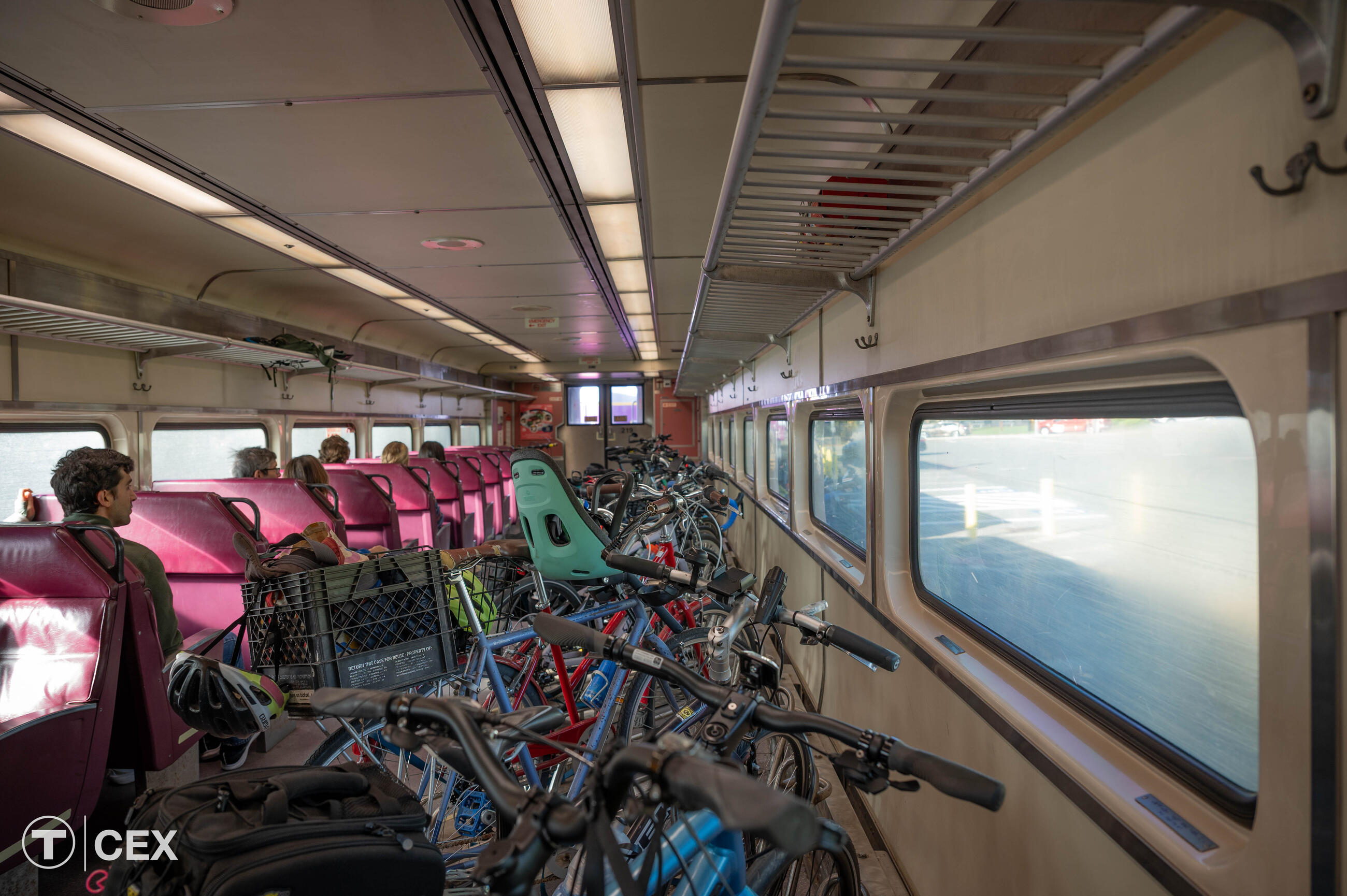
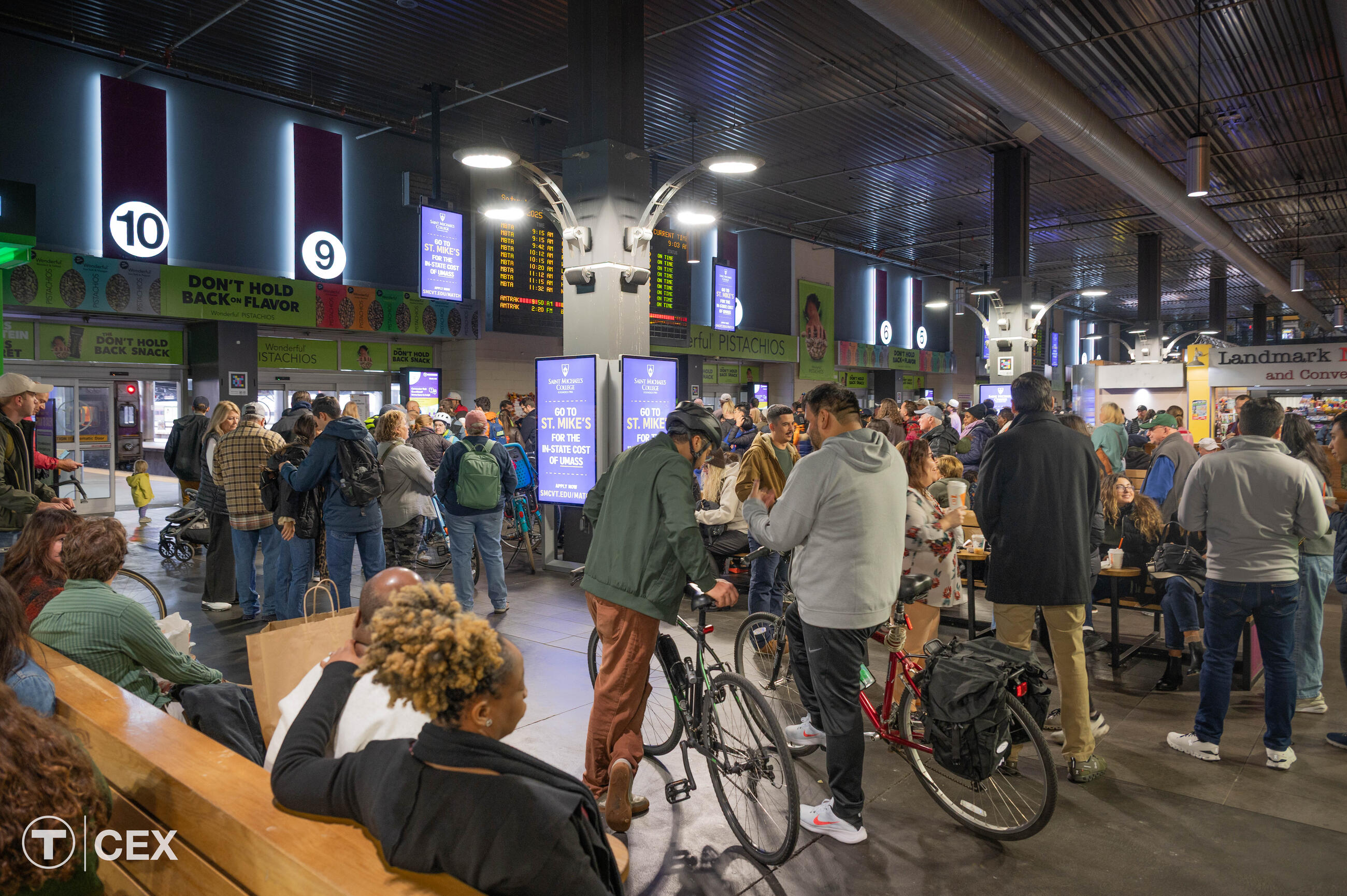
11 Regional Transit Providers Join Metro to Provide Seamless Transit Service Across Southern California Region
With eight FIFA World Cup 2026™ matches set for Los Angeles, Metro is proud to expand its World Cup Enhanced Services with more parking location options in Anaheim, Culver City, Newport Beach, Santa Monica and Torrance, as well as locations near LAX. As the official public transit provider for the Los Angeles World Cup 2026 Host City, Metro, with the vital support of the region’s regional transit providers and charter companies, will ensure fans travel to and from these unforgettable matches with seamless, accessible and safe service.
“This summer’s World Cup will redefine how fans experience the game, and Metro’s regional transit partnerships alongside expanded parking access will play a crucial role,” said Fernando Dutra, Metro Board Chair and City of Whittier Council Member. “Strong partnerships between Metro and surrounding communities, along with well-planned parking access, will be essential to ensuring accessibility and ease of travel. This is an opportunity to demonstrate how coordinated planning and shared investment can support not just a successful event, but a lasting model for how our region moves people easily, efficiently and sustainably.”
Since parking at Los Angeles Stadium will be limited, Metro and its regional transit partners and charter companies will provide affordable and direct bus service from key rail stations and locations.
Parking reservations for all locations are highly encouraged and are now available at metro.net/worldcup. Early-bird pricing is currently in effect, ranging from $55 – $95, plus a service fee, depending on the location. Reserved parking guarantees a space in the selected lot and includes round-trip enhanced bus service for the match.
Parking Locations are:
Crenshaw Metro Station
11901 S. Crenshaw Blvd., Hawthorne, CA 90250)
Culver City Transit Center (Westfield Culver City Mall):
6000 Sepulveda Blvd., Culver City, 90230
Downtown Long Beach (City Place C):
51 E. 3rd St., Long Beach, CA 90802
Downtown Santa Monica Parking Lot 1:
1234 4th St., Santa Monica, CA 90401
El Camino College:
3536 Manhattan Beach Blvd., Torrance, CA 90506
Harbor Gateway Transit Center:
731 W. 182nd St. Gardena, CA 90248
Hawthorne/Lennox Metro Station
11191 Larch Ave., Lennox, CA 90304
North Hollywood Metro Station
5350 N. Lankershim Blvd., North Hollywood, CA 91601
Pierce College Station
6201 Winnetka Ave., Woodland Hills, CA 91367
Torrance Transit Center
465 Crenshaw Blvd., Torrance, CA 90503
LA Union Station
800 N. Alameda St, Los Angeles, CA 90012
Two Orange County Locations:
ARTIC Anaheim Amtrak Station
2626 E. Katella Ave., Anaheim, CA 92806
Newport Transportation Center
1550 Avocado Ave., Newport Beach, CA 92660
LAX Locations:
Joe’s Airport Parking LAX
6151 W. Century Blvd., Los Angeles, CA 90045
Wally Park
9700 Bellanca Ave., Los Angeles, CA 90045
Airport Center
5960 W. 98th St., Los Angeles CA 90045
Marriott Hotel
9938 Airport Blvd, Los Angeles, CA 90045
Renaissance Hotel
9620 Airport Blvd., Los Angeles, CA 90045
LA Union Station’s parking is on a first-come, first-served basis, and the LAX/Metro Transit Center Station will also provide enhanced bus service.
Fans arriving at the above locations without parking a vehicle, will pay the same as regular Metro fares, $1.75 one-way, $3.50 round-trip.
Metro’s World Cup Service will get fans to the Los Angeles Stadium up to three hours before kickoff and the last service will depart up to 120 minutes after the match ends. Visit metro.net/worldcup for additional information and to reserve parking in advance.
“Metro is focused on delivering a seamless, accessible and safe experience for fans who will be traveling across our region during World Cup,” said Metro CEO Stephanie Wiggins. “We’re expanding service, coordinating closely with our valued transit partners, and providing more park-and-ride options so riders have clear, convenient options every step of the way. Our enhanced bus services are designed to move people efficiently and help them have a great time with their fellow fans as they make their way to the matches.”
Mobility Support for Accessibility Needs
Metro will provide additional temporary accessible parking spaces at each direct service location to help meet increased demand. When reserving parking, riders may indicate if they use a mobility device. Please note that parking reservations secure a general parking space; accessible spaces are available on a first-come, first-served basis.
Additionally, Metro is partnering with Access Services, which has an easy process for visitors who need paratransit service while in Los Angeles for the World Cup matches. Access Services is offered to individuals whose disabilities prevent them from independently using regular bus or rail service.
Regional Transit Providers Come Together
To provide the service, Metro is partnering with more than 10 regional transit providers and charter companies including:
Access Services
Big Blue Bus
Culver City Transit
Foothill Transit
Long Beach Transit
Montebello Bus Lines
Norwalk Transit System
OmniTrans
Orange County Transportation Authority
Riverside Transit Agency
Torrance Transit
Safety First
Safety will be a top priority as Metro prepares to welcome fans near and far, with enhanced measures designed to ensure a secure and comfortable experience across the system and at fan zones near our stations. Metro will deploy an engaged and visible presence of uniformed personnel from Metro’s Department of Public Safety ecosystem, including officers from the Los Angeles Police Department and Los Angeles Sheriff’s Department, Metro Transit Security Officers and Ambassadors across the system and will coordinate closely with local, state and federal enforcement resources. In addition, Metro will also use security technology to ensure riders can travel with confidence during one of the region’s highest-profile global events.
For more information about Metro’s transportation plan for the FIFA World Cup 2026, visit metro.net/worldcup. Fans can also visit the trip planner page at Metro.net or use their preferred transit app to map out their best route to the World Cup service locations.
Additional Quotes
Long Beach Transit
“Long Beach Transit is proud to co-operate with our regional transit partners to deliver outstanding services for the 2026 World Cup games” said Long Beach Transit President and CEO Kenneth A. McDonald. “At Long Beach Transit, exceptional customer experience is at the core of our mission. As we welcome the world, our agency is proud to provide safe, reliable mobility that connects fans, families, and cultures on a global stage.”
Montebello Bus Lines
“Montebello Bus Lines is proud to join LA Metro and our regional transit partners in welcoming the FIFA World Cup 2026 to Los Angeles. We are committed to providing a seamless fan experience that reflects the best of our region’s transit system,” said City of Montebello Mayor, Georgina Tamayo.
Omnitrans
“Omnitrans has supported opportunities, growth and connection in the region for 50 years, and we are proud to partner with Metro to connect our global community during the World Cup,” said Omnitrans CEO/General Manager Erin Rogers.
Culver CityBus
“We are excited to provide award winning transportation to everyone coming to the region for the upcoming World Cup,” said Mayor Freddy Puza. “Culver CityBus, as the California Small Transit Agency of the Year, reflects the investment and quality of public transportation Culver City has to offer. In addition to encouraging fans to ‘Go Metro,’ we’re proud to expand service with the SoFi Express, making it easier than ever to get to SoFi Stadium and ensuring residents and visitors alike can experience our reliable, high-quality transit service.”
Big Blue Bus
“Big Blue Bus is proud to support the 2026 FIFA World Cup by providing safe, reliable, and convenient service for residents, fans and visitors alike,” said Anuj Gupta, Director of the City of Santa Monica’s Department of Transportation. “With special direct service to Los Angeles Stadium on match days and regular service every 15 minutes or better on major corridors, we’re ready to help fans travel with ease and experience all that Santa Monica and the region have to offer.”
OCTA
“Whether you’re a resident of Orange County or visiting from around the world, the Orange County Transportation Authority is ready to connect you to the World Cup matches,” said OCTA Chair Jamey M. Federico. “Those who depend on our service every day know how safe and reliable it is, and we’re excited to showcase that on a global stage. We’re proud to work alongside our regional transportation partners to deliver a seamless experience for fans and highlight the very best of Southern California.”
Norwalk Transit
“Norwalk Transit System is proud to serve as a partner in delivering transit services for the 2026 World Cup. This unprecedented event brings together communities from around the globe, and we are committed to supporting a truly memorable and successful World Cup experience.”
Riverside Transit Agency
“Riverside Transit Agency (RTA) is proud to partner with LA Metro on the World Cup Games Enhanced Transit Services,” said Jim Steiner, RTA Board Chair. “As the Los Angeles region prepares to welcome fans from around the world, this initiative will enhance mobility and ensure convenient access for thousands of visitors traveling throughout the region.”
Access Services
“Access Services is proud to join LA Metro in ensuring that fans with disabilities and those with mobility challenges can navigate transportation to FIFA World Cup 2026 venues with ease,” said Andre Colaiace, Executive Director of Access Services. “Accessible transportation is essential to an inclusive fan experience, and we’re committed to delivering it on the world stage.”
Metro launched its Safety Hub and Public Safety Dashboard, providing data on security, crime, ridership, response times and equity across its system, which recorded 305 million boardings in 2025.
Metro today announced the launch of its new Safety Hub, a centralized online resource designed to provide riders, employees and the public with clear, accessible information about safety efforts and results across the transit system.
The Safety Hub serves as a comprehensive entry point for information about Metro’s public safety initiatives and progress. Developed with significant input from Metro riders and the agency’s Public Safety Advisory Council, the hub explains how Metro is working to improve safety across its entire system which recorded 305 million boardings in 2025. It will be updated regularly with data on security activity, reported crime, ridership and other key metrics, as well as context to help explain trends and how safety strategies are evolving over time.
The hub also connects users to Metro’s Public Safety Dashboard, which provides timely data on security activities, crime demographics, response times and other key statistics. The dashboard is aligned with Metro’s Public Safety Analytics and Bias-Free Policing Policies, reinforcing the agency’s commitment to equitable, accountable public safety practices.
“Safety is foundational to everything we do at Metro,” said Metro Board Chair Fernando Dutra and City of Whittier Council Member. “The launch of our Safety Hub reflects our commitment to openness and accountability. By making this information readily accessible, we are empowering our riders and the public with a transparent look at our progress and the actions we’re taking to build a safer transit system for everyone.”
The new platform is designed to provide important context about the agency’s ongoing safety work while making it easier for the public to understand how Metro measures and evaluates its efforts.
“Transparency and data integrity are essential to building public trust,” said Metro Board Member and Los Angeles County Supervisor Holly J. Mitchell who was the lead author of the motion to create the data dashboard. “We cannot ignore the connection between systemic racism and public safety, and we cannot improve what we do not track, the data dashboard helps us do both these things. This furthers our effort to provide the public and our riders with clear insight into how safety data is collected, analyzed and reported to inform outcomes rooted in fairness, equity, and accountability.”
Metro CEO Stephanie Wiggins emphasized that the hub represents a significant step forward in strengthening both safety and customer confidence.
“Keeping our riders and employees safe is Metro’s top priority,” said CEO Stephanie Wiggins. “The Safety Hub provides transparent, easy-to-understand information about what’s happening across our system and how we’re responding. By sharing timely data and performance metrics, we are reinforcing our commitment to continuous improvement and to creating a transit environment where everyone feels secure.”
Metro will provide enhanced service for all eight Los Angeles FIFA World Cup 2026™ matches, with regular $1.75 fares, $55–$95 early-bird parking, multilingual support, and $9.6 million in FTA funding.
When FIFA World Cup 2026™ kicks off in Los Angeles in just 100 days, Metro will be ready to help fútbol fanatics score winning service to all eight matches. As the official public transit provider for the Los Angeles World Cup 2026 Host City, Metro will ensure fans get to and from these unforgettable matches safely, sustainably and seamlessly.
“Metro is the smartest, safest, easiest, and most fun way to get to the World Cup,” said Fernando Dutra, Metro Board Chair and City of Whittier Council Member. “Instead of paying for some of the most expensive stadium parking or sitting in traffic, people can focus on what matters most – celebrating the love of soccer with fellow fans from around the world while going to and from the games.”
With Angelenos being joined by fans from around the world for the eight matches being played in Los Angeles and limited parking availability at Los Angeles Stadium, Metro and its regional transit partners will provide affordable and direct service from key rail stations and locations throughout the region including:
Crenshaw Station
Downtown Long Beach
El Camino College
Harbor Gateway Transit Center
Hawthorne/Lennox Station
LA Union Station
LAX/Metro Transit Center Station
North Hollywood Station
Pierce College
Additional locations will be announced in the coming months.
Metro’s World Cup Service will get fans to the Los Angeles Stadium up to three hours before kickoff and the last service will depart up to 90 minutes after the match ends. Fares for the enhanced service will be the same as regular Metro fares, $1.75 one-way and $3.50 round-trip.
Parking reservations are now available, and pricing will differ by location. Early-bird pricing is currently in effect, ranging from $55 – $95, plus a service fee. Compared to the other parking pricing where rates will be more than two and three times the Metro rates, fans are encouraged to make their plans and book early for discounted Metro parking rates. Visit metro.net/worldcup for additional information.
“The World Cup is more than just a popular tournament, it’s a moment of national and global significance,” said Metro CEO Stephanie Wiggins. “And it’s a transformative moment for Metro. We are ready to be the first choice for transportation for those enjoying World Cup matches in Los Angeles, delivering fast, safe, and easy transit tailored to the scale of this event. The improvements we are putting in place for these matches will leave a lasting legacy and strengthen public transportation for Angelenos and visitors long after the FIFA World Cup Trophy is awarded to this year’s champion.”
Metro is partnering with more than 10 regional transit providers and charter companies to deliver the World Cup Service, including Long Beach Transit.
“Public transportation is a powerful force that connects communities on a truly global stage during the World Cup,” said Long Beach Transit CEO Kenneth A. McDonald. “At Long Beach Transit, we’re proud to welcome the world by delivering dependable mobility that brings fans, families and cultures together.”
Additionally, for fans traveling via Metro Rail, Metro will be enhancing rail service on key routes during the World Cup.
To help Angelenos new to the system and visitors from around the globe navigate Metro and Metro’s World Cup Service, the agency has carefully developed enhanced multilingual wayfinding and has plans to deploy extra Ambassadors, volunteers and security to get people where they need to go quickly and efficiently.
Metro is also ensuring all Word Cup Service will be accessible for fans of all abilities with additional details on accessible services being released at a later date.
The fan experience will begin on Metro, as it does for fans attending L.A. sports and entertainment events including LAFC and Angel City matches, Dodgers games and World Series celebrations, Rose Bowl game and parade, and concerts at SoFi Stadium, Intuit Dome, and the Hollywood Bowl.
The Federal Transit Administration (FTA) recently allocated $100 million to transit systems across the United States that will be moving fans to and from FIFA World Cup 2026 games later this year. This funding was made available by Congress in the recently adopted Fiscal Year 2026 transportation spending bill. Of the $100 million appropriated by Congress for transit systems nationwide and consistent with a formula written into the funding legislation, Metro will coordinate the use of $9.6 million in FTA funding.
For more information about Metro’s transportation plan for the FIFA World Cup 2026, visit metro.net/worldcup. Fans can also visit the trip planner page at Metro.net or use their preferred transit app to map out their best route to the World Cup service locations.
Additional details about fan engagement activities at Metro stations, including details about the official LA Union Station fan zone, will be announced at a later date.